

PHILADELPHIA (OSV News) — They stood feet from Philadelphia’s Ben Franklin Bridge as cars and commuter trains blared by, yet about 300 Catholics encountered a night of Catholic faith that looked, sounded and felt like what Benjamin Franklin might have experienced in 1776, and some of his fellow Founding Fathers of the United States of America actually did.
A mostly packed St. Augustine Church in the Old City section of America’s birthplace hosted “Solemn Vespers & Te Deum Upon the Feast of St. James the Apostle, and in Thanksgiving for the Semiquincentennial of the Founding of the United States of America” on Saturday evening, July 25.
“Dr. Franklin would have been blown away,” said James Griffin, a co-founder and executive director of the Philly-based Durandus Institute for Sacred Liturgy and Music, which organized the event.
“Today, all of our priests and deacons in the church are generally obliged to say some form of evening prayer every day. What we experienced here is an opportunity for the lay faithful to also come in to experience it,” he told OSV News.
“I’ve been to many solemn vespers in the old rite, but nothing like this,” added Father Robert Pasley, the lead officiant and rector of Mater Ecclesiae Chapel in nearby Berlin, New Jersey. The priest is also a Knight commander of the Equestrian Order of the Holy Sepulchre of Jerusalem.
18th-century Latin-language vespers
It all happened at a church initially founded in 1802 with financial backing from George Washington and Commodore John Barry, a Catholic who founded the United States Navy. The church was also the first permanent establishment of the Augustinians — Pope Leo XIV’s religious order — in the United States.
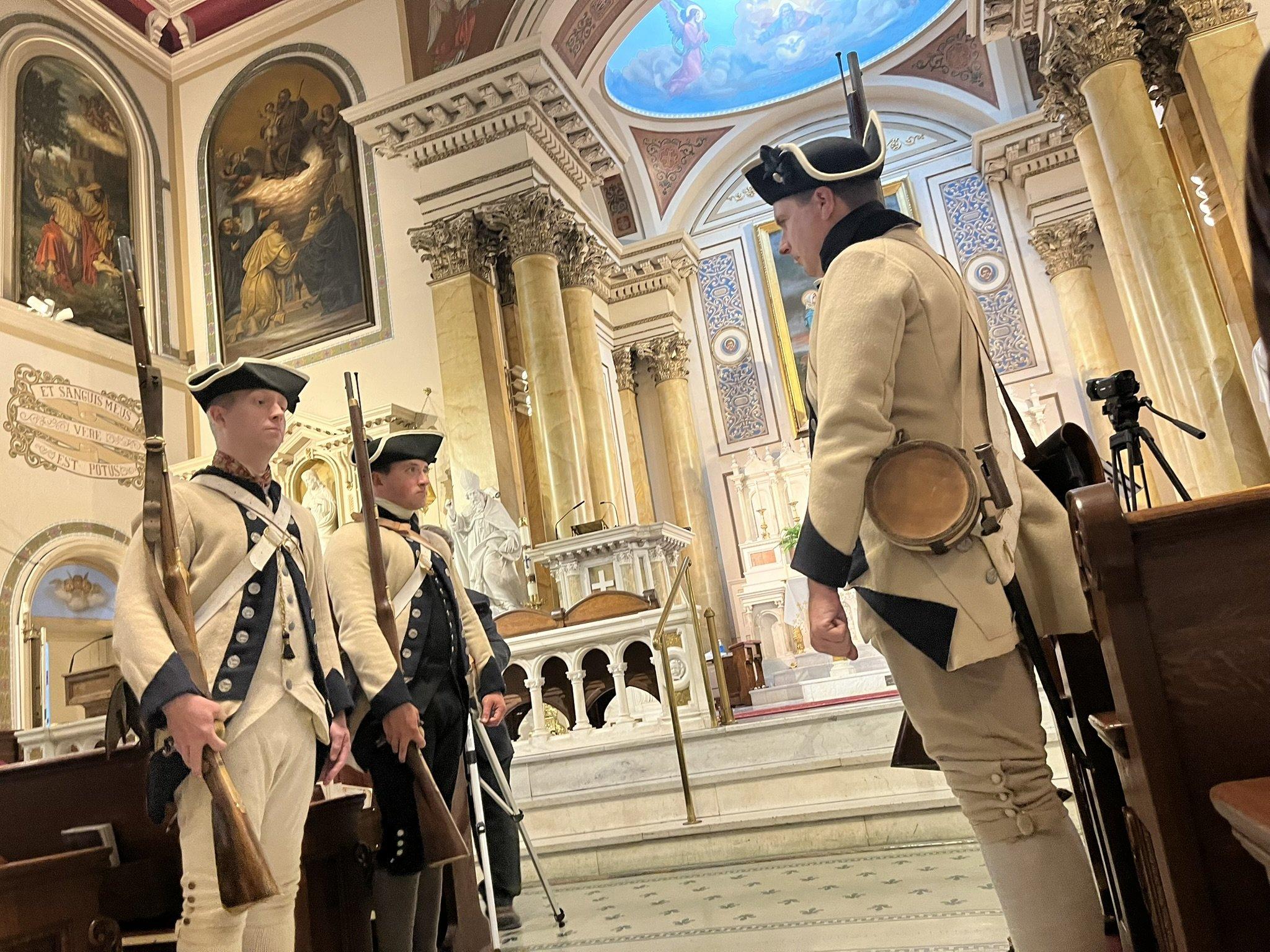
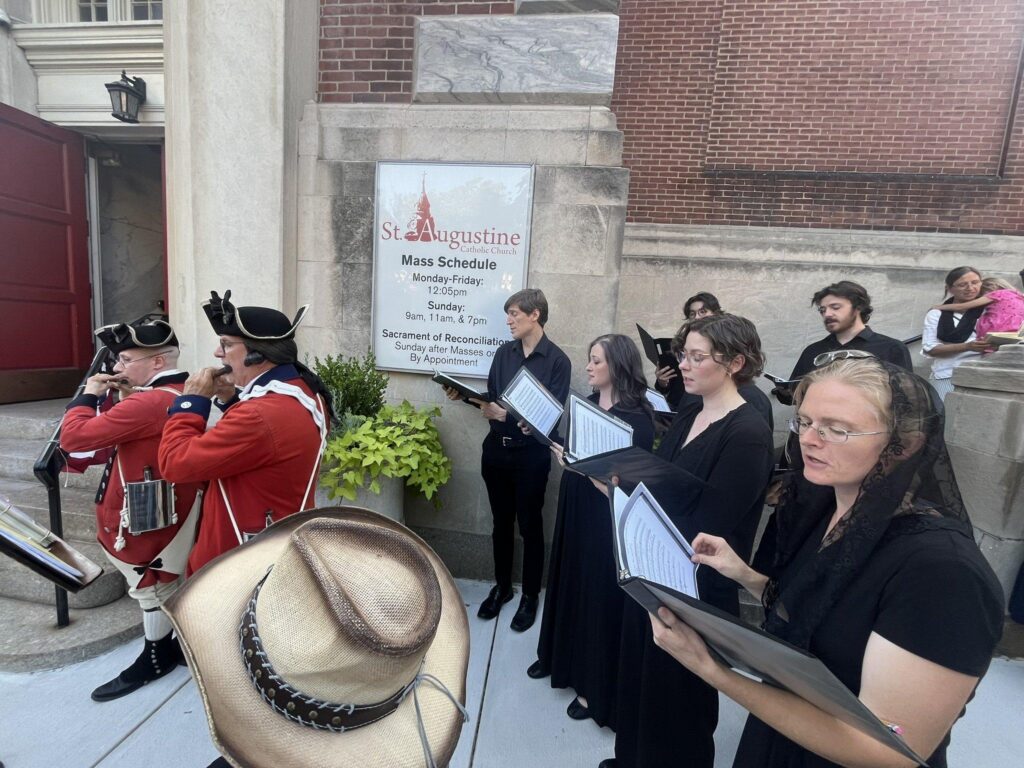
The time machine to Catholic evening prayer in late 18th-century America began just outside the church with Father Pasley, six fellow priests, fife and drum players and historians wearing clothing reminiscent of Revolutionary War times.
One of the men dressed in “Jersey Greys” recited the Declaration of Independence, which was signed less than a mile away 250 years ago, while a choir sang English-language hymns of the time calling for God’s providence upon the revolutionary cause.
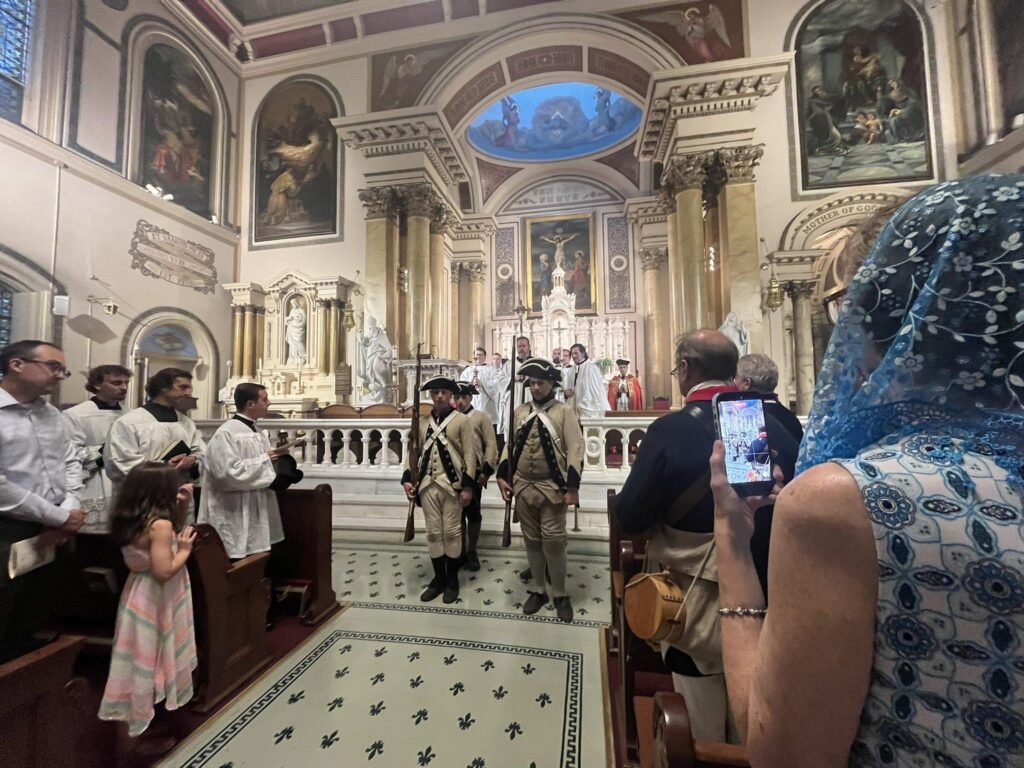
Then the hundreds who gathered stepped back inside the church to encounter nearly two hours of the 18th-century Latin-language vespers, or evening prayer. They heard choral and organ arrangements that don’t equate to the typical medieval-era Gregorian chant that current Catholics might hear at Mass.
“When you hear Gregorian chant today, what you’re really hearing most of the time (was) handed down and transcribed by French Benedictine monks called the Solesmes Congregation,” said Luke Majewski, the Durandus Institute’s program coordinator.
“In the 17th and 18th centuries, chant had become a little more tonal and metered,” he said. “There was more of a sense of rhythm to Gregorian chant and we heard that tonight from the choir that was singing, because we were trying to be faithful to what chant would have sounded like.”
That tonality came through the singing of five Psalms, continually intermixed with centuries-old antiphons, hymns, the Canticle of Mary, the collect for St. James’ feast and the reading of the day.
“Vespers are part of the divine office, and it all descends from the temple, praising God at certain hours of the day. This is evening prayer, where throughout the world we praise God for the gifts of the day,” Father Pasley said.
“It’s one of the offices of great praise and rejoicing, so it’s appropriate to celebrate the founding of our country.”
Many of the songs and scriptural choices came through the oldest remaining Catholic hymnal in the United States, written by Philadelphia-based music publisher John Aitken in 1787.
Praying vespers was a common expectation
“For the most part, anything that is in that book we can say is reflective of what at least one or two generations before would have experienced in their daily worship,” Griffin said. “This book had music for vespers on Sundays, which demonstrates that this was a common expectation for Catholics in the early years of our Republic to experience vespers.”
America’s future first vice president and second president, John Adams, encountered Catholic vespers on a visit to Old St. Mary’s Church in 1774 in Philadelphia. At that time, he was a delegate from Massachusetts to the First Continental Congress.
“The Musick consisting of an organ, and a Choir of singers, went all the Afternoon, excepting sermon Time, and the Assembly chanted-most sweetly and exquisitely,” Adams, a Protestant, said, using spelling and syntax of the period in a letter Griffin said was written to Adams’ wife, Abigail.
The “sermon time” Saturday night came from the few words expressed in English as would have been the norm of the time, words designed to not only reflect Revolutionary War times, but today.
“Like St. James, we too live in a time of turmoil. We live in a time of hardship and division,” said Father Alan Bridges of St. Joseph Church in Toms River, New Jersey.
“Yet just as in that apostolic age, we can face these trials not with despair and doom, but to see them as an opportunity for hope.”
Jay Sorgi writes for OSV News from Philadelphia.
Updated July 28, 2026, 3:26 p.m. ET
