


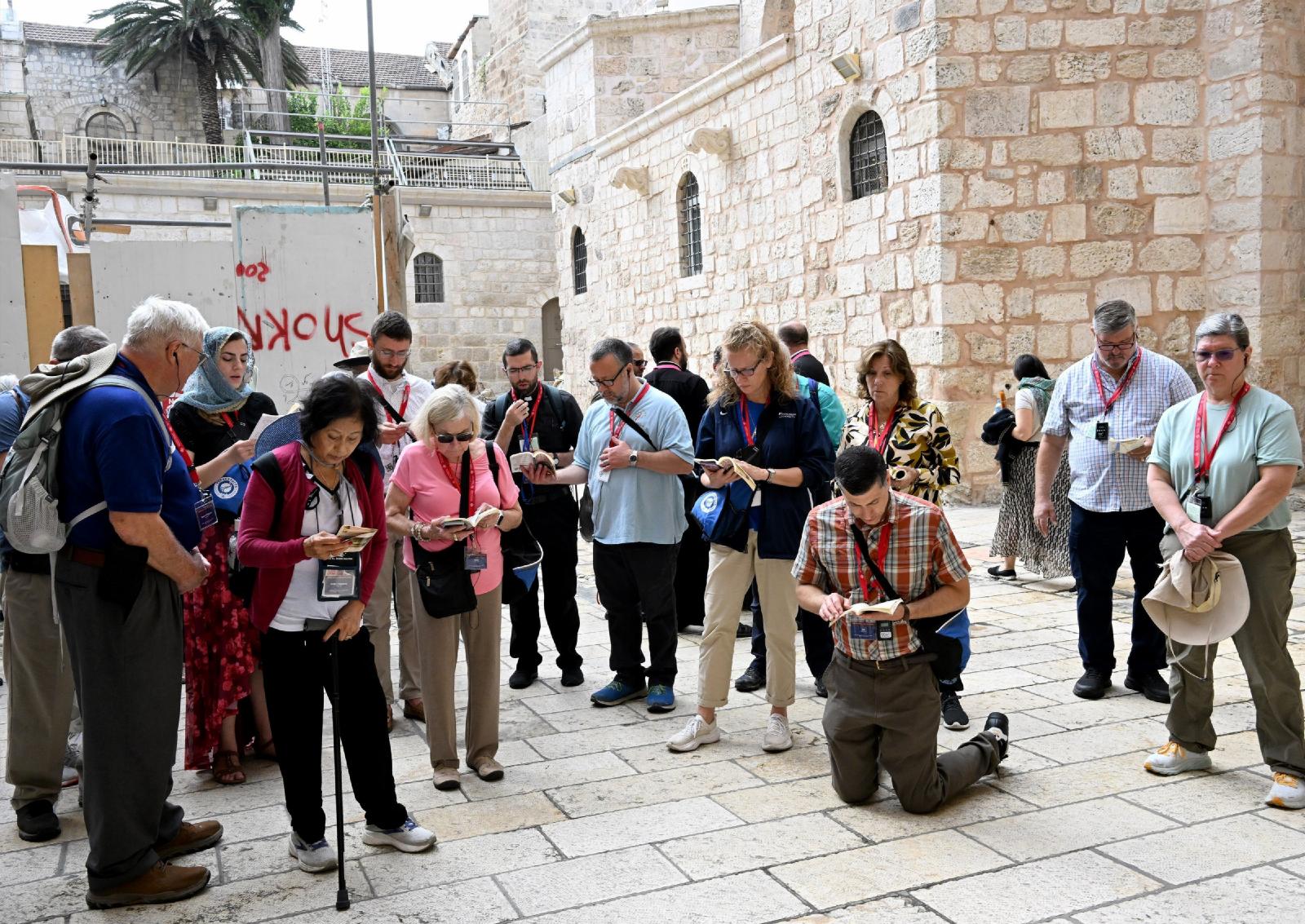
(OSV News) — What is the point of a pilgrimage? Where did this idea come from for Catholics? There is considerable evidence throughout Scripture, which supplies theological significance to the concept. Even today we see many embracing this activity with passion and the commitment of time and resources.
Pilgrimage is a part of many of the great religions of the world, for in religion humanity seeks the answers to life’s core questions. So, pilgrimage is a common human experience in which one seeks to fulfill a ritual obligation; perform an act of devotion to atone their own sins; live an experience of spirituality; or implore a grace, a miracle, a cure, etc.
The idea of a pilgrimage has an incredibly strong foundation in both the Old and New Testaments. The spiritual importance of pilgrimage is manifested often in physical journeys and trials — from Abraham’s journey of faith all the way to the missionary journeys of St. Paul.
Journeying to Promised Land
The pivotal pilgrimage in Scripture is the Exodus — the story of Moses leading the Israelites out of Egypt — through the desert, trials, temptations and sin, ever journeying toward the Promised Land. This episode has become one of the primary models of the relationship between journeying and the life of conversion and faith.
In the New Testament, we likewise see a pilgrimage’s importance, not so much in the sense of a physical journey, but in the idea of living our current, earthly lives in a way that brings us closer to the eternal.
The Infancy Narratives include an account of a pilgrimage taken by the Holy Family: “Each year his parents went to Jerusalem for the feast of Passover, and when he was 12 years old, they went up according to festival custom” (Lk 2:41-42). The 12-year-old Jesus stays behind in the Temple, unbeknownst to his parents, and speaks of his Father with the scholars.
After the inauguration of Jesus’ public life — following his baptism in the Jordan — his entire ministry unfolds as a pilgrimage back to Jerusalem, day after day, along the roads of Palestine.
Crucifixion and redemption
Christ’s death on the cross has a massive effect on the evolving definition of pilgrimage. His sacrifice introduces the idea of redemption, and the temporary nature of what we experience, as we journey toward heaven.
We see this in the Gospels, or in the accounts of the apostles. They recount to us how Jesus’ death has opened the door to heaven. With this understanding we realize that the struggles we face now — trials, sufferings, temporary worries and problems — can be our sacrifices of praise as we journey toward salvation.
The scriptural motivations for pilgrimage compel people today to experience this for themselves. But also in the Christian tradition the practice of pilgrimage has always been linked to Christ and the saints. The saints are especially honored in churches and shrines, especially those that preserve their bodies and tombs.
Once Christianity was legalized in A.D. 313, the paths most frequented by pilgrims drew a dense network on the European map. “Egeria’s Travels” was a primitive kind of travel diary by a devout pilgrim, written around the early part of the fifth century, which documents the practice of pilgrimage to the sites associated with Christ’s life. But later, when the Holy Land was conquered by Arabs, other routes were opened in the West.
Rome became an important destination for medieval pilgrims and remains so today. There also is Santiago de Compostela, in northwestern Spain, where pilgrims walk along the famous Camino. It also is still a popular destination, where the relics of St. James the Great are venerated. There are many official routes from all over Europe, with specific hostels along the way for pilgrims to rest and meet one another.
Key pilgrimage destinations
With the passing of the centuries, other places of pilgrimage become important. Around the world, sanctuaries were built in memory of a supernatural apparition, miraculous event, or other spiritual or historical relevance to the lives of saints. People have traveled to them for a variety of reasons.
The list of all world destinations of pilgrimage is many thousands in number, but here are some which are visited by more than a million pilgrims every year. In addition to Rome, the Holy Land and Santiago de Compostela, it is important to highlight significant Marian shrines: Loreto in Italy, where the Holy House of Nazareth is kept; Lourdes in France, where the Virgin Mary appeared to St. Bernadette Soubirous and many experience physical healing; and Fatima in Portugal, where Mary appeared to three shepherd children.
In the Americas, standing out for fame and number of pilgrims are the sanctuary of Our Lady of Guadalupe in Mexico and the Shrine of Aparecida in Brazil. But every country has its national shrine — in the United States it is the Basilica of the National Shrine of the Immaculate Conception in Washington, or the National Shrine of Our Lady of Champion in Wisconsin, the only approved Marian apparition site in the U.S.
Different than typical travel
From a religious perspective, a pilgrimage is a trip different than usual. It is not only for admiring masterpieces of art, although many places of pilgrimage are full of history and beauty. In days gone by pilgrims could be imagined as ragged and emaciated, willing to forgo any comfort along long roads full of dangers. But a conscientious pilgrim still chooses a certain restraint and intentionality as one chooses accommodation, food and drink, and, of course, places an importance on silence and prayer.
To experience something different from other trips, the pilgrim must be different and live differently in the simplicity of faith. Otherwise, the pilgrimage does not contribute to real change.
The pilgrim moves within the geography of faith, along the path on which are scattered traces of holiness, in places where God’s grace has been shown with particular splendor and produced abundant fruits of conversion and holiness.
One goes on a pilgrimage to ask God for help needed to live more generously your own Christian vocation once back in your home, explains the Vatican’s Directory on Popular Piety and the Liturgy.
Therefore, the pilgrimage is not, and never should be, just “a journey to a place of religious interest.” Alone or with others, it is a physical component of the path of one’s heart toward God.
Deborah Castellano Lubov writes from Rome where she covers the pope and the Holy See.
