


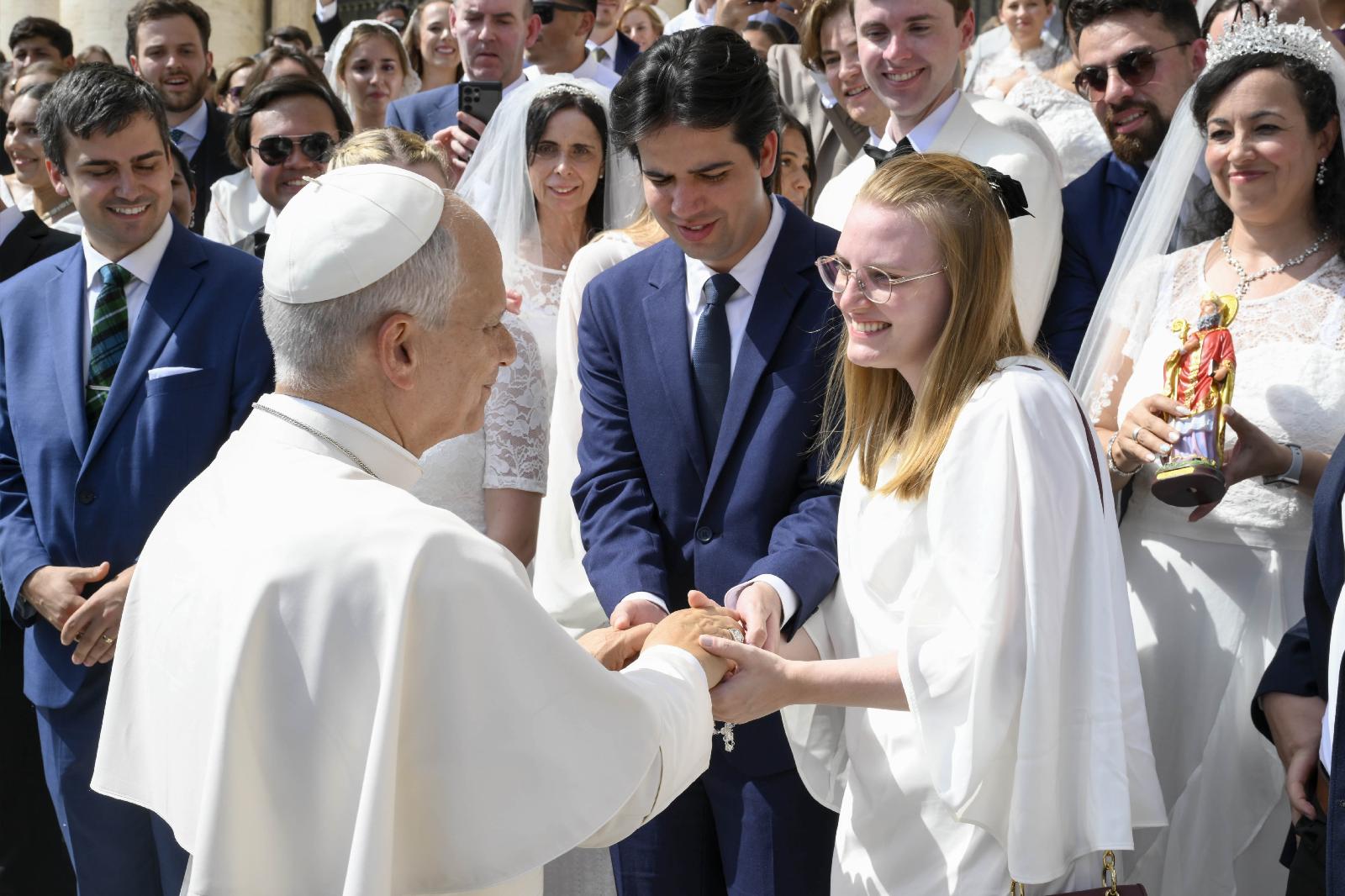
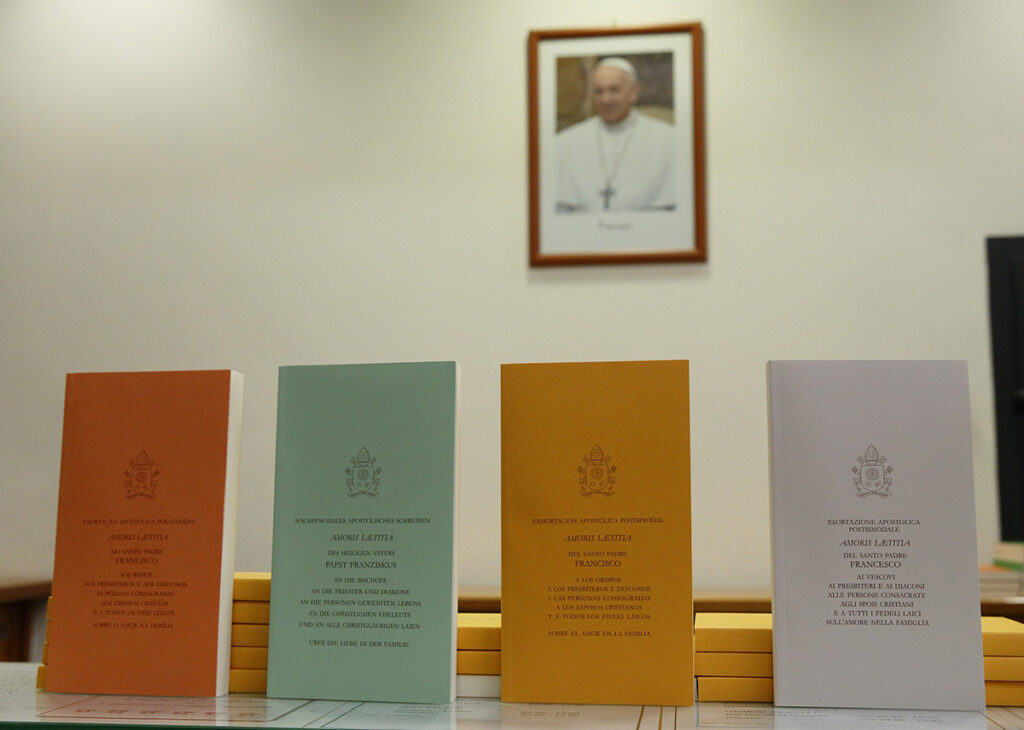
(OSV News) — A decade after the release of “Amoris Laetitia” (“The Joy of Love”) sparked both praise and criticism, Vatican officials say an upcoming meeting on the document will focus on listening to pastoral experiences rather than rehashing old disputes.
“We will not try to erase differences to arrive at a consensus: Even a divergence that is better understood can be a fruit of listening,” Jesuit Father Giacomo Costa, a consultant to the General Secretariat of the Synod, said in prepared remarks at a Vatican press conference Oct. 2.
“Ten years later, the question is not what ‘Amoris Laetitia’ says, but what we have learned by trying to live it,” he added.
In March, Pope Leo XIV convened the heads of national bishops’ conferences worldwide as well as the heads of Eastern Catholic Churches to the Oct. 7-14 meeting titled “Ten Years After ‘Amoris Laetitia’: Proclaiming the Gospel With Families Today.”
Families included in ‘Amoris Laetitia’ meeting
According to Gabriella Gambino, undersecretary of the Dicastery for Laity, Family and Life, an estimated 200 participants, including bishops, a number of families and theological experts, will attend the meeting.
“They are families that we tried to distribute by geographic area so as to have representation from all continental areas,” Gambino, the coordinator of families for the meeting, told journalists. “And substantially they represent the underlying themes of the meeting’s thematic framework.”
According to a document released by the dicastery, that thematic framework is structured around five themes, including discerning the realities and challenges facing families today, listening to young people discerning the vocation to marriage, accompanying couples through the decisive early years of married life, walking with families in complex situations, and embracing conjugal and family love as an impetus for mission.
Pope Francis promulgated the apostolic exhortation following two synods of bishops on the family in 2014 and 2015. It was published in April 2016 and addressed the hopes and challenges of love, marriage and family life. However, the document’s eighth chapter, which focused on couples in irregular situations, drew some pushback over the possibility of sacraments for divorced and civilly remarried Catholics.
Upcoming meeting will be an ‘exchange of gifts’ among local churches
Responding to a question about those disagreements, including mixed reactions or objections from bishops’ conferences in Africa and elsewhere, Father Costa, who oversees the meeting’s methodology, denied that local dioceses were expected to adopt a uniform directive from the Vatican.
“It is not a logic of something pre-established by Rome that arrives from above where you simply have to obey; here we are churches that are each trying to proclaim the Gospel in the situation and conditions that they can,” he said.
“Its reception is an important phase. But it is precisely a creativity that is born, so you cannot say, ‘Well, the families in Africa are bad, the others are good because they applied it.’ Everyone has made a journey. Now let us recount these journeys to one another, and from here we move forward,” the Jesuit priest explained.
Describing the upcoming meeting as an “exchange of gifts” among local churches, Father Costa confirmed that Pope Leo intends to participate as much as possible at the eight-day meeting, barring prior commitments.
“Regarding the pope’s presence, clearly he does as he pleases, but we can reasonably imagine that he will be present especially during the plenary sessions, the discussions and the presentations of the discussion summaries — essentially the afternoons,” he explained.
“I imagine that on one day or another he might have fixed engagements he cannot miss — substantially, not only at the beginning and the end, but as far as possible alongside the commitments he must carry out, also in all moments of debate on the meeting’s final report,” Father Costa added.
Pastoral concerns will be addressed
Gambino told journalists that major pastoral concerns expected to be discussed include secularization and declines in sacramental marriages. Citing ad limina data, the dicastery undersecretary noted that religious marriages fell 45% in Poland over the past five years, while in Australia they dropped from 88% in 1970 to 16% in 2024.
She also said that it was important to note that the Church’s objective “is not, so to speak, to ensure that texts are slavishly applied in every reality, because each reality presents characteristics so heterogeneous compared to others.”
“The central question is how to transmit the faith today in families, and in what way do families succeed in building up the Church? Because without families, the Church cannot reinvigorate its Christian roots,” Gambino added.
In her prepared statement, Orietta Rachele Grazioli, lecturer of Canon and comparative family law at the Pontifical John Paul II Theological Institute for Marriage and Family Sciences, said the purpose of the meeting is not meant to simply “review a document,” but rather to look closely at “the family and pastoral realities that have brought this text to life in distinct ways” across different cultures.
Grazioli, the meeting’s deputy coordinator of experts, also told journalists that bringing together bishops’ conferences, families and experts from very different contexts means “giving voice to those realities that may have read and lived this text in different ways. What matters is what will emerge from the encounter among these contexts.”
Junno Arocho Esteves is an international correspondent for OSV News. Follow him on X @jae_journalist.
