


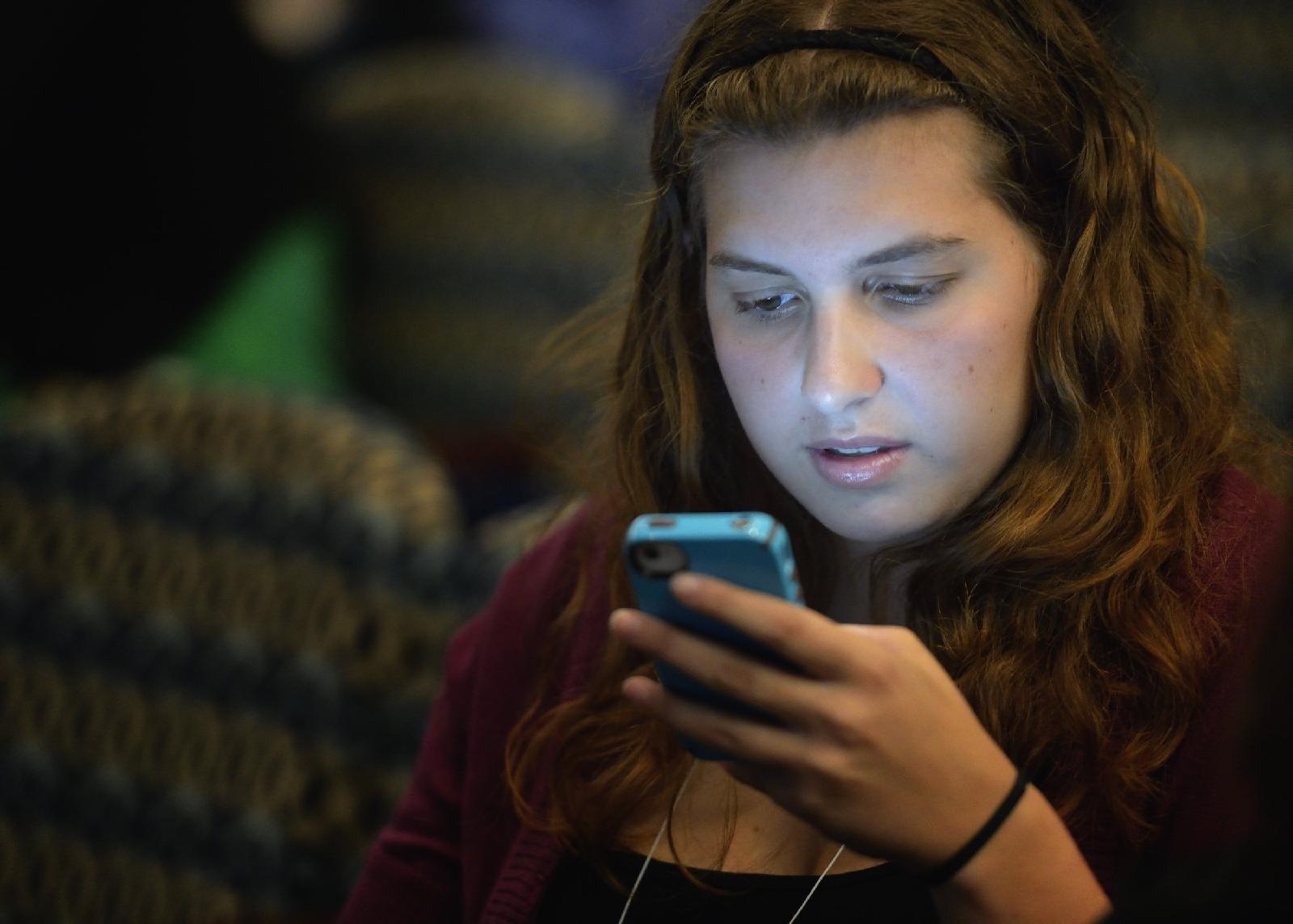
(OSV News) — “Ban” sounds like a harsh word — a draconian measure taken in the direst of circumstances, certain to meet with resistance.
So just imagine what would happen if a ban was applied to the use of smartphones — and even social media — for Catholic school students.
Chaos as administrators attempted to enforce rules, and students defied them? Pushback from helicopter parents terrified at the prospect of not being able to reach their kids during the school day?
Or perhaps surprisingly, not only compliance — but as OSV News found, endorsement by both students and parents?
“It’s been very popular — anecdotally, the students have loved it, because they’re actually talking to each other again,” said Jesuit Father John Belmonte, superintendent of Catholic education in the Diocese of Venice, Florida, where a smartphone ban at all 15 diocesan Catholic schools was enacted at the beginning of the 2025-2026 academic year.
“They rediscovered what actually being social is like, as opposed to social media,” he added. “I even heard a report that some students started an UNO card playing club at one of our high schools, so they could play card games during lunch. Those things were not happening when they were glued to their cellphones.”
Pilot programs were given a trial run at selected diocesan schools a year earlier.
Father Belmonte had the idea when listening to the broadcast of a Chicago friend, whose topic was school cellphone bans.
“I was listening to his radio show. … And I thought, ‘You know what, I’m going to give this a try,'” he recalled. “So we put it together — but it was really inspired by news stories of other school districts and schools that were implementing bans.”
More than 6,500 students are affected, and policies are now uniform for all diocesan schools. Every manner of non-school issued electronic devices are subject to the ban, and are stored in lockable pouches known as Yondr bags. Students keep the bags with them, and — at the end of the school day — open them through an unlocking mechanism station.
“One of the fourth grade boys who was not part of the pilot asked the principal if he could get one of those bags, because he wanted to participate in the program,” laughed Father Belmonte. “The little ones looking at the big ones saying, ‘Oh, I’d like to do that too.’ So he wanted to sort of self-ban his cellphone.”
Student focus and outcomes
Student attentiveness has also improved, he noted.
“When it comes to academics,” Father Belmonte explained, “you want students focused on the teacher and the lesson — and if they’re distracted by their phones and trying to sneak text messages during classroom time, that becomes a problem.”
Nationwide, 26 states have mandated complete bans on smartphones in K-12 public schools, while others allow usage with on-campus restrictions. According to Education Week, “31 states either already limit or ban students from using their personal devices in school or plan to do so for the 2025-26 or 2026-27 school years.”
Why the seemingly sudden action? In two words, mental health.
The U.S. surgeon general issued a 2023 advisory warning children and adolescents who spend more than three hours a day on social media face double the risk of mental health problems, including experiencing symptoms of depression and anxiety.
A December 2025 study in the journal of the American Academy of Pediatrics examining more than 10,500 children found those who received phones at age 12 vs. 13 had a more than 60% higher risk of poor sleep and a more than 40% higher risk of obesity.
Long before those alerts, however, Calvert Hall College High School — a private, independent Catholic boys school outside Baltimore with 1,245 students — decided upon a ban of its own. In 2006, students were allowed to have cellphones at school, but were required to keep them in their lockers. By 2010, they could only use devices outdoors in a designated area; in 2015, use was extended to anywhere outside on the 32-acre campus. The penalty for ignoring the ban without permission remains six days of detention.
“We also look at this as a way for one-on-one interaction, as opposed to the multitasking that you see between lots of adults and even with students,” Danielle Hladky, director of Communications and Marketing, told OSV News. “At other institutions that don’t have a policy as such, you’re trying to speak to someone — but they’re texting or they’re on their computer, and they’re only haphazardly listening.”
However, Hladky wants it understood that — even for an 180-year-old school — Calvert Hall is not tech-averse.
“We’re not trying to shy away from phones; smartwatches; AI enabled glasses; things of that nature,” she explained. “We want to embrace and find ways that we can use them as a community, to help our students grow — because as we know this is where we’re headed as a society. But also realizing that there’s a time and a place.”
As in the Diocese of Venice, student focus is more intense than elsewhere.
“Hearing stories from other educators that I know that are in public and private schools,” Hladky said, “they don’t have that same experience in the classroom of engagement and authenticity that can be lost with the multitasking of technology.”
A 2023 study by Common Sense Research found 43% of children ages 8 to 12, and 88%-95% of children ages 13-18, have their own smartphone; half of U.S. children get their first smartphone at 11.
Social media and mental health
Christina Mehaffey — principal of Faustina Academy in Irving, Texas, a private, independent K-12 Catholic school with 220 students — echoed not only the same issues of student engagement, but a loss of appreciation for what truly matters.
“We’re seeing digital dependence, addictions, all over the place. Kids are just struggling left and right,” she stressed. “And they’re inattentive; they’re not engaged. They don’t care about the good, the true and the beautiful, because they have this entertainment in their face and at their fingertips.”
Realizing social media was delivering a lot of rot with some good, Mehaffey made what could seem a radical decision: Faustina Academy students would not only not use their smartphones on campus — they wouldn’t be social media users, either. The social media moratorium began with a verbal commitment in 2018, followed by a written commitment in 2022.
“If your child enrolls, no active (social media) accounts until they graduate or leave the school. Not even summers; no Christmas — they can’t have it,” she said. “And I said, here’s the reason: The messages from social media and the internet are geared towards taking kids away from reality.”
Even worse than that, Mehaffey said, is the easy electronic access to inappropriate material.
“If we’re going to be a school centered on our faith and our goal is heaven — which is the reason we exist — why are we basically giving our children Playboy and telling them to just stick to the articles? What are we doing, as parents?”
An April 2025 Pew Research Center survey reported, “Most teens credit social media with feeling more connected to friends. Still, roughly 1 in 5 say social media sites hurt their mental health, and growing shares think they harm people their age.”
While 74% of teens find social media helpful for building connections, 45% also admit they spend too much time using it.
Wider phone restrictions
Mehaffey hopes other schools might follow her lead — and has assembled a package to shepherd them through the social media-free process.
“The leadership of the school has to stand firm,” she advised, “and new families should be given a brief understanding of what the school is about, and what they do and don’t allow — that needs to be upfront.”
“But really, why are parents sending them to a Catholic school, instead of the neighboring charter school or public school?” asked Mehaffey. “Because we’re teaching them the Catholic faith. What’s the purpose of teaching the Catholic faith? To get them to heaven. If the school is really intent on that mission — and they really want to live by the mission — this is an easy sell.”
Kimberley Heatherington is an OSV News correspondent. She writes from Virginia.
Celebrate Catholic Schools Week is Jan. 25-31, 2026.
