


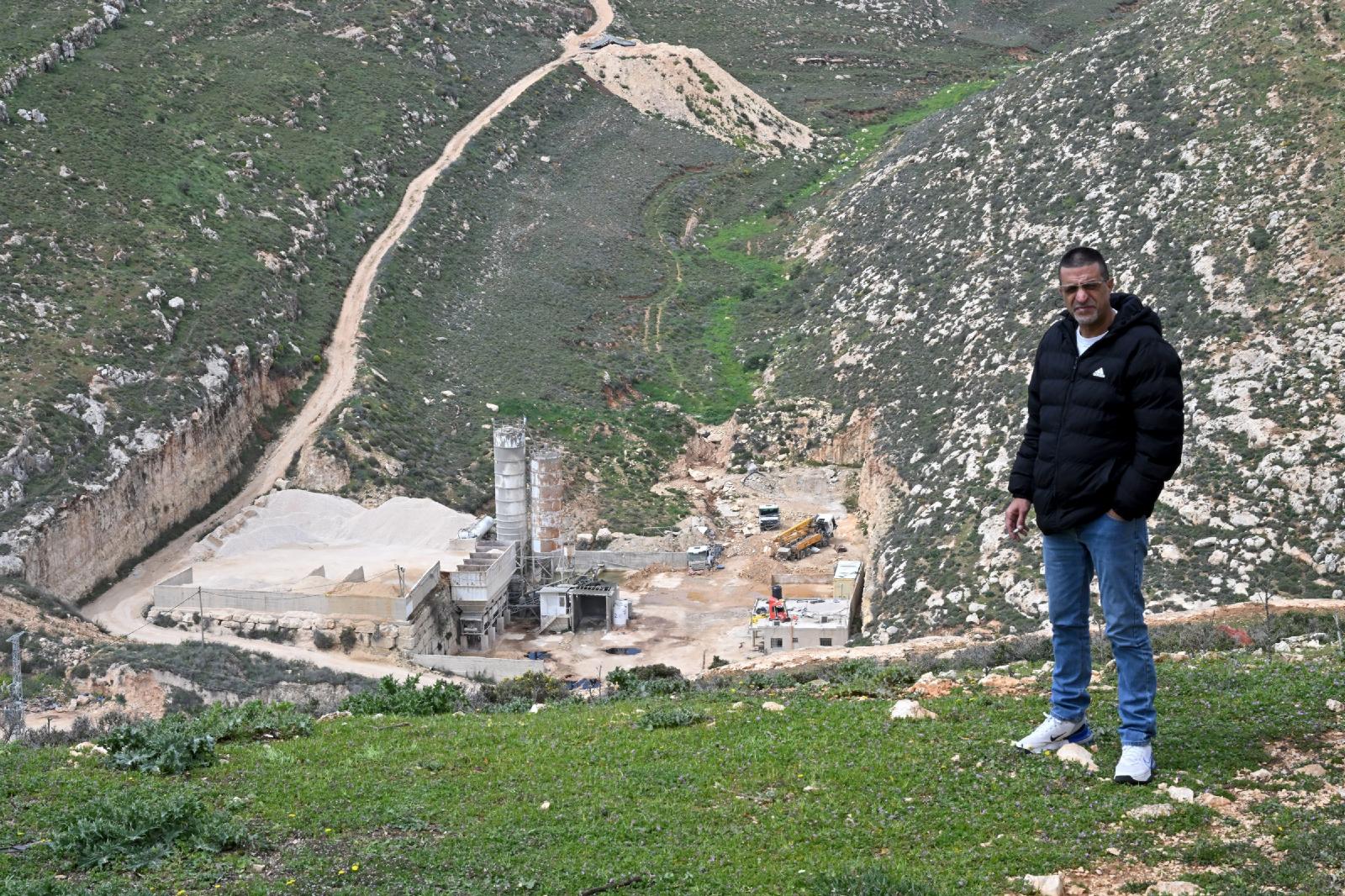
JERUSALEM (OSV News) — Since the morning of March 19, Roland Bassir has not been able to access the quarry and concrete plant he and his brother have owned and worked for the past 20 years at the western edge of the West Bank village of Taybeh.
It is Bassir’s and his brother’s only livelihood, he said.
That day some 30 extremist Israeli settlers made good on their threat — which they posted in a video — of taking over the quarry and entered the site, hoisted an Israeli flag atop one of the structures and held prayer services there.
‘Problems with settlers’
“Since Oct. 7, 2023, I have had problems with the settlers,” Bassir told OSV News, remembering the date of the Hamas attack on southern Israeli communities that started the Israel-Hamas war in the Gaza Strip. “They took lands above the quarry,” said Bassir, 50, nervously holding a cigarette as he gazed at the property in the valley below from his vantage point at the edge of the village.
He is too scared to approach the area any closer since settlers chased and attacked him when he tried to get to his factory earlier. “Last week they brought a backhoe and opened up a dirt road and went into the quarry and are not allowing us in. They put guards around the quarry.”
The settlers have pitched a large tent just outside the quarry, and any time he has tried to get close, they come out to threaten him and prevent him from coming to the quarry, Bassir said.
‘I can’t sleep at night’
“I am depressed, I can’t sleep at night,” said Bassir. “I can’t understand how people can just come and take over my 20 years of work. It is unjust. It is indescribable. I feel miserable. I tell my children that God is with us and we want peace, we are peaceful people, but I am afraid for the future, that it will get worse.”
Another Taybeh resident, who asked not to be named out of fear of retribution by settlers, said settlers recently also broke into a horse stall on the outskirts of the village and stole the horse and its colt, claiming that it belonged to them. Despite evidence the owner presented to the Israeli police that the horse belonged to him, the settlers were permitted to keep the horse while the owner was told he should help the settlers look for their horse if the one they stole was not theirs, the resident said.
Parish priest Father Fawadleh
The takeover of the quarry raises “significant concerns about attempts to impose new facts on the ground,” said Taybeh’s Christ the Redeemer parish priest Father Bashar Fawadleh.
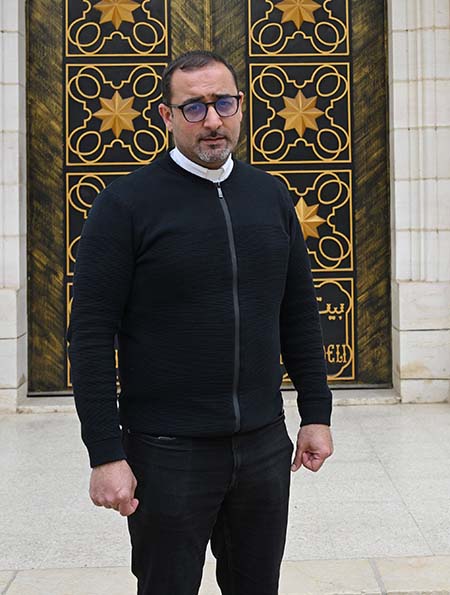
“We feel that we are losing everything,” said Father Fawadleh. “We are losing our land, we are losing our fruits, we are losing our income. … But who can stop them? This is creating fear in people’s hearts.”
Settlers have also been violently attacking Palestinian farmers living in structures built by the Latin Patriarchate on patriarchate-owned land in the Jordan Valley community of Hamamat Al-Maleh, with 11 of the 13 families who live there fleeing because of the violence. Patriarchate attorney and head of endowments Zaki Sahlieh told OSV News the patriarchate has been in touch with Israeli authorities to protest this violence.
Recent escalation of violence
In a written statement, Sahlieh told OSV News the patriarchate “expresses its deep concern regarding the recent escalation of violence affecting Palestinian communities in the Jordan Valley.”
“Such acts are unjustifiable and pose a serious threat to stability and peaceful coexistence. The Patriarchate, as a religious institution serving all communities, reaffirms its commitment to these values,” the statement said.
“We call for restraint, respect for the rule of law, and the protection of all civilians and their property.”
As of March 25, neither the Israel Defense Forces nor the police had responded to requests from OSV News for comment.
Yellow gate on main road
At the outbreak of the U.S. and Israel-Iran war, Taybeh residents were also surprised by the overnight erection of a yellow gate on the main road out of the village. The gate can be opened and closed at will by the soldiers, so one minute it may be open and the next closed for several hours, said Madees Khoury.
Khoury’s family-run Taybeh beer brewery has felt the effect of the war as outside visitors have stopped coming to the brewery. The owners struggle to get their merchandise to business clients in Jerusalem and Bethlehem.
Taybeh is considered to be the last all-Christian populated village in the West Bank.
‘Situation deteriorating constantly’
Speaking via video link from Jerusalem at a March 15 webinar organized by the International Oasis Foundation, Cardinal Pierbattista Pizzaballa, the Latin patriarch of Jerusalem, said in the West Bank “the situation is deteriorating constantly: Almost every day there are attacks by settlers on Palestinian villages. There are now almost a thousand checkpoints; Palestinians still struggle to move about, and permits have largely been canceled.”
According to Embrace the Middle East Foundation, approximately 45,000 of the West Bank’s Palestinian population of 3.2 million are Christian. According to the United Nations Office of the High Commissioner for Human Rights, over 500,000 settlers lived in the West Bank in 2025.
Since 2025, Taybeh has become surrounded by six settler outposts, three on the west side and three on the east, where in July 2025, a group of armed settlers set fire to the surroundings of the fifth-century Byzantine ruins of St. George Church, wrote threatening graffiti and destroyed olive groves nearby.
Shepherds expelled from pastureland
This is a part of the increasing wave and severity of settler violence, which has erupted since the start of the Israel-Hamas war in 2023, noted the Israeli human rights group B’tselem. Now since the start of the U.S. and Israel-Iran war Feb. 28, Palestinians and activists report more cases of severe violence, including “arson, expulsion of shepherds from pastureland and farmers from their fields, killing and theft of livestock, destruction of crops, theft of equipment and personal belongings, and blocking of access roads.”
Human right groups and activists maintain that the attacks are being carried out in collusion with the Israeli police and army, who do little to stop them.
More than 1,800 settler attacks
According to a Feb. 3 Peace Now report, more than 1,800 settler attacks resulting in injuries or property damage were documented in 2025; 838 Palestinians were injured in settler attacks; and nine Palestinians were killed by settlers. These attacks led to the displacement of 22 Palestinian communities and the eviction of thousands of Palestinians from tens of thousands of dunams, or pieces, of land.
Before the far-right political parties of National Security Minister Itamar Ben-Gvir and Finance Minister Bezalel Smotrich joined the Israeli government, Taybeh never experienced any problems with the residents of the two nearby settlements of Rimonim and Kochav HaShahar, and would go there freely to work, said Father Fawadleh, Taybeh’s parish pastor.
Problem is ‘fanatic mentality’
“So our problems are not with the settlers inside these settlements. Our problems are with the fanatic mentality from the settlers created by Smotrich and Ben-Gvir, who want to create the ‘Kingdom of Israel,'” the parish pastor said.
The first effect of the settler violence is emigration, he said, with 16 families and 10 individuals leaving Taybeh since 2023, constituting some 80 people out of the village’s population of 1,200.
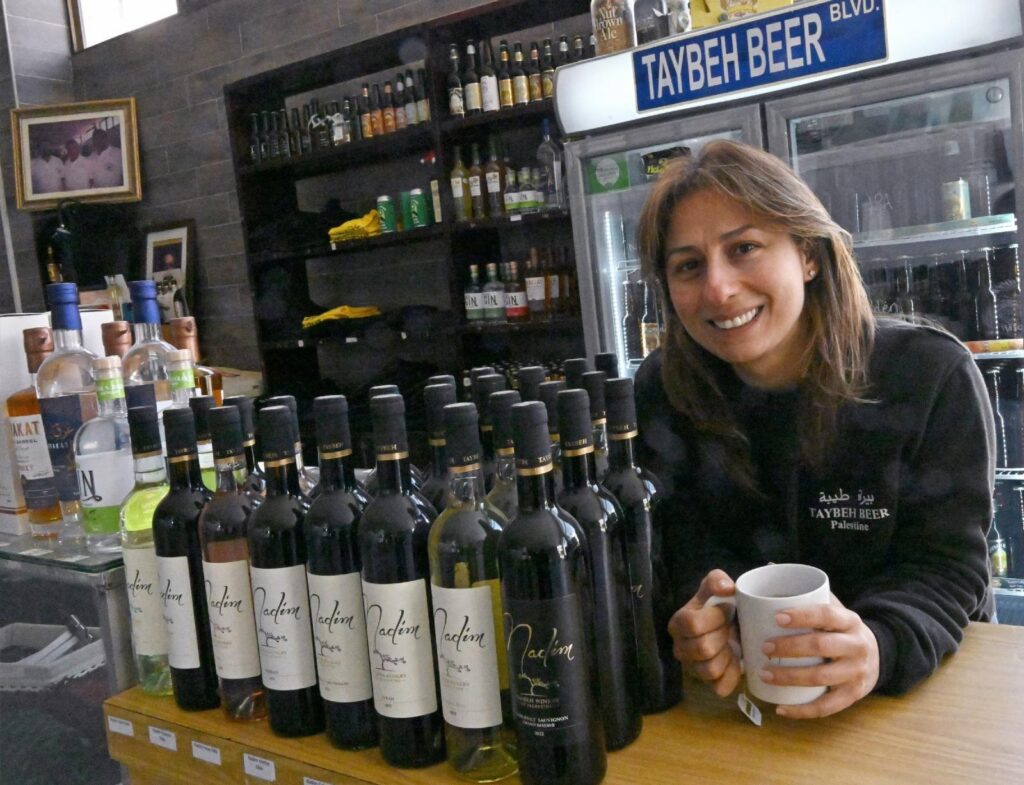
Khoury, whose family owns the brewery, and her sister Nadine, who returned to Taybeh five years ago from Boston with her husband and three children, said they have become afraid of walking alone in their own village for fear of running into settlers inside Taybeh. Nadine said she wants to remain in Taybeh despite the difficulties but is concerned for the safety of her children.
Frightening ‘to live like this’
“You can’t imagine how frightening it is to live like this in your own village,” said Nadine.
“This is the new panorama the settlers have created,” said Father Fawadleh. “Inside Taybeh, we are fearful all the time and we don’t know exactly what’s happening from one minute to the next. … I can encourage (my parishioners), but I cannot give them safety. … I’m here to give them safety and security in faith, in hope,” he told OSV News.
“So we still are hoping and we still hope in the third day, in the new resurrection and the new life for ourselves. And we are here as a resistance in this land because we are rooted in this land. And when I say resistance, that means we resist (with our) faith.”
Judith Sudilovsky writes for OSV News from Jerusalem.
