


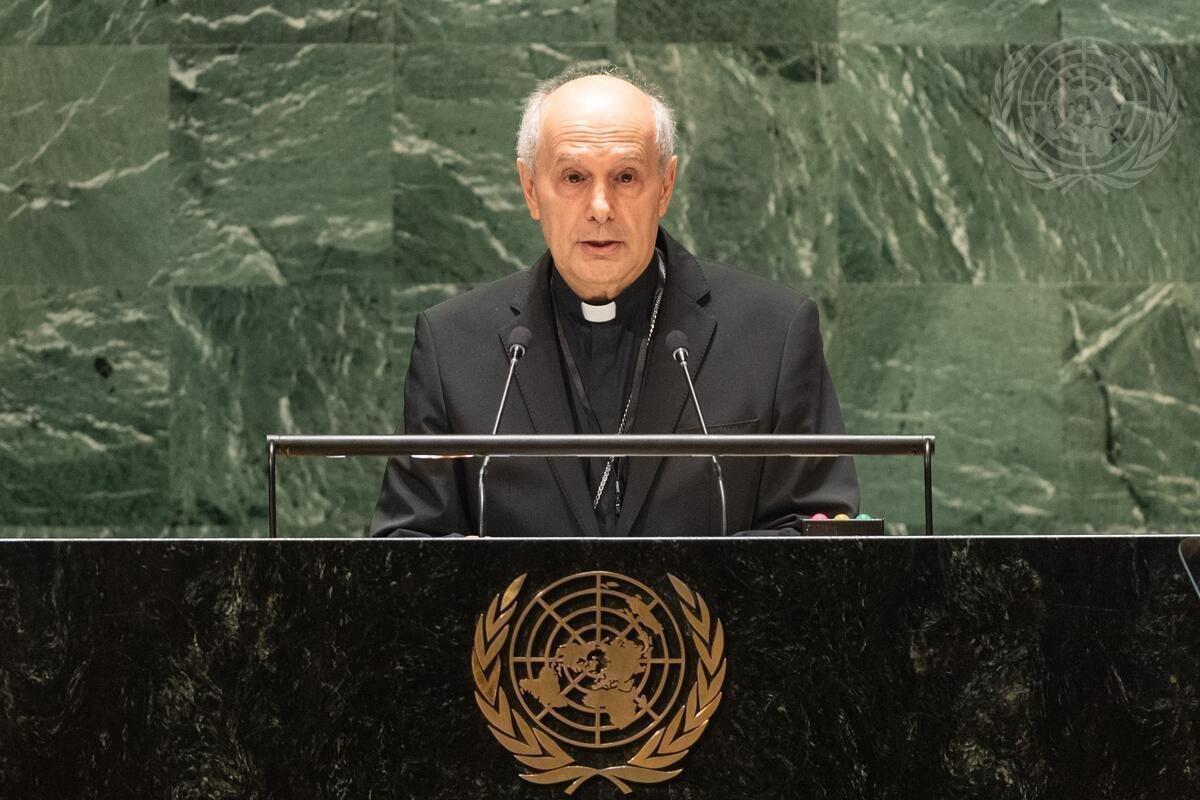
(OSV News) — As atrocities against civilians surge globally, the Vatican’s top diplomat to the United Nations stressed the crucial need for both prevention and accountability — and the vital roles of individual nations and the global community in those tasks.
Archbishop Gabriele G. Caccia, the Holy See’s permanent observer to the U.N., delivered a statement at a Jan. 19 general debate ahead of a U.N. diplomatic conference on preventing and punishing crimes against humanity.
Under international law, crimes against humanity are defined as a number of acts knowingly committed in a widespread or systematic fashion against a civilian population.
Murder, rape and sexual violence, extermination, enslavement, deportation or forcible transfer of a population, unlawful imprisonment, torture, persecution, apartheid and forced disappearances are among the crimes recognized as such.
In his address, Archbishop Caccia described such crimes as “one of the most serious challenges confronting humanity.”
He noted that “while this assembly is discussing how best to address those crimes, violations of the sanctity of human life persist and, in many contexts, appear to be increasing.”
Civilian death surge
Civilian deaths in conflict surged by 40% in 2024, with at least 48,384 persons, mostly noncombatants, killed, according to data released in June by the U.N.’s Office of the High Commissioner for Human Rights.
The data painted “a picture of a global human rights landscape in need of urgent action,” U.N. human rights chief Volker Türk said at the time.
“The continued absence of effective collective responses is not without consequence: children, women, and members of ethnic and religious minorities continue to suffer persecution, violence and death, in ways that profoundly wound human dignity and the moral conscience of humanity,” said Archbishop Caccia in his Jan. 19 address.
Noting that the prohibition of crimes against humanity is “well established” under international law, the archbishop said that “the central challenge before us is not the recognition of these crimes, but the development of effective measures to prevent their commission and to ensure accountability when they occur.”
National duty, international cooperation
The archbishop stressed that “the duty to prevent and counter crimes against humanity rests first and foremost” with nations, whose jurisdictions remain “the primary locus for investigation and prosecution” of such atrocities.
At the same time, Archbishop Caccia said, international cooperation is “indispensable” for countering crimes against humanity.
“Any future international framework should build firmly upon existing customary international law, in order to preserve legal coherence, foster trust among states, and facilitate the broadest possible consensus,” he said.
The archbishop quoted a Jan. 9 address by Pope Leo XIV to members of the Holy See’s accredited diplomatic corps, in which the pope observed that “in order to engage in dialogue, there needs to be agreement on the words and concepts that are used. Rediscovering the meaning of words is perhaps one of the primary challenges of our time.”
‘Suffering calls for justice’
Archbishop Caccia also cited an Oct. 3, 1953, address by Pope Pius XII to a congress on international law, in which the pope, reflecting on the horrors of the Second World War, had called for international agreements clearly defining and proscribing such crimes.
“Although more than 70 years have passed since then, Pope Pius’ call still remains fully valid,” said Archbishop Caccia.
Through international cooperation, he said, the “transnational dimensions” of crimes against humanity can be addressed, while states lacking resources to prevent and prosecute crimes can receive much-needed support.
“Such cooperation should strengthen, rather than weaken, the principles of complementarity, due process, and full respect for fundamental human rights,” he said.
Archbishop Caccia also advocated in his address for the victims of such crimes.
“Their suffering calls for justice, protection and assistance, as well as for legal approaches that ensure their voices are heard and their dignity upheld,” he said. “Any future framework should therefore include appropriate safeguards for victims and witnesses, while ensuring fair procedures and full respect for fundamental human rights.”
Gina Christian is a multimedia reporter for OSV News. Follow her on X @GinaJesseReina.
