


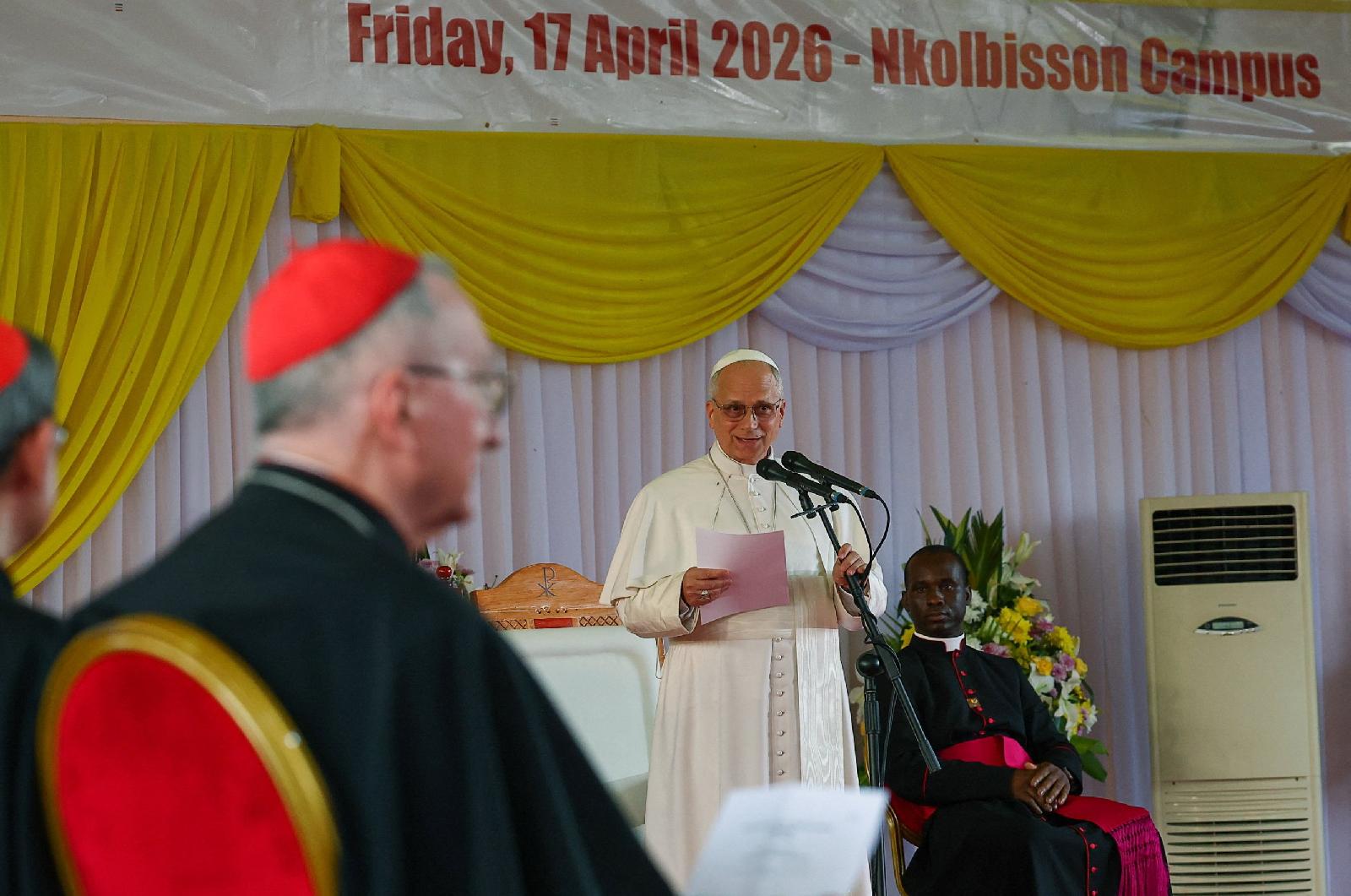
YAOUNDÉ, Cameroon (OSV News) — Pope Leo XIV has warned that the rise of artificial intelligence threatens to change humanity’s relationship with truth, calling on Catholic universities to help form leaders capable of navigating an increasingly digital world with integrity and discernment.
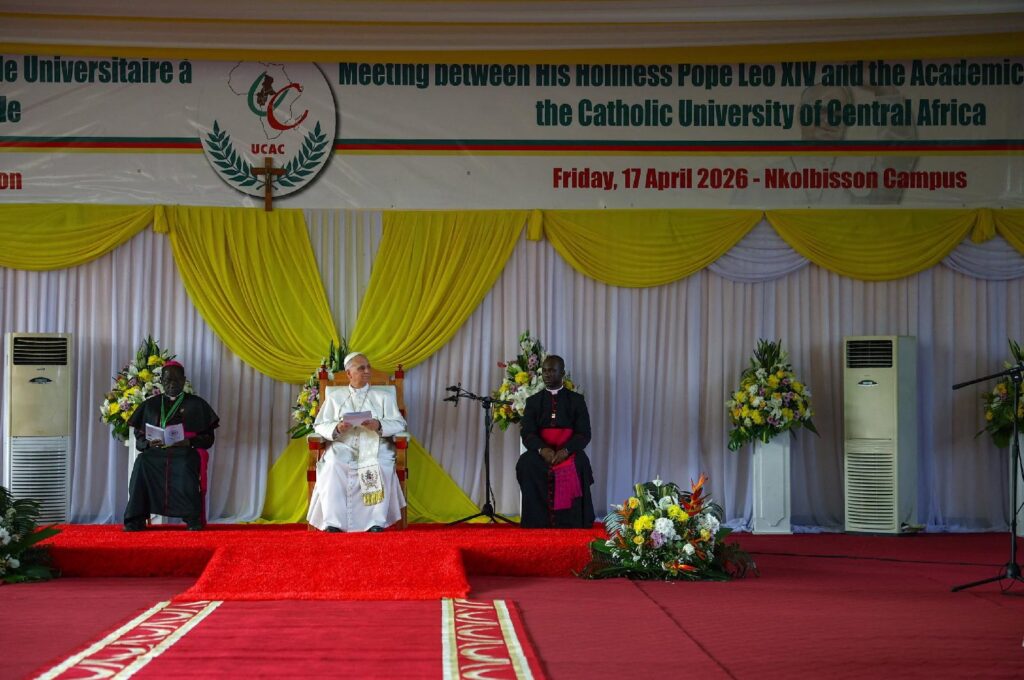
Speaking to students and professors at the Catholic University of Central Africa in Yaoundé, Cameroon April 17, the pope delivered a long address that touched on AI, corruption, the purpose of Catholic higher education, and the Church’s mission to unite faith with reason.
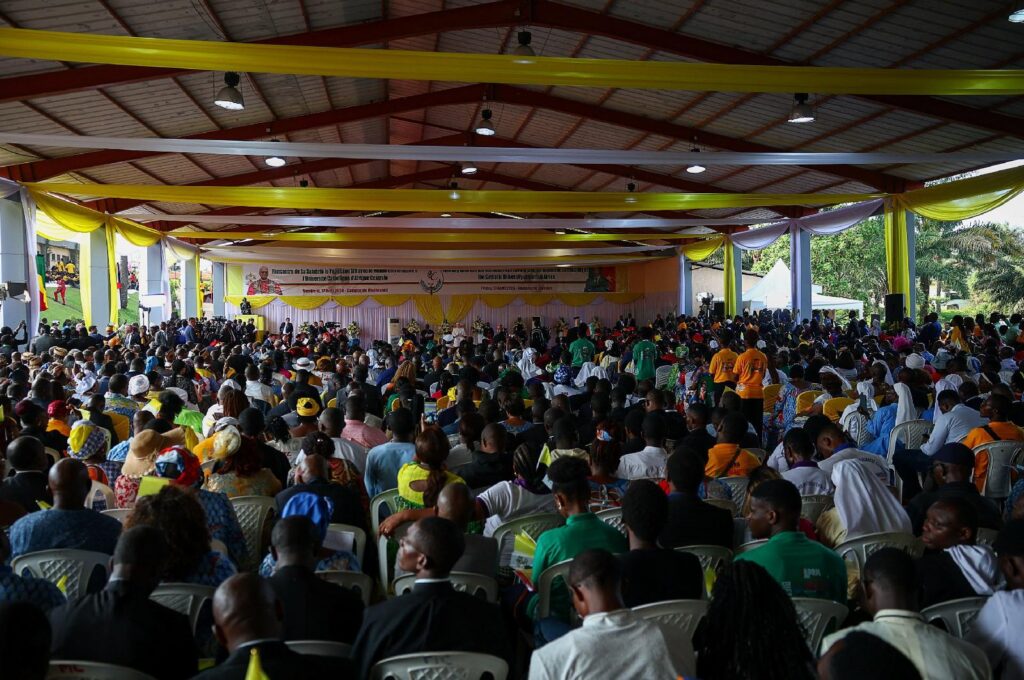
“Like every great historical transformation, this too calls not only for technical competence, but also for a humanistic formation capable of making visible the logic behind economics, embedded biases and forms of power that shape our perception of reality,” the pope told the students and professors, who were gathered in an open-air pavilion festooned in the papal colors yellow and white.
Risk of replacing human encounter
Pope Leo cautioned that some digital environments are “structured to persuade” and carry the risk of replacing genuine human encounter.
“When simulation becomes the norm, it weakens the human capacity for discernment. As a result, our social bonds close in upon themselves, forming self-referential circuits that no longer expose us to reality,” the pope said.
“We thus come to live within bubbles, impermeable to one another,” he said. “Feeling threatened by anyone who is different, we grow unaccustomed to encounter and dialogue. In this way, polarization, conflict, fear and violence spread.”
He added: “What is at stake is not merely the risk of error, but a transformation in our very relationship with truth.”
The pope directly addressed the students, drawing a pointed contrast between AI and incarnated reality. “Dear friends, you, however, are real persons!” he said. “Creation itself has a body, a breath, a life to be listened to and safeguarded.”
‘Born from the heart of the Church’
Pope Leo grounded his remarks in the long tradition of Catholic intellectual life, quoting both St. John Henry Newman’s “The Idea of a Catholic University” and St. John Paul II’s 1990 apostolic constitution “Ex Corde Ecclesiae,” which remains the foundational Church document on Catholic higher education.
The Catholic university, he said, is “‘born from the heart of the Church’ and shares in her mission to proclaim the truth that sets us free,” echoing John Paul II’s text. He emphasized that faith and reason are not opposed, but “support one another” in the pursuit of truth “in all its dimensions.”
“At a time when many in the world seem to be losing their spiritual and ethical points of reference, finding themselves imprisoned in individualism, superficiality and hypocrisy, the university stands out as a privileged place of friendship, cooperation and, at the same time, of interiority and reflection,” Pope Leo emphasized.
He continued: “From its very origins in the Middle Ages, its founders set truth as its goal. Today still, for truth, for, as St. John Henry Newman wrote, ‘All true principles run over with God, all phenomena converge to him.'”
‘Responsibility of the highest order’
The pope urged Catholic universities to take seriously their “responsibility of the highest order” to shape “minds capable of discernment and hearts ready for love and service.”
Catholic institutions, he said, must prepare “future leaders, public officials, professionals and other actors in society to carry out with integrity the responsibilities entrusted to them” and to situate their work “within an ethical framework at the service of the common good.”
Founded in 1989 by the Association of Episcopal Conferences of Central Africa, the Catholic University of Central Africa has about 5,000 students across multiple campuses, according to students who attended the event. Its students hail from many different African countries, including Chad, Equatorial Guinea, the Democratic Republic of the Congo and the Republic of the Congo.
In his speech, Pope Leo also addressed one of the most persistent challenges facing the African continent, calling corruption a “scourge” from which Africa must be freed — a remark that prompted spontaneous cheers and applause from the crowd.
The pope said that awareness of this problem must take root during students’ years of formation, shaped by the “moral rigor, selflessness and coherence of life shown by their educators and teachers.”
Pope Leo calls students ‘builders of the future’
Spiritual and human accompaniment, the pope added, are essential to a Catholic university’s identity. Through campus ministry, spiritual formation and moments of reflection, students are “invited to deepen their interior life and to orient their engagement in society in the light of authentic and enduring values.”
“In this way, dear students, you learn to become builders of the future of your respective countries and of a world that is more just and humane,” he said.
“By bearing witness to the truth — especially in the face of the illusions of ideology and passing fashions — you will foster an environment in which academic excellence is naturally united with human uprightness.”
The meeting was part of Pope Leo’s 11-day apostolic visit to the African countries of Algeria, Cameroon, Angola and Equatorial Guinea. April 17 was his final day in Cameroon before traveling to Luanda, Angola, April 18.
Courtney Mares is Vatican editor for OSV News. Follow her on X @catholicourtney.
