


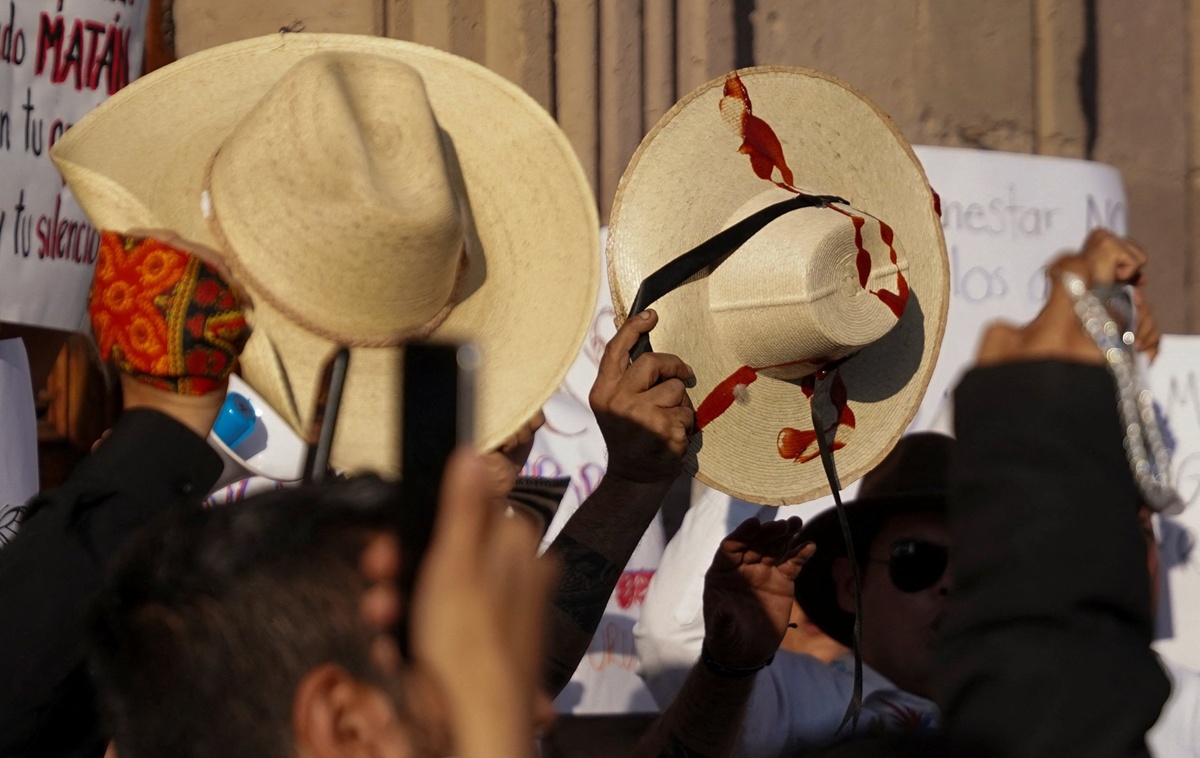
(OSV News) — Mexico’s Catholic leaders have urged the country’s political leaders to listen to victims of violence, seek input from all sectors of society and work together toward pacifying the country as the nation confronts rampant insecurity.
Swaths of the country are currently under the control of criminal groups, and citizens are increasingly being exposed to crimes such as extortion.
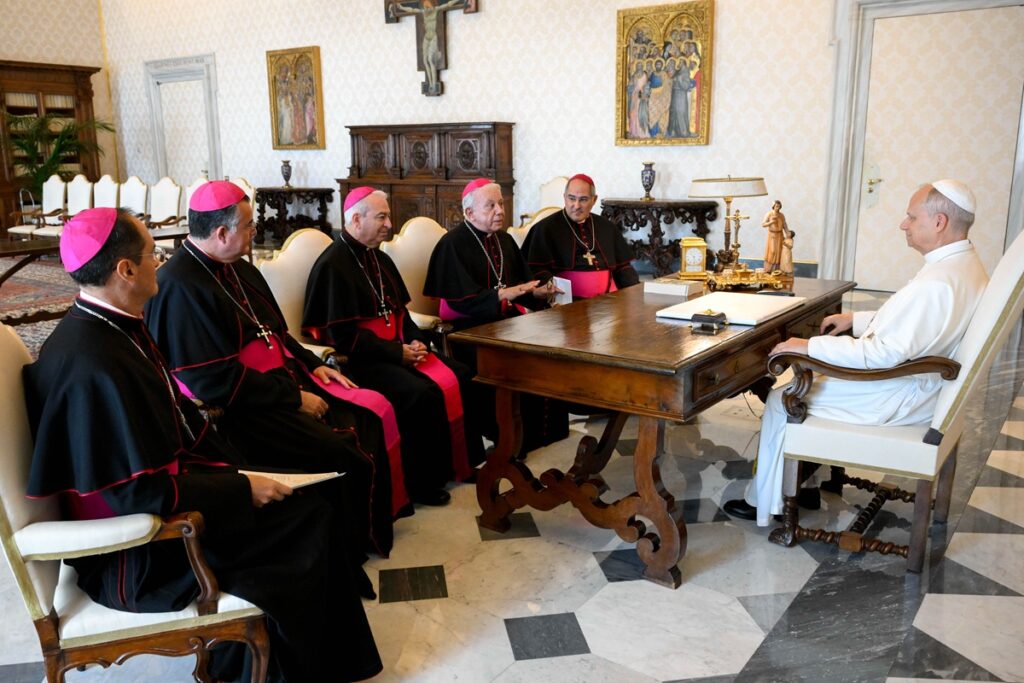
“We don’t come today to ask permission to build peace. We come to implore every sector of society, every Mexican, and the Mexican state itself to assume this historic responsibility, because peace cannot wait,” Auxiliary Bishop Héctor Pérez Villarreal of Mexico City said Jan. 12.
He made the comments in announcing the second edition of the National Dialogue for Peace, a peace-building initiative sponsored by the Mexican bishops’ conference, the Jesuits’ Mexico province and the Conference of Religious Superiors of Mexico.
Goal ‘to bring people together’
“We don’t seek to polarize, but rather to bring people together. We don’t want to shout, but rather to listen. We don’t want to see the problem in a simplistic way, but rather to truly delve into the paths to peace,” added Bishop Pérez Villarreal, secretary-general of the Mexican bishops’ conference.
The National Dialogue for Peace emerged from the 2022 atrocity of two elderly Jesuits, Fathers Javier Campos and Joaquín Mora, being murdered by a well-known local crime boss as they protected a man chased into their parish in an indigenous community in the Sierra Tarahumara of northern Chihuahua state.
The first initiative organized peace forums across the country, culminating in a national gathering in early 2024. Its first diagnosis of Mexico’s security situation was presented to the 2024 presidential candidates — with then-candidate Claudia Sheinbaum, now president, telling the dialogue’s organizers and participants: “I don’t share the pessimistic evaluation of the present moment.”
The forum offered a space for victims to be heard, while the dialogue’s organizers have worked with experts from civil society to present proposals to political leaders, served as a liaison with government officials in some states — including many from the ruling MORENA party — and initiated programs to repair the social fabric in communities afflicted by criminal activities.
“As the National Dialogue for Peace, what we are doing is reviving best practices. We are sharing what exists today that is positive and has offered good results … to reach agreements and improve the conditions for peace to exist,” said Jesuit Father Jorge Atilano, director of the National Dialogue for Peace.
The security situation is discouraging, however, according to the dialogue’s organizers.
‘Devastating’ data
“What we hear is concern about the country’s insecurity. Above all, what we’ve pointed out is the issue of growth of extortion, which reflects greater (criminal) control over territories and this exploitation to access both public and private resources,” Father Atilano said.
“What we found” in the first forum “was devastating: vast territories where the state no longer governs, where violence has become the only law and where institutions have retreated in the face of organized crime and an isolated and fragmented society,” said Marist Brother Luis Felipe González Ruiz, second vice president of the Conference of Religious Superiors of Mexico.
The second national forum organized by the dialogue is scheduled for Jan. 30 to Feb. 1 at the Jesuit-run ITESO university in Guadalajara.
It comes as President Sheinbaum weathers pressure from U.S. President Donald Trump to curb drug cartel violence and fentanyl production.
Trump alleged after U.S. special forces grabbed Venezuelan President Nicolás Maduro in a daring Jan. 3 raid that “the cartels are running Mexico. It’s very, very sad to watch and see what’s happening to their country.” He added in the Jan. 8 interview with Sean Hannity. “We are going to now start hitting land with regard to the cartels.”
Trump has expressed respect for Sheinbaum, even as he has mused over military intervention in Mexico. Sheinbaum has repeatedly rejected Trump’s offers of U.S. military assistance in combating drug cartels.
The Mexican president has quietly made concessions to Trump’s demands by ramping up migrant enforcement, abandoning her predecessor’s security policy known as “hugs, not bullets” — something called for by Catholic leaders after the murders of the two Jesuits — and sent 55 drug cartel leaders to the United States to face federal charges there.
Sheinbaum said Jan. 8 that Mexico’s murder rate had fallen 40%, its lowest level since 2016, during her 15 months in office. Critics countered that the number of disappeared climbed by 20% during 2025 and justice is still missing for many victims.
“There’s still a deep challenge to state order in Mexico,” Falko Ernst, a security analyst in Mexico City, told OSV News. “Any help, including from the Catholic Church, is more than welcome in order to add additional hands to what will hopefully be consistent efforts to tackle the situation.”
“We believe that, without truth and justice for the victims in the country, there can be no peace,” said Elena Azaola Garrido, an academic from the Center for Research and Higher Studies in Social Anthropology who works with the dialogue.
“Mexican society is not defeated,” Bishop Pérez Villarreal concluded. “It is tired, but willing to organize; hurting, but hopeful. … Every sector of Mexican society and the state (must) assume its historical responsibility.”
David Agren writes for OSV News from Buenos Aires.
