


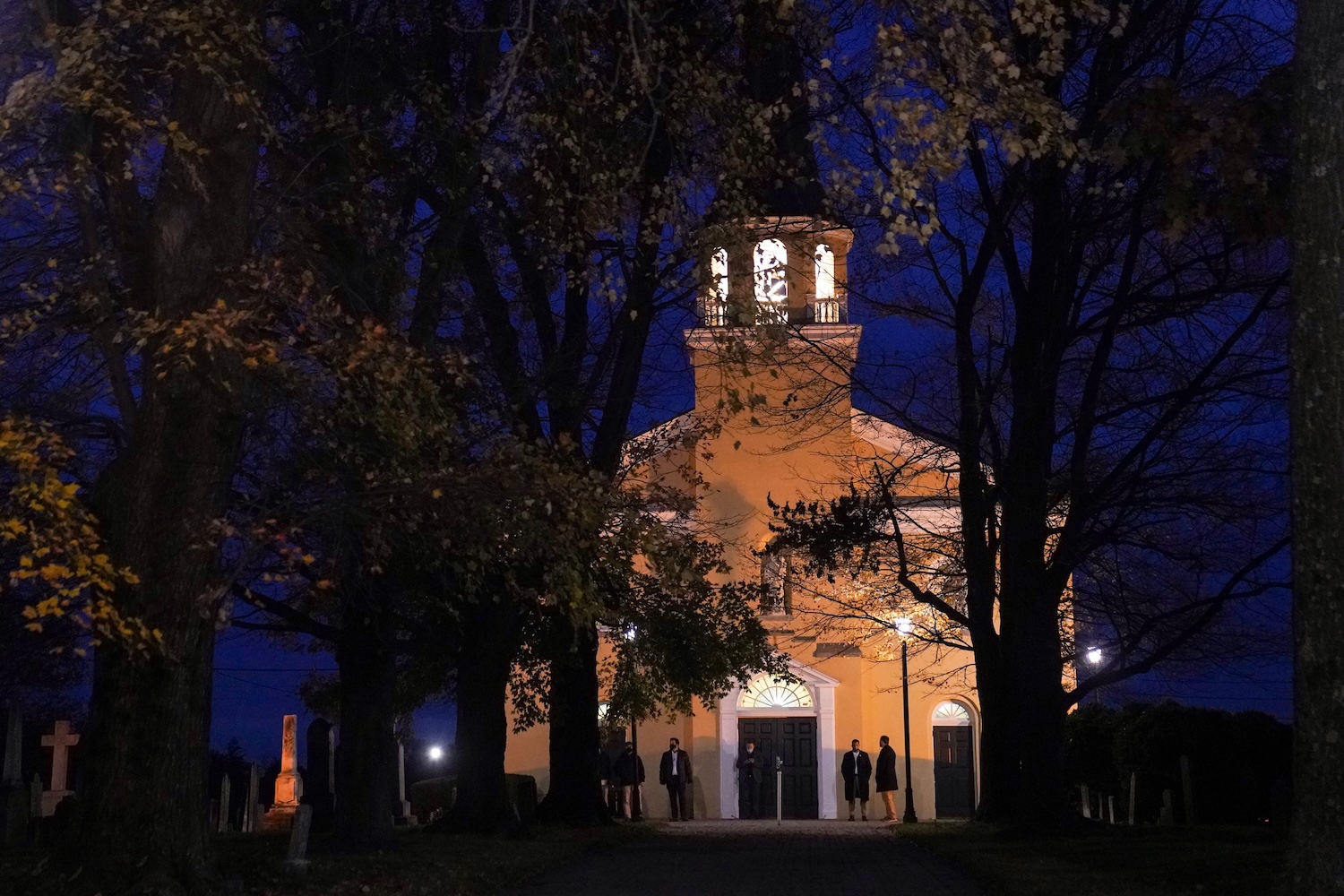
As the nation marks the 250th anniversary of the American Revolution this year, this series will examine the origins of the church and Catholic life in each of the 50 states, following the order in which they ratified the United States Constitution. The journey begins in Delaware, the first state — small in size, but foundational in the nation’s constitutional life.
Delaware’s story did not begin as that of a single, unified colony, but as a small and frequently contested stretch of land along the Delaware River. First settled by the Dutch in the 1630s, then claimed by the Swedes and eventually absorbed by the English, the region was shaped early on by cultural variety and political uncertainty.
Beginning with religious liberty
During the years of Dutch and Swedish control, Catholics were neither welcome nor free to practice their faith publicly. That began to change in 1682, when the territory came under the authority of William Penn, whose Quaker commitment to religious liberty allowed for greater tolerance, even toward Catholics.
Still, for much of the 18th century, Catholic life in what is now Delaware remained informal and widely scattered. There were no established parishes or resident clergy. Instead, Catholics in places such as Lewes, Dover, New Castle and a handful of other settlements were visited periodically by Jesuit missionaries based across the Maryland line, with Mass most often celebrated in private homes.
Growth with Jesuit missions
Over time, these Jesuits established two small pastoral centers: one in Murderkill Hundred in 1745, in what is now central Delaware, and another in Mill Creek Hundred in 1772, about seven miles west of present-day Wilmington. (In colonial Delaware, a “hundred” functioned much like a township.) It was in Mill Creek that Delaware’s first Catholic church would be built, shortly after the colony became the first to ratify the Constitution on Dec. 7, 1787.
One of the most important figures in this early chapter was Cornelius Hollahan, a Catholic immigrant from Ireland who settled in Mill Creek in 1730. His home became a familiar stopping place for traveling priests, offering both hospitality and a setting for the celebration of the sacraments.
First log chapel
In 1772, the Jesuit priest Father Matthew Sittensperger (who also went under the name Manners) purchased a nearby property known as Coffee Run, and in 1790 a log chapel was erected there and named “St. Mary’s.” With its construction, Delaware gained its first Catholic church, marking the transition from a scattered mission community to a visible and enduring center of Catholic life in the new state.
The story of Catholic life at Coffee Run did not end with the construction of that first modest chapel. In the summer of 1804, an Irish priest named Patrick Kenny arrived in America aboard a crowded ship from Dublin, quickly regretting the decision as he endured the heat and hardship of the voyage. He remained, however, and in time became pastor of St. Mary’s.
From Coffee Run, Kenny ministered to widely scattered Catholic families across northern Delaware, traveling long distances on horseback and often in poor health to celebrate Mass and administer the sacraments. While much of his work was among poor immigrant laborers, he also benefited from the support of prominent Catholic families, including members of the Du Pont family, whose assistance helped sustain the mission and, in whose powder works many of Kenny’s parishioners labored. Over the course of his long ministry, Kenny strengthened what had once been a fragile outpost of Catholic life.
Cathedral and continued growth
By the early 19th century, the Catholic presence that had taken shape at places like Coffee Run was being drawn into a more formal ecclesiastical structure. In 1808, Pope Pius VII erected the Diocese of Philadelphia, placing all of Delaware within its boundaries, where it would remain for the next 60 years. In this period of consolidation, and again through the efforts of Father Kenny, the first Catholic church in Wilmington soon followed, with the dedication in 1818 of St. Peter’s Church (now Cathedral).
That steady growth culminated in 1868, when Pope Pius IX established the Diocese of Wilmington, encompassing all three Delaware counties along with much of the eastern portion of Delmarva Peninsula in Maryland and Virginia.
Today, the church in Delaware — together with nine counties on Maryland’s Eastern Shore — serves nearly a quarter million Catholics across 57 parishes, 18 missions and 29 schools, a striking testament to a Catholic community that began generations earlier in log chapels and missionary outposts, shaped by the quiet perseverance of Father Kenny and countless others like him, whose names have faded even as their work has endured.
Father Anthony D. Andreassi, a priest of the Brooklyn Oratory of St. Philip Neri, holds a doctorate in history from Georgetown University. His research and writing have focused on the American Catholic community. After spending many years in Catholic secondary education, he is on the staff of the Oratory parishes of Assumption and St. Boniface in Brooklyn, New York.
