


By Peter Stockland and The B.C. Catholic
DORVAL, Quebec (OSV News) — Archbishop Richard W. Smith of Vancouver, British Columbia, said the 62 Indigenous cultural items received from the Vatican mark “a gift freely given” and an important step in rebuilding trust between the Catholic Church and Indigenous peoples.
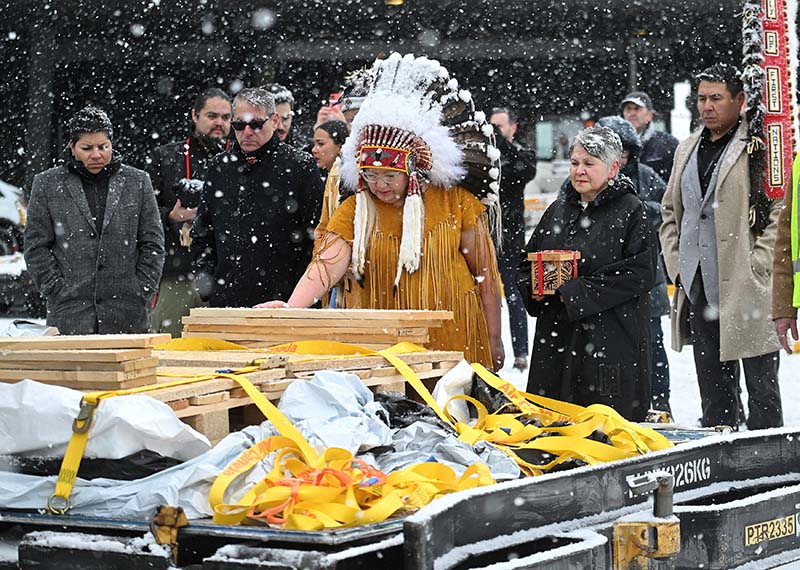
A deeply prayerful celebration greeted their arrival at Montreal’s Trudeau Airport in Dorval on Dec. 6, even after a delay in transit from Frankfurt, Germany.
Aged and some fragile artifacts
The aged and sometimes fragile artifacts reportedly required additional handling before release, but the holdup did nothing to dampen spirits. What was billed as a media conference unfolded instead as a 90-minute welcome home filled with ceremony, gratitude and emotional relief at the long-awaited arrival.
The artifacts, including a rare century-old Western Arctic kayak, were formally transferred to Indigenous leaders in Montreal as part of the Jubilee of Hope declared by Pope Francis. Before his death, the pope expressed his wish that the items be returned. Pope Leo XIV carried out that intention, gifting them from the Vatican Museums’ “Anima Mundi” collection to the Canadian Conference of Catholic Bishops, or CCCB, for immediate return.
Youth delegates who traveled to Frankfurt to accompany the transshipment shared how the experience deepened their sense of the spiritual significance of the return. “I learned the power of prayer,” Peyal Laceese, of the Tsilhqot’in Nation, told The Catholic Register, a weekly newspaper based in Toronto.
Fellow traveler Katisha Paul said the appearance of a swan during their time in Germany was taken as a sign of ancestral presence.
‘Looking to see our ancestors’
“We are all looking to seeing our (ancestors) feel the mountains, winds, the warmth of our lands and our waters,” said Paul, who is also a youth member of the Union of B.C. Indian Chiefs.
She linked the eight-year effort to reclaim the objects with a broad, spiritually rooted movement to reassert Indigenous rights and restore cultural belongings long held abroad. For some, the steps taken so far represent “rescuing our ancestors from the Vatican” and from other institutions where they remain outside Indigenous stewardship.
Paul noted that the U.N. Declaration on the Rights of Indigenous Peoples, ratified by Canada, provides important international leverage supporting the return of such items.
Opening prayers led by Algonquin Elder Claudette Commanda, followed by throat singing and a Red River Jig performance, set a reverent and joyful tone. Leaders from the Assembly of First Nations, Inuit Tapiriit Kanatami, the Inuvialuit Regional Corporation, the Métis National Council and local First Nations welcomed the sacred items and bundles back to Canada.
Bishops, government leaders
Also attending were Archbishop Smith; Cardinal Gérald C. Lacroix of Québec, primate of Canada; Msgr. Paul Butnaru, counselor of the apostolic nunciature in Ottawa, Ontario; Minister of Canadian Identity and Culture Marc Miller; and Caroline Dromaguet, CEO of the Canadian Museum of History.
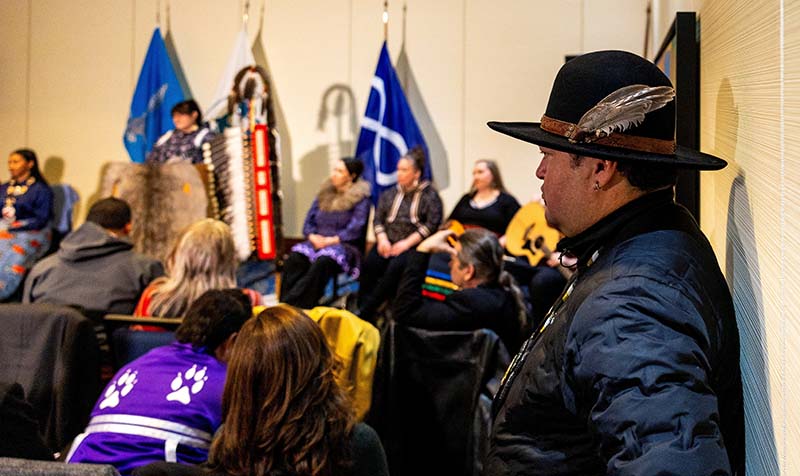
“This gesture is a gift freely given — an act of reconciliation rooted in the grace of the Jubilee Year of Hope,” said Archbishop Smith, a member of the Canadian Catholic Indigenous Council and one of the CCCB’s key representatives during the handover process. “A gift, unlike restitution, is offered in freedom and friendship, as a sign of renewed relationship and mutual respect between the church and Indigenous peoples.”
For the Inuvialuit, the return of the rare kayak marks the culmination of a long-held hope.
“We are proud that after 100 years our kayak is returning to the Inuvialuit Settlement Region,” said Duane Ningaqsiq Smith, chair and CEO of the Inuvialuit Regional Corporation, or IRC. “It is believed to be one of only five of its kind built more than a century ago. … This is a historic step in revitalizing Inuvialuit cultural identity and values within our changing northern society.”
Worked toward this moment
Indigenous leaders noted that elders and residential school survivors have worked toward this moment for decades. A 2017 Assembly of First Nations resolution mandated efforts to secure the return of sacred items taken abroad, while the IRC has pressed specifically for the kayak’s to come back to Canada. The emotional weight of the return was evident in repeated references to the artifacts as relatives rather than objects.
“This step reflects the courage and persistence of the leaders, elders and survivors who came before us,” said Victoria Pruden, president of the Métis National Council. “But this is not the end of the journey. … Reconciliation is ongoing work, grounded in relationships, responsibility, and the continued pursuit of truth, justice, healing and dignity for our peoples.”
National Chief Cindy Woodhouse Nepinak called the return “an important moment” for First Nations.
“Our relatives are finally home,” she said. “For First Nations, these are not only artifacts. They are sacred, living items.” Both she and Natan Obed, Inuit Tapiriit Kanatami president, emphasized that “this is just the beginning,” noting that much work lies ahead to determine provenance and arrange final returns to specific Indigenous communities.
Canadian Museum of History
According to the CCCB, the artifacts will be housed temporarily at the Canadian Museum of History in Ottawa, where National Indigenous Organizations will lead the work to establish the provenance of each item and determine its final destination.
The handover in Canada follows a November audience in Rome, where Pope Leo formally entrusted the artifacts to Archbishop Smith, Bishop Pierre Goudreault of Sainte-Anne-de-la-Pocatière, who is CCCB president, and Father Jean Vezina, the conference’s general secretary.
The items — including an Inuit kayak, masks, moccasins and etchings — had been held in the Vatican Museums for more than a century.
Archbishop Smith said in an earlier interview the transfer was “a milestone in the long journey of reconciliation and healing,” and especially meaningful as the Jubilee Year of Hope draws to a close.
Emphasize healing relationships
“This Jubilee, like previous jubilees, wants to emphasize the importance of healing relationships,” he told America magazine.
A statement from the Holy See and the CCCB in November said the gift marks “the conclusion of the journey initiated by Pope Francis,” who met Indigenous delegations repeatedly before his 2022 “penitential pilgrimage” to Canada and later directed that the items be returned. Pope Leo “desires that this gift represent a concrete sign of dialogue, respect and fraternity,” the statement said.
Archbishop Smith said the bishops’ role “has really been a facilitating one, just working with the Holy See, working with the Indigenous leaders to make this happen.” He noted that the momentum “goes back to Pope Francis. … it’s really something that grew out of his heart.”
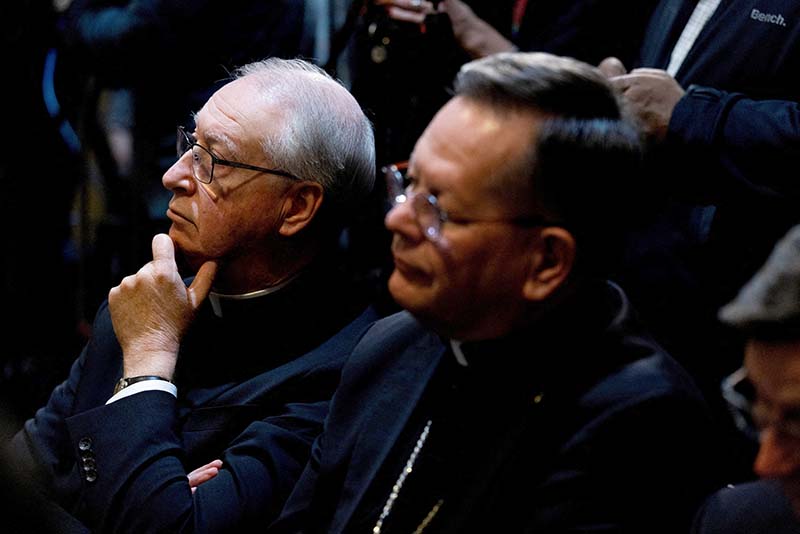
Bishop Goudreault previously said Pope Leo’s decision to entrust the items to the bishops — rather than to a government or directly to an Indigenous body — was “a tangible sign of his desire to help Canada’s Bishops walk alongside Indigenous Peoples in a spirit of reconciliation during the Jubilee Year of Hope and beyond.”
Missionary Exhibition of 1925
The artifacts originated from First Nations, Métis, and Inuit communities and were part of the ethnological exhibition organized for the Vatican Missionary Exhibition of 1925. Missionaries sent them to Rome between 1923 and 1925 for the display encouraged by Pope Pius XI, after which they were incorporated into the Vatican’s collection. Documentation certifying their origins and transport was transferred alongside the items.
Canadian Ambassador to the Holy See Joyce Napier called the return “an important and a right step.” The Vatican has made similar gestures recently, including the return of three fragments of the Parthenon Marbles to Greece in 2023.
Peter Stockland is with The Catholic Register, Canada’s national Catholic newspaper based in Toronto. The B.C. Catholic is the weekly newspaper of the Archdiocese of Vancouver. This story was originally published by The B.C. Catholic and distributed through a partnership with OSV News.
