


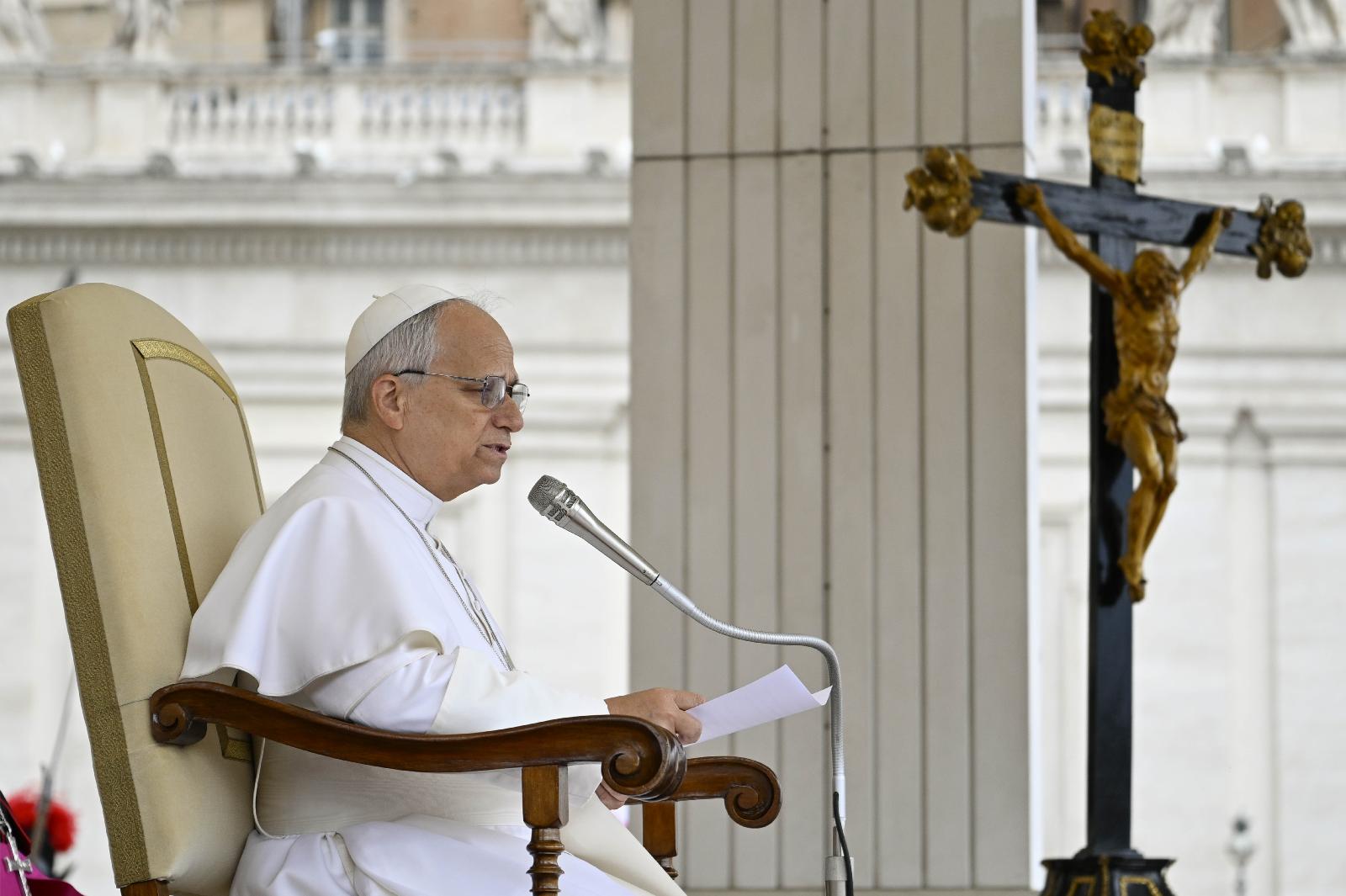
(OSV News) — The following is the full text of Pope Leo XIV’s general audience address given May 6 in St. Peter’s Square.
Catechesis. The Documents of the Second Vatican Council. II. Dogmatic Constitution Lumen gentium. 8. The Church, pilgrim in history towards the heavenly homeland
Brothers and sisters, good morning and welcome!
As we focus today on a section of Chapter VII of the Second Vatican Council’s Constitution on the Church, let us reflect on one of its defining characteristics: its eschatological dimension. The Church, in fact, journeys through this earthly history always looking towards her final destination, which is the heavenly homeland. This is an essential dimension which, however, we often overlook or downplay, because we are too focused on what is immediately visible and on the more concrete dynamics of the life of the Christian community.
The Church is God’s people journeying through history, which has the Kingdom of God as the purpose of all her action (cf. LG, 9). Jesus initiated the Church precisely by proclaiming this Kingdom of love, justice and peace (cf. LG, 5). We are therefore called to consider the community and cosmic dimension of salvation in Christ and to turn our eyes to this final horizon, to measure and evaluate everything from this perspective.
The Church lives in history in the service of the coming of the Kingdom of God in the world. She proclaims the words of this promise to all and always; she receives a pledge of it in the celebration of the Sacraments, particularly the Eucharist; she puts its logic into practice and experiences it in relationships of love and service. Furthermore, she knows that she is the place and the means where union with Christ is realized “more closely” (LG, 48), whilst at the same time recognizing that salvation can be bestowed by God in the Holy Spirit even beyond her visible boundaries.
In this regard, the Constitution Lumen gentium makes an important statement: the Church is the “universal sacrament of salvation” (LG, 48), that is, the sign and instrument of that fullness of life and peace promoted by God. This means that she does not identify perfectly with the Kingdom of God, but is its seed and beginning, for its fulfilment will be granted to humanity and the cosmos only at the end. Believers in Christ, therefore, walk through this earthly history, marked by the maturation of good but also by injustices and sufferings, without being either deluded or despairing; they live guided by the promise received from the One who will “make all things new” (Rev 21:5). Therefore, the Church realizes her mission between the “already” of the beginning of the Kingdom of God in Jesus, and the “not yet” of the promised and anticipated fulfilment. As the guardian of a hope that enlightens the path, she is also invested with the mission of speaking clearly to reject everything that mortifies life and prevents its development, and to take a position in favour of the poor, the exploited, the victims of violence and war, and all those who suffer in body and in spirit (cf. Compendium of the Social Doctrine of the Church, no. 159).
As the sign and sacrament of the Kingdom, the Church is the pilgrim people of God on earth who, drawing precisely on the final promise, reads and interprets the dynamics of history through the Gospel, denouncing evil in all its forms and proclaiming, in word and deed, the salvation that Christ wishes to bring about for all humanity and His Kingdom of justice, love and peace. The Church, therefore, does not proclaim herself; on the contrary, everything within her must point to salvation in Christ.
From this perspective, the Church is called to recognize humbly the human fragility and transience of her own institutions who, despite being at the service of the Kingdom of God, bear the fleeting image of this world (cf. LG, 48). No ecclesial institution can be treated as absolute; indeed, since they exist within history and time, they are called to continual conversion, to the renewal of forms and the reform of structures, to the continual regeneration of relationships, so that they may truly fulfil their mission.
Within the horizon of the Kingdom of God, we must also understand the relationship between the Christians who are carrying out their mission today, and those who have already completed their earthly existence and are in a state of purification or beatitude. Lumen gentium, in fact, affirms that all Christians form a single Church, that there is communion and sharing of spiritual goods founded on the union with Christ of all believers, a fraterna sollicitudo between the earthly Church and the heavenly Church: that communion of saints that is experienced in particular in the liturgy (cf. LG, 49-51). By praying for the departed and following in the footsteps of those who have already lived as disciples of Jesus, we too are sustained on our journey and strengthen our worship of God: marked by the one Spirit and united in the one liturgy, together with those who have gone before us in faith, we praise and give glory to the Most Holy Trinity.
Let us be grateful to the Council Fathers for reminding us of this most important and beautiful aspect of being Christian, and may we strive to cultivate it in our lives.
Special greetings:
I greet all the English-speaking pilgrims and visitors taking part in today’s Audience, particularly the groups from Belgium, The Netherlands, Finland, Ghana, Uganda, New Zealand, India, Indonesia, Japan, Malaysia, Canada and the United States of America. I greet in particular the faculty and students from the University of Florida, Saint Mary’s College and Christendom College and all those participating in the AI Conference at the Gregorian University. Upon all of you, and upon your families, I invoke the joy and peace of the risen Jesus! May God bless you!
Summary of the Holy Father’s words:
Dear brothers and sisters, in our ongoing catechesis on Lumen Gentium, we focus on the eschatological dimension of the Church. As the “universal sacrament of salvation,” the Church is a sign and instrument of the fullness of God’s promises. As the pilgrim People of God, the Church interprets history through the lens of the Gospel and speaks decisively against all evil. At the same time, the Church acknowledges the need for continual conversion so she may properly fulfill her mission. As members of the same Body, we too are called to renewal. We do this by remaining in communion with Christ and one another. The entire Church is most closely united in our praise of God in the liturgy. There we pray for the faithful departed and ask the Saints to intercede for us so that we may all receive the fullness of God’s promises in the Kingdom of Heaven.
