

PHILADELPHIA (OSV News) — The nation’s 250th anniversary and the conclusion of the 2026 National Eucharistic Pilgrimage in Philadelphia July 5 evoke memories of a major Eucharistic gathering held in that city the same year the U.S. marked its bicentennial.
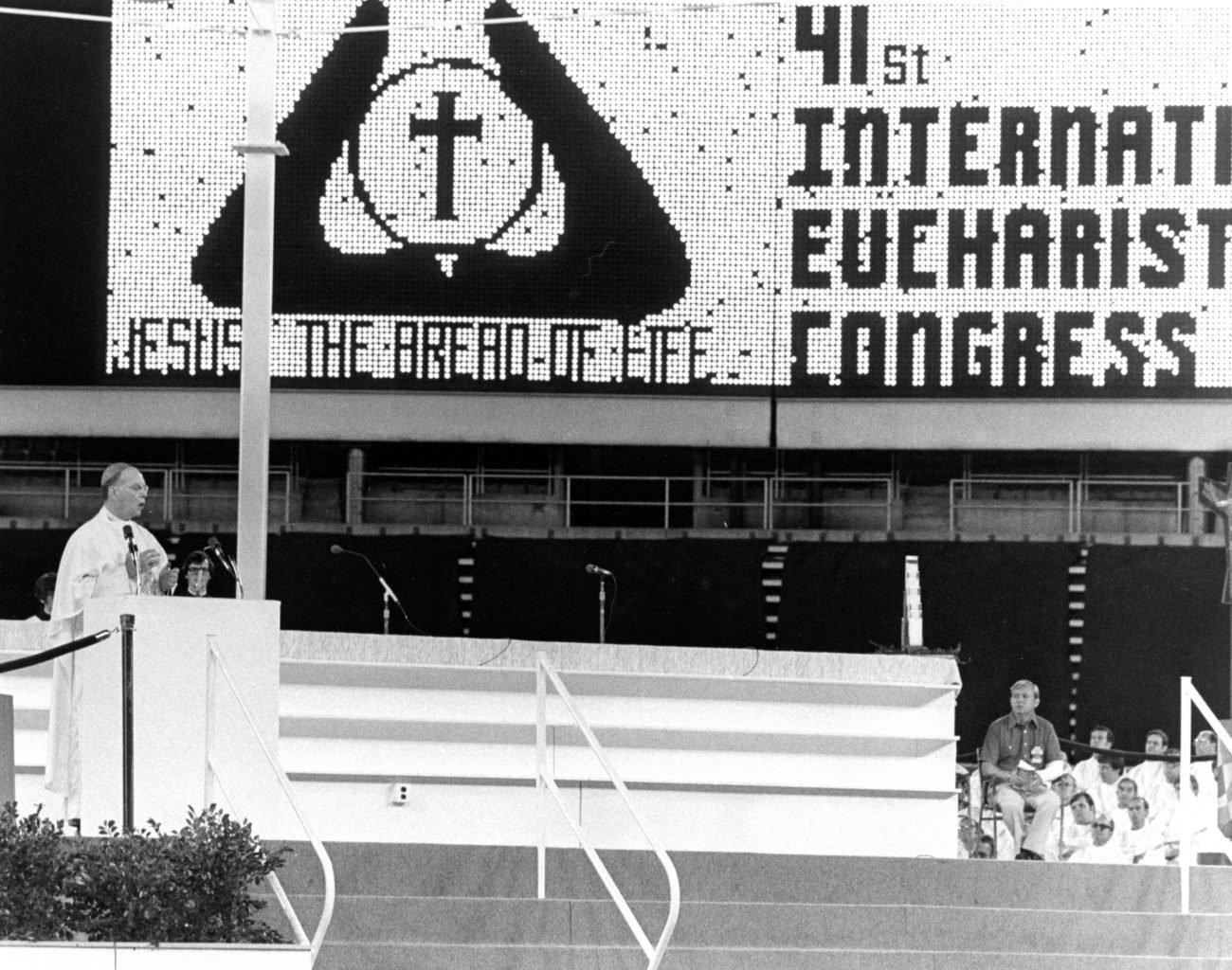
More than 1.5 million — including 44 cardinals and 417 bishops from across the globe — flocked in 1976 to Philadelphia for the 41st International Eucharistic Congress, a weeklong celebration of the Church’s central mystery of faith.
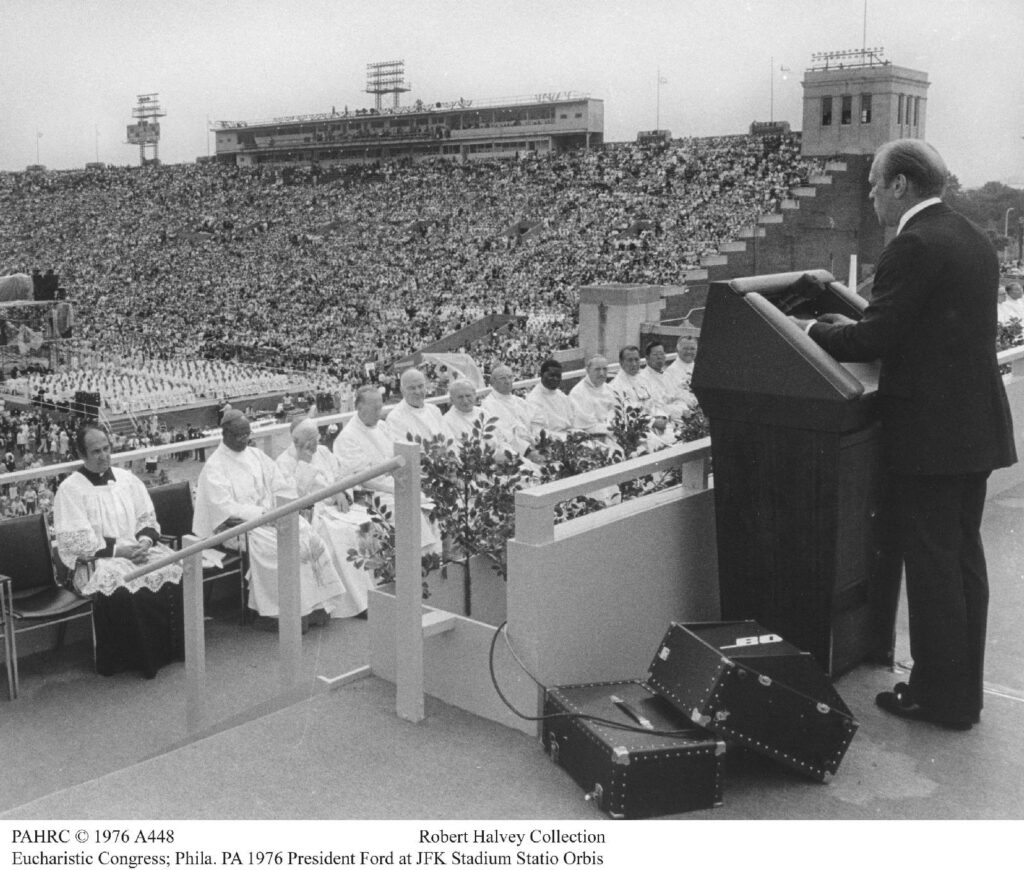
Among those on hand were Cardinal Karol Wojtyla, the future St. John Paul II; Dorothy Day, co-founder of the Catholic Worker Movement; and President Gerald R. Ford, who addressed some 96,000 congress participants at the former Veterans Stadium in Philadelphia.
Prayerful contemplation during evening procession
St. Teresa of Kolkata was also a participant, with one memorable photograph from the event showing her cupping a small candle in her hand, head bent in prayerful contemplation, during an evening procession along the city’s Benjamin Franklin Parkway.
The theme of the congress, which took place Aug. 1-8 of that year, was “The Eucharist and the Hungers of the Human Family,” a focus that had been approved by St. Paul VI, who was pope at the time.
According to the congress’ official program, that theme had been sparked by the soon-to-be-beatified Venerable Fulton J. Sheen, then archbishop of Rochester, New York.
Asked by the congress’ executive secretary, Father Walter J. Conway, for his thoughts on the gathering’s organizing principle, Archbishop Sheen was reported to have said, “Have you ever thought of the starving souls all about us? There are people starving in body for food and people starving in soul for God.”
A particular hunger featured each day
Each day of the congress was dedicated to a particular hunger: for God, for bread, for freedom and justice, for the Spirit, for truth, for understanding, for peace — and for Jesus, the Bread of lLife.
Congress events — which featured liturgies, conferences, cultural exhibits, Eucharistic adoration and processions — spanned a number of locations within the Archdiocese of Philadelphia, including the Cathedral Basilica of Sts. Peter and Paul, the city’s former Civic Center and Spectrum arena, St. Charles Borromeo Seminary (then located in Wynnewood, Pennsylvania), and local parishes and shrines.
On Aug. 7, 1976, liturgies were celebrated in the Roman and several Eastern Catholic rites, among them Armenian, Ukrainian, Ruthenian, Maronite and Melkite, with Masses also taking place in multiple languages, among them Chinese, Lithuanian, Polish, Spanish and Vietnamese.
Old St. Joseph Parish in Philadelphia hosted a Mohawk Indian liturgy, while Veterans Stadium saw a concelebrated Eastern Catholic liturgy followed by a Eucharistic procession and all-night adoration.
Congress pivotal for CRS Rice Bowl
Msgr. Robert Coll, founder of what became Catholic Relief Services’ Rice Bowl initiative, recalled to OSV News before his death in April that the congress was pivotal in scaling up the collection — which had begun as a parish and community effort in Allentown, Pennsylvania — to the national level.
The congress planning had been “under the tutelage” of Cardinal John J. Krol, then archbishop of Philadelphia, who had heard about Rice Bowl and “invited us to Philadelphia to explain what was going on,” Msgr. Coll told OSV News in a 2025 interview.
Brokering that connection had been then Msgr. (and later Cardinal) John P. Foley, editor of the Archdiocese of Philadelphia’s newspaper, The Catholic Standard and Times, and a member of the Eucharistic congress’ board of governors.
The monsignor recalled that the congress was being planned amid the 1972-1975 global food crisis, when the level of hunger throughout the world, particularly in the Sahel in Africa, was “frightening … really frightening.”
Petition forwarded to bishops
During the congress, “a petition was forwarded to the American bishops,” who expressed their desire to “continue the Rice Bowl program throughout America,” Msgr. Coll told OSV News.
By 1976, at least 118 U.S. dioceses had raised more than $5.1 million thanks to Msgr. Coll’s basic concept.
Decades later, the legacy of both the 41st International Eucharistic Congress and the Rice Bowl effort it propelled remain vibrant, said Anne Ayella, CRS diocesan director for the Archdiocese of Philadelphia, and Lizanne Hagedorn, executive director of the archdiocese’s Nutritional Services Development hunger relief agency.
Speaking to OSV News after Msgr. Coll’s death in April, Ayella recalled her experience attending the congress. At the time, as a senior majoring in biology at St. Joseph’s University, she was exploring the relationship between malnutrition and brain development.
“I was totally motivated by the fact that so many people were not going to live up to their potential,” said Ayella, adding the experience of the Eucharistic gathering in Philadelphia helped to shape the course of her life.
“It all came together my senior year because of the Eucharistic congress,” she said.
Gina Christian is a multimedia reporter for OSV News. Follow her on X @GinaJesseReina.
