
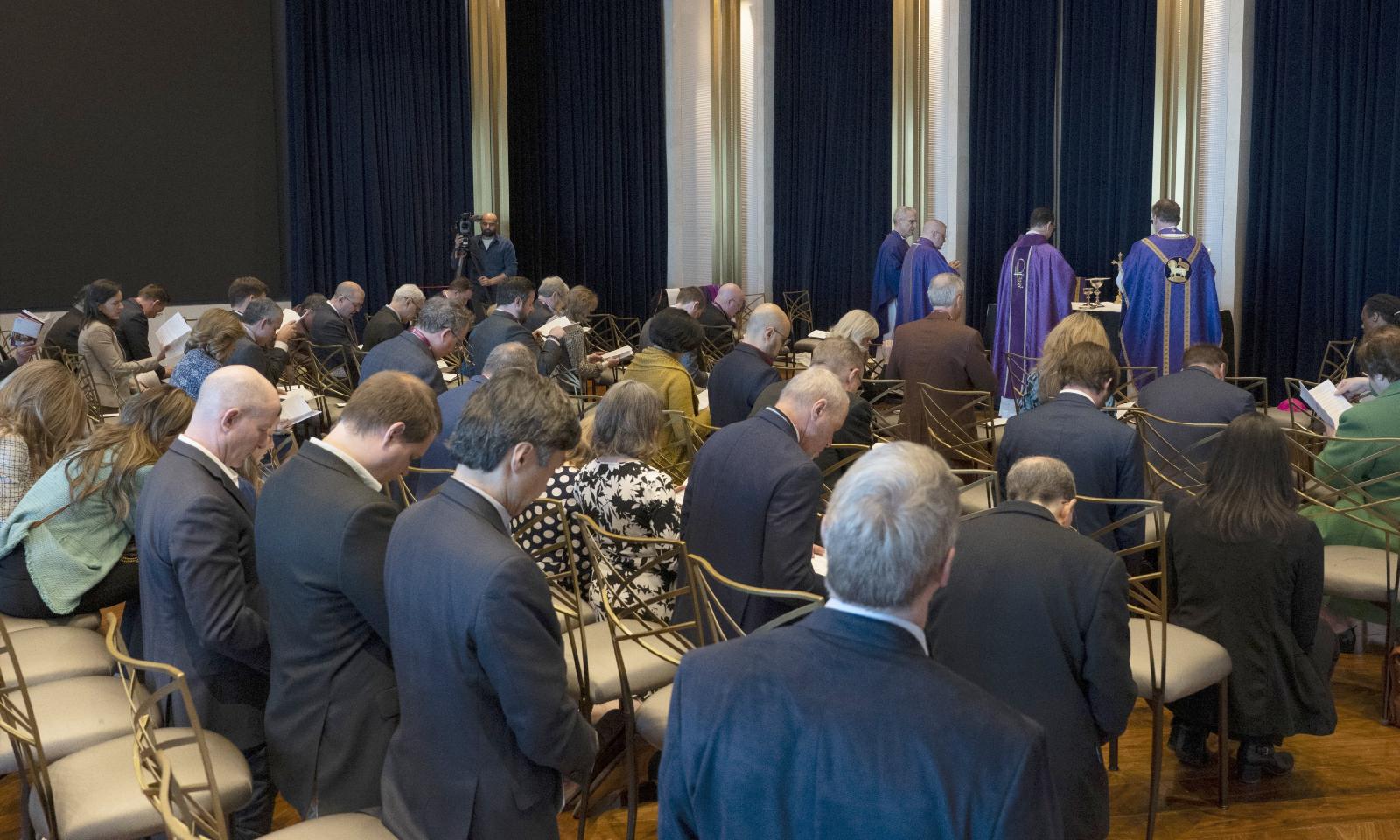
WASHINGTON (OSV News) — The Napa Institute — the California-based organization dedicated to equipping Catholic leaders “to bring the light of Christ into every sphere of culture” — held its second Ecumenical Forum on March 18 at the Museum of the Bible.
Its presenters described the event in Washington as “designed to bridge divisions and create a gracious space of collaboration,” and featured a Catholic Mass, a first for the Protestant-founded museum.
A first for the Protestant-founded Museum
The form of the Mass celebrated at the Ecumenical Forum also served as one example for how ecumenical unity among Christians could be realized in obedience to the Lord Jesus Christ’s prayer in the Gospel for his Church to be one. It reflected elements drawn from a nearly 500-year Reformation tradition that were formally approved by the pope for Catholic worship in 2015.
Napa Institute has made notable headlines in the last couple of years, as co-founder and chairman Timothy Busch has hosted small guest list dinner salons with invitees on very opposite ends of the Catholic ideological and theological spectrum.
That irenic spirit has since expanded with its Ecumenical Forum.
“My prayer for the time is that the friendships and dialogues nurtured will draw us ever closer to unity,” Busch told OSV News. “We don’t want to minimize our differences. Rather, center ourselves on what cannot be divided: the person of Jesus Christ, the truth of the Gospel, and the authority of Scripture that bears witness to him.”
Mass celebrated as an example of ecumenical unity
The gathering of 75 Christians from different traditions was notable not only for the location — an extraordinary, 430,000-square-foot facility that opened in 2017 with thousands of objects ranging over 4,000 years of biblical history — but also because of the historic nature of the Catholic Mass celebrated in the museum with the permission of its evangelical Christian leadership.
While the Museum of the Bible is nonsectarian, it was established and largely funded by Steve Green, the evangelical Christian president of the Hobby Lobby arts and crafts chain and the museum board’s chairman. The majority of the board are evangelical Christians as well.
Forum presentations included “Evangelicals & Catholics Together”; “America 250: Reading Our History, Collaborating With an Eye Toward the Future”; “Growing Catholic Emphasis on Bible Reading”; a social and cultural change panel; breakout discussions; and Protestant worship.
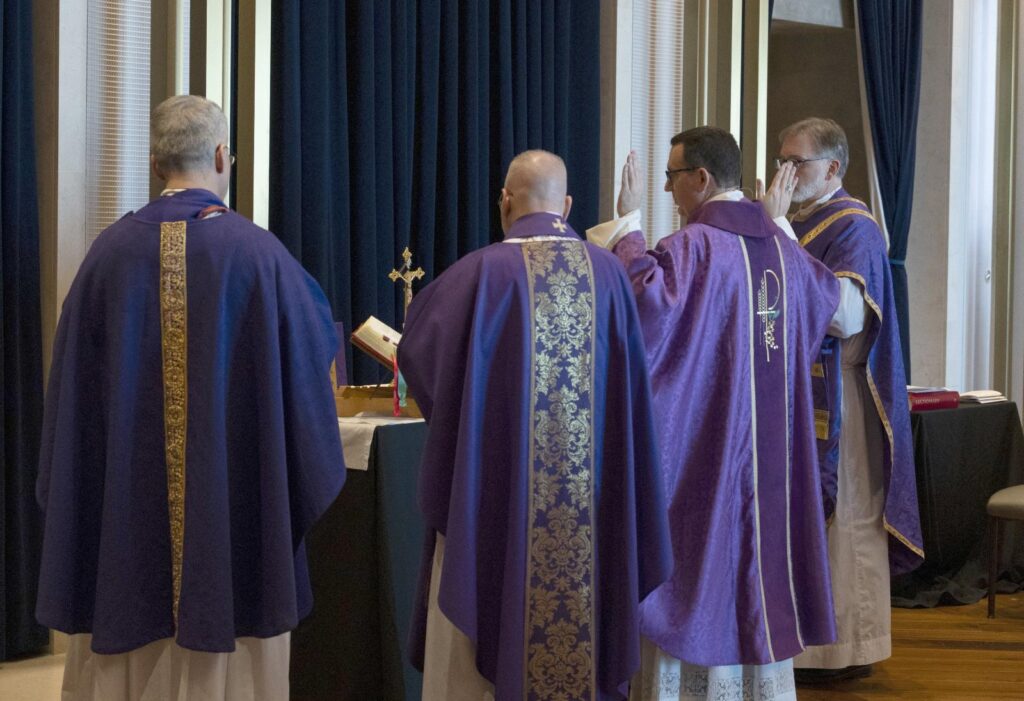
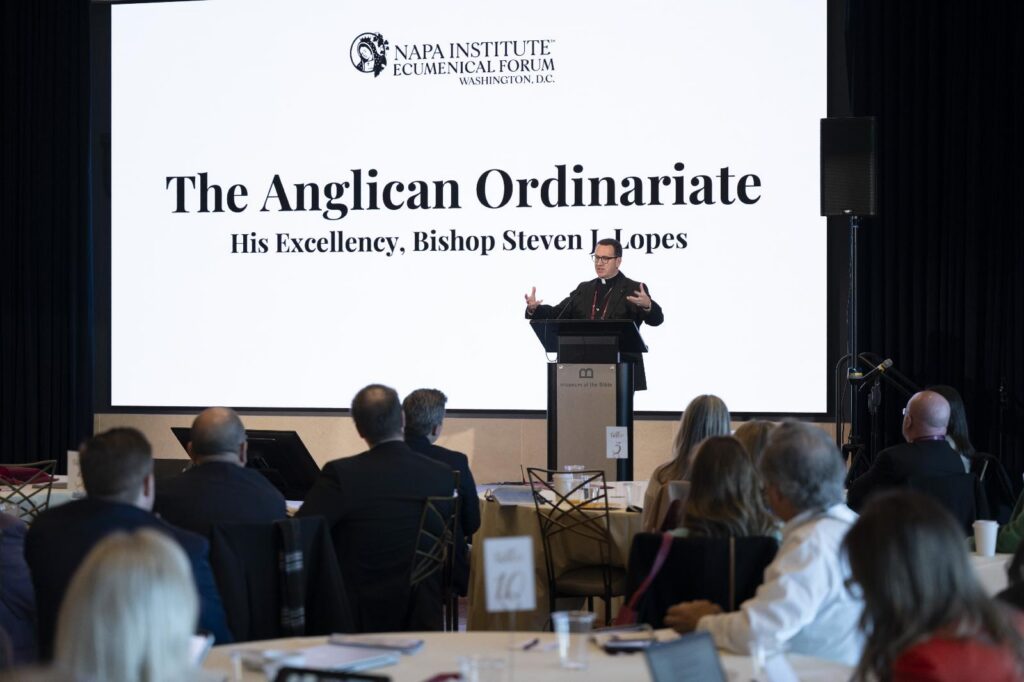
The Catholic Mass was celebrated by Bishop Steven J. Lopes — the first bishop of the Ordinariate of the Chair of St. Peter — according to Divine Worship: The Missal, which provides the liturgical form for Mass proper to the Catholic Church’s personal ordinariates for the Anglican tradition.
The Anglican Ordinariate: A bridge between traditions
Established under Pope Benedict XVI’s 2009 apostolic constitution “Anglicanorum Coetibus,” the ordinariates are kinds of Catholic dioceses that celebrate the Mass, Liturgy of the Hours, sacraments and other liturgies in traditional English according to liturgical books reflecting their Anglican heritage and approved under Pope Francis. The term “Anglican ordinariate” is a commonly used informal way to refer to these Catholic dioceses and their unique tradition.
In 2019, Pope Francis expanded the ordinariates’ mission to invite all Protestant Christians into full Catholic communion and enliven the faith of Catholics who had weakened or fallen away from the practice of the faith.
Prior to the Mass, Bishop Lopes, whose ordinariate consists of some 40 communities in the U.S. and Canada, provided a brief historical introduction on the “Anglican ordinariate.”
“It was a result of a movement among several Anglican bishops worldwide to approach the Holy See with a question of whether or not it was possible — as a fruit of the ecumenical dialogues — to come into full communion with the Catholic Church in some sort of corporate manner, and not leave at the door everything that brought you there,” he explained.
Ecumenical dialogue, Bishop Lopes noted, “is actually supposed to lead somewhere. And traditionally what we have said about that somewhere is full, visible, and sacramental communion of the Church: in order to be able to give the world that witness of the body of Christ enlivened by the Holy Spirit.”
Numerous non-Catholics took part in the Mass
Numerous forum participants took part in the Mass, including some from non-Catholic traditions.
“These are wonderful people, serious people — who take very seriously the Lord’s command to pray and to work that all might be one,” Bishop Lopes told OSV News, speaking of the day’s events. “It’s not just an ecumenical impulse that they share, but an ecumenical imperative — and it’s a beautiful thing to see and be part of.”
Alexei Laushkin — a co-host of the forum and CEO of the Kingdom Mission Society, who has spent more than 20 years building coalitions across America’s various Christian communities — agreed.
“In the 250 years of America’s founding, to have a gathering of Catholics and Protestants to seek Jesus’ teaching together is just so significant,” Laushkin shared with OSV News.
“In part,” he continued, “because we can be seeking first the kingdom of God, about some of the big issues that are impacting us — increased secularism; trying to reach others for the faith, as it relates to spreading the Gospel of Jesus Christ; and also strengthening our pro-life, sanctity of marriage, and care for the poor witness.”
Laushkin said he believes it’s a watershed moment.
“To have this together — with Napa hosting it — represents a milestone,” he said, “where we’re praying for unity, and increased friendship, and increased fruit between the two traditions.”
Kimberley Heatherington is an OSV News correspondent. She writes from Virginia.
