


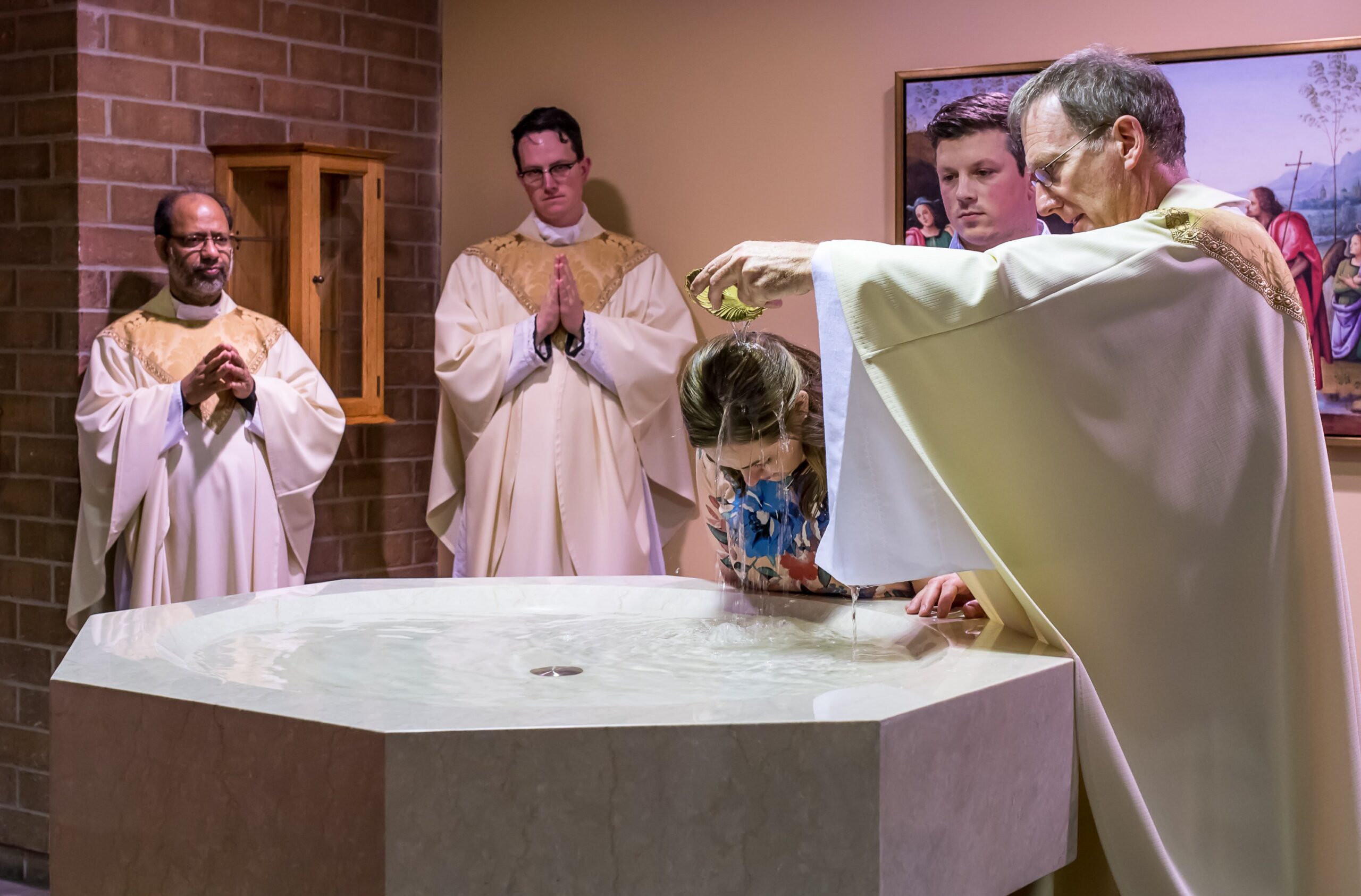
(OSV News) — While the religiously unaffiliated are on the rise globally, something curious is also happening: Some dioceses have reported significant upticks in adults preparing to enter the Catholic Church this Easter.
Sherry Anne Weddell, the co-founder and executive director of the Catherine of Siena Institute in Colorado Springs, Colorado, and an expert in Catholic evangelization, said that the “high point” of adult Catholics joining the Catholic Church in the U.S. was in 1999, with 172,000 adult baptisms and receptions.
“And then there was just a steady sort of decline,” she said.
That has since changed.
New increases
“There was significant growth between 2023 and 2024,” she told OSV News. And while the data for 2025 and 2026 have yet to be published, “the numbers that are being reported are getting bigger and bigger.”
The 2024 Official Catholic Directory reported that in 2023, 619,775 people entered the Catholic Church in U.S. Latin-rite dioceses. Of those, 77.6% were infant baptisms, 9.5% were baptisms of minors, 4.8% (29,752) were adult baptisms, and 8.1% (50,490) were receptions into full communion from another Christian tradition, which could include adults or minors.
In 2024, adult baptisms and receptions (adults and minors) increased again to 34,552 and 55,453, respectively, according to the 2025 Official Catholic Directory.
This year, the Archdiocese of Newark, New Jersey, is among dioceses reporting an uptick in Catholic conversions, with 1,701 individuals preparing to join the Church — a 30% increase since 2025, a 48% increase since 2024 and a 72% increase since 2023. Of those, 645 catechumens will celebrate the sacraments of baptism, Confirmation and Eucharist during the Easter Vigil on April 4 –a 14% rise since 2025, a 41% rise since 2024 and a 75% rise since 2023.
Father Armand Mantia, the archdiocese’s director of the Order of Christian Initiation of Adults — the Catholic adult initiation process — says the Church’s lasting stability contributes to the rising numbers.
“In this nebulous world of gray, the Catholic Church has offered some black and white,” he said. “They see in the Catholic Church a consistency in teaching, a consistency in values, a historical provenance and scriptural providence to what we’re doing.”
In Ohio, the Diocese of Cleveland has more than doubled its OCIA “class” since 2023. In Virginia, the Diocese of Richmond is touting a “record” 900 to be baptized at Easter. In Indiana, the Diocese of Fort Wayne-South Bend held its 2026 Rite of Election outside its cathedral — in a larger parish church — to also accommodate growing numbers.
In the Archdiocese of Boston, more than 680 catechumens plan to join the Church at Easter, an increase from last year’s 450, and previous years’ average of 250-300. Boston Archbishop Richard G. Henning “has been saying that there’s some sort of revival,” said Patrick Krisak, the archdiocese’s director of faith formation and missionary discipleship.
Pockets of revival
“There may not be a revival across the country, but there are revivals,” he said. “And at what point do all of those pockets of revival that we’re seeing all over the country add up to a revival?”
Krisak cited liturgy, certainty amid change and moral leadership as possible attractions. There is also old-fashioned rebellion, he said.
“There’s also the sense in which generations like to be countercultural,” he said. “If you’re rebelling against the folks who rebelled against the establishments, then you’re in some sense perhaps turning back to some aspects of the establishment.”
In the Archdiocese of Portland, Oregon, the one of the largest OCIA groups in recent memory attended this year’s Rite of Election, where catechumens present themselves to their local bishop as they begin their final preparations to join the Church.
The rise began in 2023, when the number was about 700. That grew to 1,000 the following year, then 1,200, and this year to 1,700 registered.
Last year, Archbishop Alexander K. Sample told the new converts it was their turn to bring someone to the Church. It appears to have made an impact, Father Randy Hoang, the Portland Archdiocese’s assistant director of the Office of Divine Worship, told OSV News.
“We are witnessing a broader renewal among our people,” he said. “Many are beginning to live what was once a largely private faith more openly in daily public life, and that witness is now bearing fruit.”
In the Archdiocese of Denver, catechumens jumped from 669 in 2022 to 936 in 2024. Andrew McGown, the archdiocesan executive director of mission and evangelization, said the Denver Archdiocese has indeed “seen a statistical increase, but when you average that out around our 120 pastorates, it’s really only three people per parish more than we had three years ago — so it’s not staggeringly larger numbers.”
However, he added: “What I know is happening in our parishes is that we have a considerably larger amount of energy being put into trying to offer programs, initiatives, events that are geared towards those who are not in the community.”
Several of the diocesan representatives who spoke with OSV News noted that their increased OCIA numbers are not attributable to a post-COVID postponement of sacraments, as that time has passed.
Campus revivals
Catholic ministries on college campuses are reflecting growth as well. St. Mary’s Catholic Center at Texas A&M University brought 70 people into the Church this past November, while at the University of Notre Dame, 125 new Catholics — the largest group there in at least 25 years — received the sacraments last Easter. This year, Notre Dame expects to surpass that number with 163 catechumens and candidates.
This past semester, Arizona State University’s Newman Center welcomed 52 students into the Church, and they are expecting 50 more for the 2026 Easter Vigil. The previous record for any year was 39 in 2019. Ben Power, the OCIA coordinator at ASU’s Newman Center, attributes that growth to “relationships and communities that are being built and spread across ASU’s campus.”
Reports of more adults joining the Catholic Church “is true not just in the U.S., but in significant parts of Europe,” Weddell said.
The Archdiocese of Paris will welcome 788 converts this Easter, its largest group ever. The Archdiocese of Westminster, England, reported its highest number of converts since 2011 and a 60% increase from 2025 to 2026. Dioceses in Belgium, Ireland and the Netherlands have also reported increased numbers of people joining the Church in recent years.
In the United States, some 92% of Catholics are “cradle Catholics” — people who say they were raised Catholic and also say they are Catholic when asked about their religion today. The remaining 8% are converts to Catholicism.
“What if, instead of 8 or 9%, we went to 20%?” asked Weddell. “It changes the dynamic.”
“Traditionally, almost all Catholics were cradle Catholics,” she explained. “We could be moving into a new kind of American Catholic culture, in which intentional Catholicism is much more common than inherited Catholicism.”
The Center for Applied Research in the Apostolate, a national, nonprofit research center that conducts social scientific studies about the Catholic Church at Georgetown University, counseled that reports of increased numbers of converts are still at this point anecdotal. The nation’s nearly 200 dioceses and archdioceses will not begin formally reporting 2025 sacramental data until early 2026, and those figures will only be publicly available with the release of the 2026 Official Catholic Directory later this year.
And yet, “There’s this growth in the numbers,” affirmed Weddell, who visits dioceses from coast to coast. “Many of the parishes I’ve talked to say, ‘Yeah, we’re seeing it — in our own small way.'”
Kimberley Heatherington is an OSV News correspondent. She writes from Virginia. OSV News staff contributed to this story.
