


(OSV News) — A New York state bishop has echoed a recent call from the nation’s Catholic bishops to respect God-given human dignity, regardless of immigration status.
“As a nation, we know in our hearts that we can and should do better. As Christians, we must,” said Bishop Michael W. Fisher of Buffalo, New York.
The bishop publicly released his pastoral letter “Once Aliens, Too” Dec. 1, having shared it with clergy Nov. 28 ahead of the first Sunday of Advent.
Nov. 26 shooting of Guard members
Addressing clergy, he also acknowledged the “horrible tragedy” of the Nov. 26 shootings of two West Virginia National Guard members on duty in Washington — an attack that killed one and critically wounded the other — by a suspect who is an immigrant from Afghanistan.
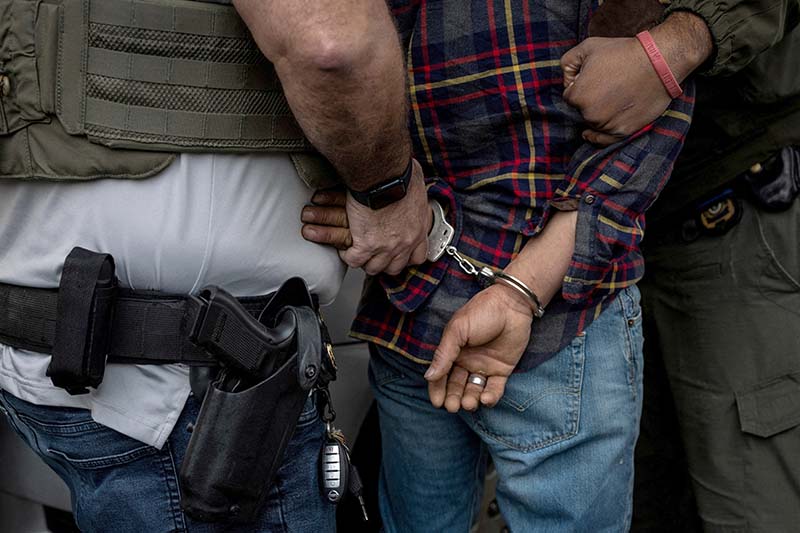
Bishop Fisher’s letter — drawing extensively on Scripture, multiple papal documents and Catholic social teaching — joins a growing chorus of statements and messages stressing the need to uphold human rights amid the Trump administration’s crackdown on unauthorized immigration, which has included sweeping enforcement raids and third-country deportations.
As of Nov. 16, well over 65,000 individuals are in ICE custody, with 73.6% of those detained having no criminal conviction. Many of those with convictions were responsible for minor offenses such as traffic violations, according to Syracuse University’s Transactional Records Access Clearinghouse.
Other bishops’ messages in immigration
The U.S. Conference of Catholic Bishops approved a special pastoral message on immigration Nov. 12 amid their annual fall meeting in Baltimore, with the Catholic bishops of New York state releasing a separate message Nov. 13 entitled “For You Too Were Once Aliens,” a title referencing the divine command in Leviticus 19:33-34 to care for the alien and the stranger.
Bishop Fisher’s pastoral letter, along with the USCCB and New York State Catholic Conference messages, all point to Catholic social teaching on immigration, which balances three interrelated principles — the right of persons to migrate in order to sustain their lives and those of their families, the right of a country to regulate its borders and control immigration, and a nation’s duty to regulate its borders with justice and mercy.
Bishop Fisher noted in his letter that he sought to offer “some personal perspective” on the recent USCCB message, which condemned the “indiscriminate mass deportation of people” and the “dehumanizing rhetoric and violence” against immigrants, while describing condemnation of law enforcement officers acting within their proper authority as “unacceptable.”
Chapter 25 of Matthew’s Gospel
He began by quoting from the 25th chapter of Matthew’s Gospel, in which Christ judges the nations based on their works of kindness and mercy.
“In terms that the merest of children can understand, Jesus details what it means to be a faithful follower and the reward which awaits those concerned with the well-being of others,” wrote Bishop Fisher. “In demonstrating love and care for the most vulnerable — and compassion toward society’s outcasts — we serve Christ Himself.”
While “the bishops are under no illusions about the complexities involved with reforming our nation’s immigration system,” and “fully accept” that the government has a duty to secure the nation’s borders, “the requirement to act with charity toward friend and stranger alike, however, takes precedence over all other imperatives,” said Bishop Fisher.
He said that Catholic social teaching — which articulates the living out of holiness while building a just society — “begins with the premise that every person, regardless of nationality or legal status, possesses inviolable dignity and fundamental rights.”
Inherent rights of working class
Bishop Fisher cited Pope Leo XIII’s 1891 encyclical “Rerum Novarum” as a “foundational teaching on the inherent rights of the working class,” one “which also asserts the right of people to migrate, particularly when deprived of the dignity of having access to life’s basic necessities.”
Quoting the encyclical, Bishop Fisher said that Pope Leo XIII directly condemned “the ideas of the totalitarian and the imperialistic state, as well as that of exaggerated nationalism.”
The bishop also cited Pope Pius XII’s 1952 encyclical, “Exsul Familia Nazarethana,” which he said “evoked the Holy Family’s exile in Egypt as a model for all refugee families, as well as the Church’s duty to care for migrants, regardless of the reasons for their displacement.”
Quoting Pope Pius XII — who warned of the dire consequences of neglecting migrants’ spiritual and material needs — Bishop Fisher added, “There never has been a period during which the Church has not been active in behalf of migrants, exiles and refugees.”
‘True brothers and sisters’
“Catholics are to regard migrants not as strangers but as true brothers and sisters,” he said.
The bishop said St. John Paul II had “further amplified” that requirement, stating in his 1996 message for World Migration Day that “for Christians, the migrant is not merely an individual to be respected in accordance with the norms established by law, but a person whose presence challenges them and whose needs become an obligation for their responsibility.”
Pope Francis had “issued a rebuke and call to action” in the 2020 encyclical “Fratelli Tutti,” which “made clear that the moral stature of a society is measured by how it treats the vulnerable,” said Bishop Fisher.
Pope Leo XIV has carried that message forward, with his first apostolic exhortation, “Dilexi Te” recalling “the long history of the Church’s requirement to show preference for the poor and demonstrate compassion toward immigrants,” said Bishop Fisher.
Advent, during which “our hearts and minds are filled with expectation of the One who comes to us disguised as a vulnerable child from a distant place,” prompts renewed reflection on “our obligations to ‘the stranger’ among us,” said Bishop Fisher.
“Mindful that our ancestors were also ‘once aliens’ in need of compassion, care, and opportunity, we must speak out for those who desire only the same,” he wrote.
Gina Christian is a multimedia reporter for OSV News. Follow her on X @GinaJesseReina.
