


(OSV News) — On the eve of his final day in France, the Vatican confirmed that Pope Leo XIV held a private meeting in Lourdes with seven victims of sexual abuse.
According to a statement by the Vatican press office Sept. 27, the survivors — four men and three women — were accompanied by Bishop Gérard Le Stang of Amiens, president of the Council for the Prevention and Fight Against Pedophilia of the French bishops’ conference.
“The pope met with each of them individually and privately, listening to their stories, to the pain and suffering they experienced — sometimes, unfortunately, with the complicity or silence of those who could have helped them — and to their proposals to ensure that this never happens again,” the Vatican said, adding that with some, “he paused for a few moments in prayer.”
After meeting with each victim, the pope met with them together and thanked them “for their painful testimony.” The Vatican also said he reaffirmed his “commitment to ensuring that the evil they experienced is not repeated for others.”
“Pope Leo expressed his closeness to them and, through them, to all those who have suffered and still suffer from the wounds of the abuse they endured,” the statement read.
Before concluding the meeting with a blessing, Pope Leo asked the group of survivors to pray for him and expressed his hope of “being able to work together so that the community of the faithful may increasingly become a place where men and women of all ages can find comfort and healing.”
Five of the survivors were scheduled to speak at an invitation-only press conference in Lourdes after the meeting, with attendees selected by the victims themselves; the other two participants chose to remain anonymous.
Asked about the significance of the papal meeting with abuse survivors in Lourdes — long regarded as a place of healing for those who suffer — Antonia Sobocki told OSV News she saw the encounter as a “wonderful” sign.
“I hope this is the catalyst which begins a journey of healing and peace for people injured by abuse,” she told OSV News Sept. 27 after leaving the Lourdes meadow where Pope Leo celebrated Sunday Mass.
“We cannot give back everything taken by abuse, but just because we cannot give back everything, does not mean we cannot give back anything,” she said. “And what we can give back, although so little by comparison to what has been taken, means so much to those who have suffered sexual violence and then the re-abuse of being disbelieved.”
A survivor of abuse outside the Church, Sobocki, who is Catholic, went on to found LOUDfence, an advocacy initiative that supports victims of clerical sexual abuse.
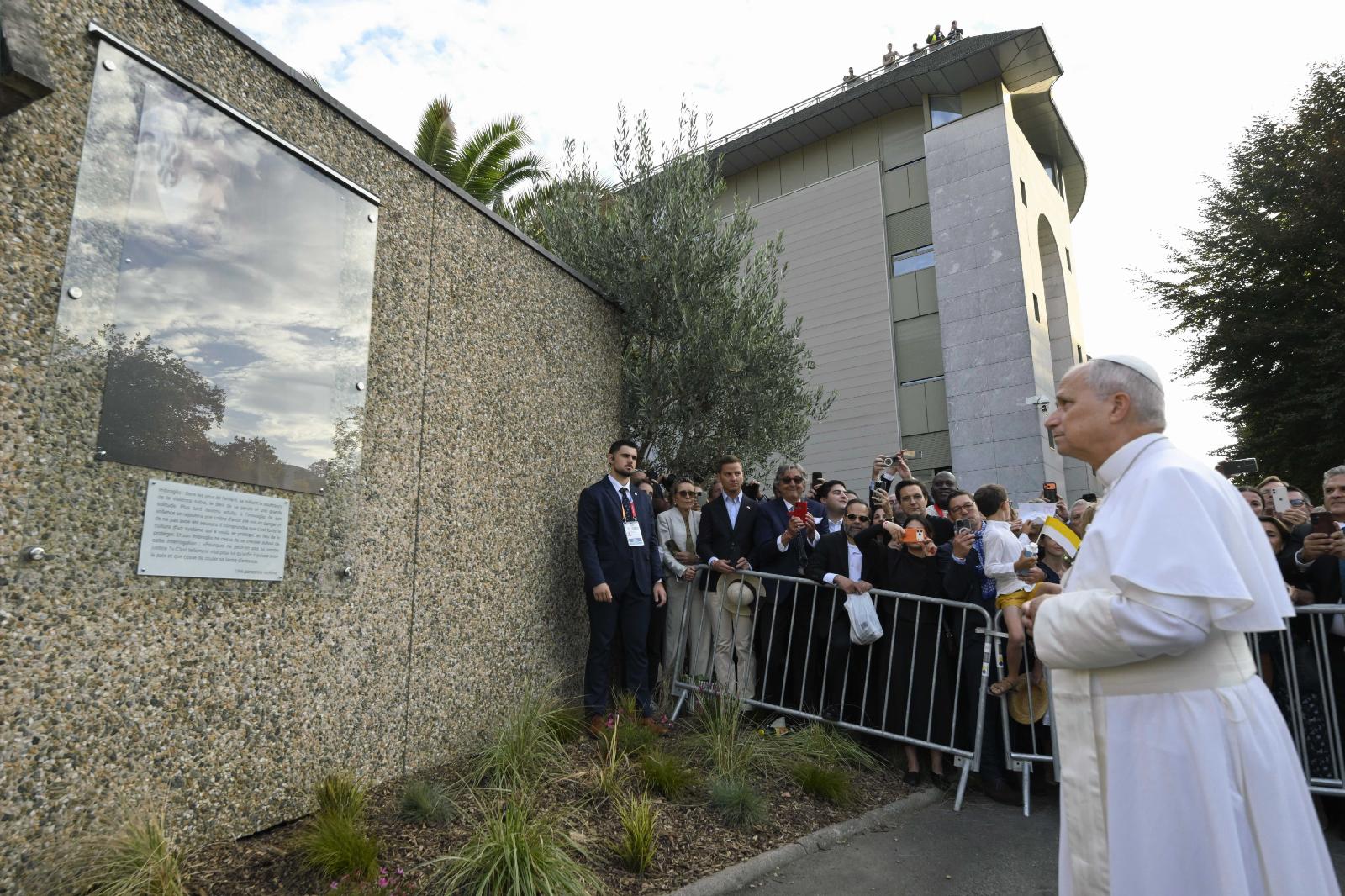
Earlier in the day, before meeting the bishops of France, the pope stopped briefly to pray in front of a commemorative plaque dedicated to victims of clergy sexual abuse.
The plaque featured an inscription signed by “a victim” that described the pain abuse survivors endured from childhood into adulthood, and the anger felt “at having been placed in danger and left unrescued.”
“They will come to understand that an entire institutional culture chose to protect itself instead of protecting them,” the inscription read.
Pope Leo to French bishops: continue safeguarding path, remain vigilant
During his meeting with the country’s bishops, Pope Leo acknowledged their efforts in facing “with determination the painful scourge of abuse” in the Church.
“You have taken courageous measures to respond through listening, the search for truth, justice, forgiveness and making amends, and through a firm commitment to a culture of prevention and protection against these crimes,” the pope said.
Thanking the bishops, Pope Leo encouraged them to “continue along the path you have begun” while “maintaining the greatest vigilance.”
The Catholic Church in France implemented widespread safeguarding reforms and financial compensation protocols since the 2021 release of a landmark report by the Independent Commission on Sexual Abuse in the Church, known as CIASE.
Bishop Pierre-Antoine Bozo of La Rochelle, spokesperson for the French bishops’ conference, told journalists Sept. 27 that the pope’s private meeting with victims showed that the Church “cannot ignore this issue, and it must always remain among our concerns.”
Several survivors’ associations in France, however, criticized the decision to select individuals rather than representatives of established organizations to meet with the pope.
The French bishops’ conference spokesperson pushed back on the criticism, noting that “two of the seven names that came to us were people we did not know, who came to us through the groups and associations.”
Bishop Bozo also said inviting so many groups to the meeting would have created a “very, very large format” and would not have the same impact as a smaller meeting.
“What helps us in accompanying victims is listening to them. And to listen to them, you cannot have 50 people in front of you. So that is truly what the pope wanted,” the bishop said. “So, I think what the pope chose was truly that: to listen in order to act and react better.”
Sobocki added that, “No one speaks for all survivors.”
“One in three girls and one in six boys will experience abuse,” she told OSV News. “That’s a huge number of people and they are not one homogeneous group. The survivors meeting Pope Leo have thoughts and feelings just as valid as the groups who feel they were excluded.”
Major reform in the Church in France accelerated by public scrutiny
In 2019, in the wake of mounting public scrutiny, the Catholic Church in France was forced to confront the scale of the sexual abuse crisis, prompting the bishops to establish CIASE.
In October 2021, the independent commission released its final report, which revealed that an estimated 216,000 children were sexually abused by clergy and religious workers between 1950 and 2020. The figure increased to some 330,000 victims when factoring in those abused by laypeople employed in Catholic schools, youth groups and parishes.
According to the report’s executive summary, “the Catholic Church’s immediate reaction was to protect itself as an institution” and showed “complete, even cruel, indifference to those having suffered abuse.”
In the wake of the report’s revelations, the French bishops established the National Independent Authority for Recognition and Reparation, known as INIRR, to process claims of abuse and provide compensation to abuse survivors.
The INIRR concluded its mandate Aug. 31, and the country’s bishops created the National Independent Authority for Supporting Victims in the Church, an independent and permanent national body to support victims and survivors of abuse.
Nevertheless, in recent years, the Church in France has had to deal with the fallout of several high-profile revelations of abuse, including the late Jean Vanier, founder of the L’Arche communities, who, after his death, was found to have abused at least 25 women between 1950 and 2019.
L’Arche was the first to publicly disclose the allegations against Vanier, and published extensive reports detailing the findings of its investigation.
Another high-profile case was that of the late Abbé Pierre, the famed priest known as a staunch advocate of the poor, who was accused of sexually harassing and assaulting dozens over several decades.
According to The Associated Press, one of the survivors meeting with Pope Leo was a victim of abuse at the hands of Abbé Pierre.
Mosaics by alleged abuser covered in Lourdes
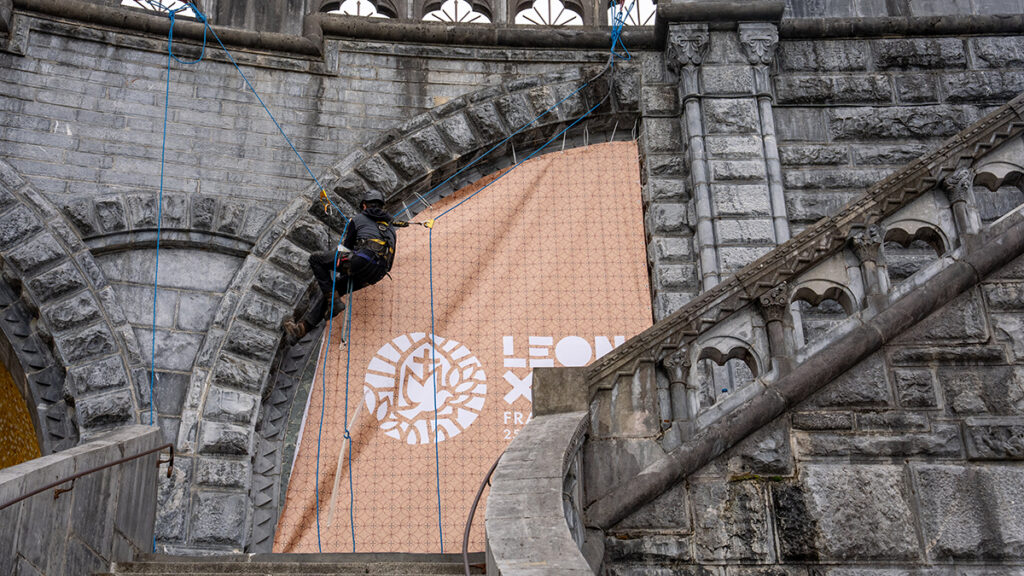
Pope Leo’s visit to the Basilica of Our Lady of the Rosary in Lourdes also drew attention to the alleged abuses by Slovenian Father Marko Ivan Rupnik, whose mosaics once adorned the basilica’s facade.
In the wake of the ongoing canonical trial against the priest, who is accused of sexually and spiritually abusing more than two dozen women over several decades, Bishop Jean-Marc Micas of Tarbes and Lourdes ordered the mosaics above the entrance to be covered in March 2025.
The rest of the mosaics across the church’s facade were completely covered a week before the pope’s arrival in France.
When journalists asked whether the French bishops’ conference agreed with Bishop Micas’ decision to cover the mosaics, Bishop Bozo said the conference “cannot comment on the decision of the bishop of Lourdes.”
However, he noted, Bishop Micas made “a good choice,” and it was clear that displaying the controversial priest’s artwork “was no longer possible” because “it created such a symbolic burden for the victims.”
The bishop also said covering the mosaics “had to be done” because having them displayed made it difficult to make those who suffer, especially abuse survivors, feel welcome at Lourdes.
“I think covering them is a first step,” Bishop Bozo added, “Afterward, a new work will need to be proposed.”
Sobocki told OSV News that covering the mosaics was “in response specifically to the Rupnik case, but the impact this action has is for victims everywhere. This is a gift of care and solidarity for millions of people who have been impacted by this grave injury.”
Five of Father Rupnik’s alleged victims penned an open letter Sept. 23 to Pope Leo ahead of his visit to Lourdes, noting the significance that he will meet with “victims of abuse like us, in a place where Father Rupnik’s mosaics will no longer be visible on the basilica’s facade.”
The survivors urged the pope for transparency, highlighting that they had received no updates regarding the priest’s canonical trial, as well as the “public ridicule and defamation” they faced after revealing the alleged abuses they suffered.
“Because we, Your Holiness, have lost all trace of justice, and because a trial conducted in oblivion offers no guarantees to anyone — neither to the accused nor to the victims — and is irreconcilable with the very concepts of law, truth, justice, fairness, and mercy that you, Your Holiness, hold dear,” they wrote.
Junno Arocho Esteves is an international correspondent for OSV News. Follow him on X @jae_journalist.
