


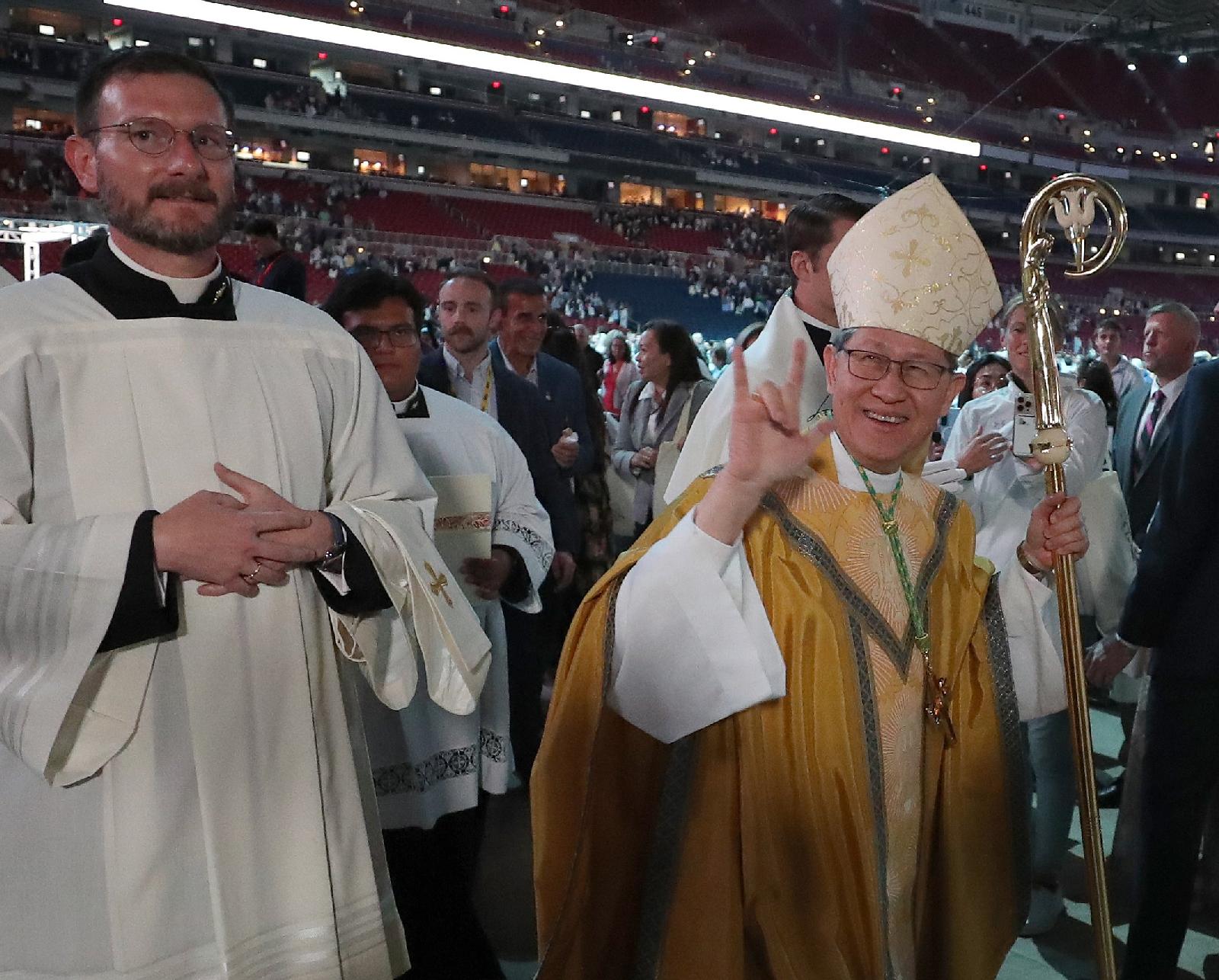
(OSV News) — The following is the full text of Cardinal Luis Antonio Tagle’s homily at the Sept. 24 beatification Mass for Blessed Fulton J. Sheen in St. Louis. Cardinal Tagle serves as a pro-prefect in the Holy See’s Dicastery for Evangelization, leading its Section for the First Evangelization and New Particular Churches, and is the archbishop emeritus of his native Manila, Philippines. The cardinal presided over the beatification Mass as Pope Leo XIV’s delegate.
Dear brothers and sisters,
We thank our loving God — Father, Son and Holy Spirit — who has gathered us as a family of faith on the solemn occasion of the beatification of Archbishop Fulton J. Sheen, son of Illinois, son of the United States of America, indeed, son of the world.
I bring to you the paternal greetings of His Holiness, Pope Leo XIV, who rejoices at the beatification of his fellow countryman, his fellow Illinoisan, and brother bishop. Let us pray for the Holy Father’s pastoral visit to France, which starts tomorrow.
Pope Leo’s apostolic letter declaring that Archbishop Fulton Sheen may henceforth be called “Blessed,” describes the archbishop as a tireless preacher of the Gospel through the modern means of communication, and a diligent shepherd animated by missionary zeal. What a description.
Among many of his virtues and ministries, two stand out: his being an evangelizer or proclaimer of the Gospel, and his being a missionary shepherd.
It is not surprising that the three liturgical readings for today’s Mass highlight the mission of evangelization. It is for being a zealous and creative evangelizer and advocate for mission that Fulton Sheen is called “blessed,” or “fortunate” or “happy.”
Please look happy. We are in a beatification. “Beato,” “beata,” blessed, fortunate, happy. But some of us might be wondering what is “blessed” or “blessed” or “fortunate” or “happy” about proclaiming the Gospel and going on mission?
Many of the evangelizers and missionaries from the beginnings of the Church up to our time have suffered rejection, even persecution. So why declare Fulton Sheen a blessed?
Oh, maybe he is blessed because he was a radio and television celebrity, a renowned writer followed by millions of admirers, and a global traveler when he served as the national director of the Society for the Propagation of the Faith.
So, is he blessed, or blessed, because he is famous? What blessedness, thus, the missionary evangelizer, Archbishop Fulton Sheen, shared with us.
Among many aspects of blessedness, let me focus on two, indicated by our liturgical readings and confirmed in the life and mission of blessed Fulton J. Sheen. So only two points.
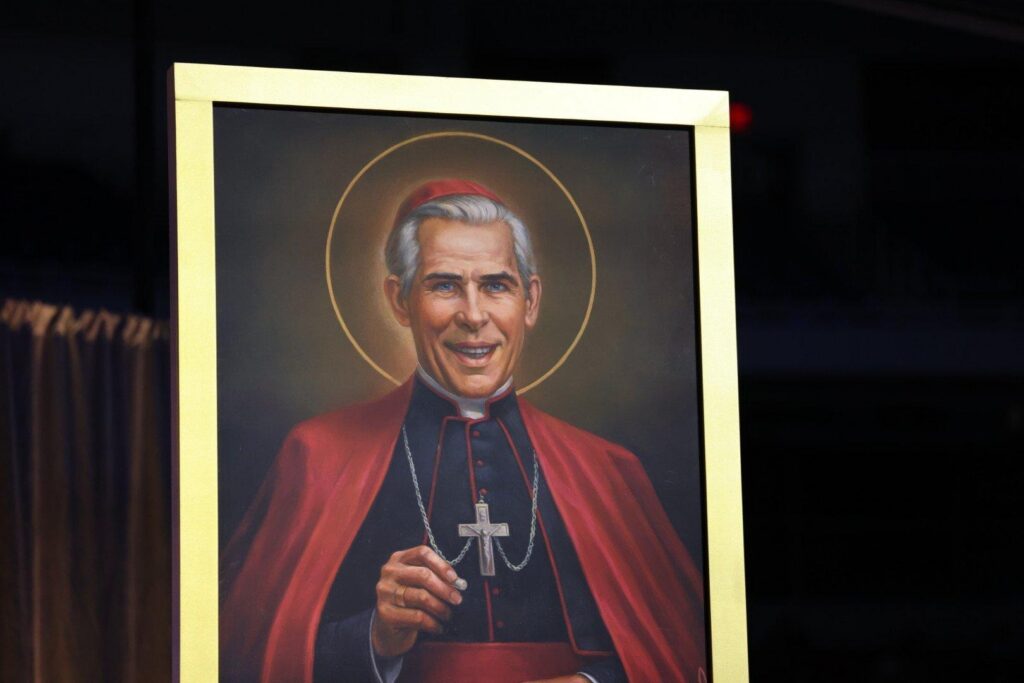
First, the missionary evangelizer is truly blessed, fortunate and happy because of the gift of communion with Jesus. That’s the root of blessedness: communion with Jesus.
As the Gospel clearly states, the risen Lord chooses and sends his friends to proclaim the Gospel to every creature. Blessed are you to be seen, chosen and sent by the Lord himself.
To choose yourself and to go wherever you want to go is not mission, and it is not blessedness.
Dear priests, blessed are you when you tell the good news of Jesus to all people. St. Paul in the second reading is blessed because he does not preach himself, but rather Jesus Christ as Lord.
To preach your own wisdom, rather than that of Jesus, is falsifying the Word of God, according to St. Paul. And it is not mission. It is not blessedness.
Blessed and beautiful are your feet when you announce God’s salvation and peace, according to the prophet Isaiah in the first reading.
To journey on land, water and air while proclaiming destructive words and doing violent acts is not mission. It is not blessedness.
Blessed are you when the risen Lord works with you and confirms the Gospel you preach through his miraculous signs.
To be self-sufficient and self-affirming — “congratulations to myself” — that is a bad sign. It is not a miraculous sign. It is not mission. It is not blessedness.
A missionary evangelizer, therefore, is known by Jesus and is called to know Jesus and his Gospel, is called to labor humbly with Jesus. And in the process, a missionary evangelizer gets to know oneself — himself or herself — in Jesus.
Blessed are you when Jesus sees you, knows you, calls you, sends you, and labors with you.
Blessed are you when you come to know your true self and mission because Jesus knows you and you know Jesus. Blessed are the authentic missionary evangelizers.
During an audience, Pope Pius XII once asked Bishop Sheen how many conversions he could claim as his own, we should say, success story. How many conversions could you claim?
He answered the pope, and I quote, “I really have not counted in order not to have the temptation to believe that they were mine.” Then he added that he saw himself, and I quote, “Simply as a porter who is sometimes able to lead people to the open door of the house of God. I have had some success as a porter.”
Blessed are you, porter to the house of God’s house!
Once asked by a friend why he became a priest, he replied, I was called to tell this story, the Gospel, the story of Jesus. I never tire of telling it. I never tire of improving my telling of it. I love my calling.
O, blessed are you, storyteller of Jesus, encountered in his Word, in the Eucharist, in the Holy Hour, and in his body, the Church. Blessed Fulton J. Sheen.
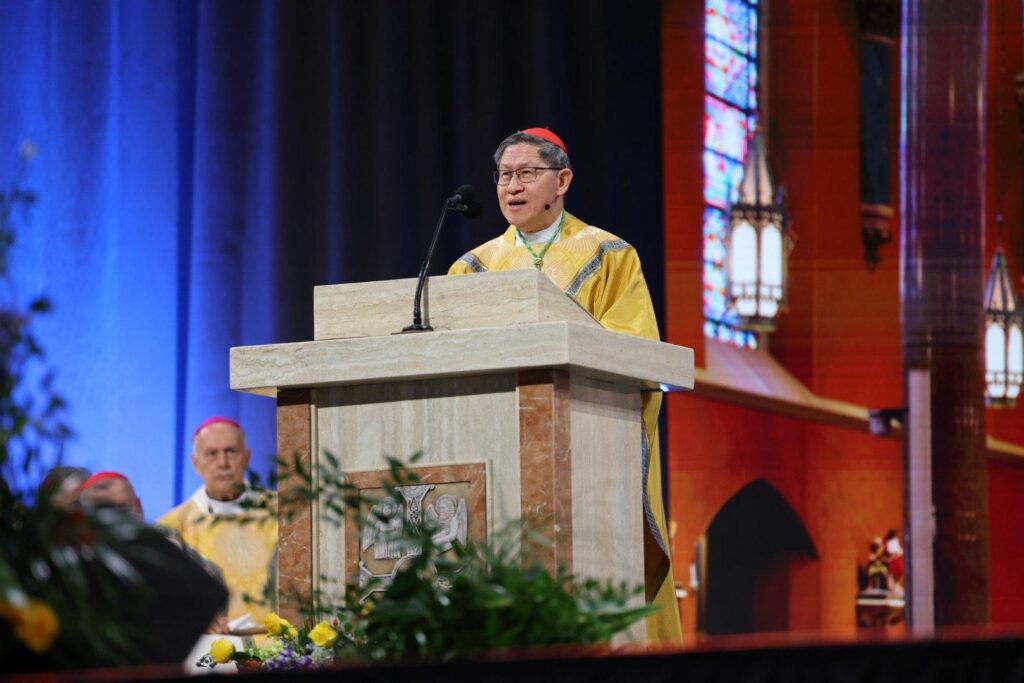
I now come to the second and final point. The second aspect of the blessedness of a missionary evangelizer is this: The missionary evangelizer is blessed by the communion with persons and peoples, especially the poor and the vulnerable, and this is communion in the name of Jesus Christ in the Gospel.
The risen Lord sends his disciples to preach the Gospel to every creature — not to an abstract world or society, every creature. And those who believe and are baptized will be manifested even to the evangelizer the marvelous signs of the presence of the Kingdom of God.
To use preaching as an excuse to avoid concrete persons and to be blind to God’s action in them is not mission. It is not blessedness.
Blessed are you when, like St. Paul, you count yourself as the people’s slave, servant, for the sake of Jesus. To dominate over others and to make your importance felt is not mission, it is not blessedness.
Blessed are you when you count yourself as an earthen vessel so that the power may be of God and not from you, as St. Paul says in the second reading.
To preach the Gospel from a posture of self-righteousness that prevents you from empathizing with other people’s brokenness is not mission. It is not blessedness.
Archbishop Fulton Sheen shared with a friend an observation that there are priests today, and I quote, “who behave as though they are administering the sacraments to anonymous groups of people with no thought of their individual identity.”
So he prefers that we know, get to know, each person. Now, which groups of people often remain more anonymous, ignored and forgotten than others? The poor. The poor people.
In this address at the third session of the Second Vatican Council on the ninth of November 1964, Bishop Sheen stated, and I quote, “I beg you most earnestly, venerable fathers, that the notion of poverty be strongly affirmed in this council. Put your finger on the 30th parallel. Run it around a globe of the earth. What do you find? Practically all the prosperity is above the 30th parallel, and the greater part of the poverty of the world is beneath the 30th parallel, that is, in Africa, Asia and Latin America. The greater number of bishops in this council is living in want or in persecution. And they come from all peoples and all nations. As only a wounded Christ could convert a doubting Thomas, so only a Church wounded by poverty can convert a doubting world.”
Wow. The good bishop echoed and expanded these ideas in a television conference recorded in 1967, serving almost like an examination of conscience and of lifestyle. And he took up his own challenge by giving to the poor whatever remunerations he received from his various commitments and by animating the missionary commitment of the Church in the United States towards the poor churches of the world.
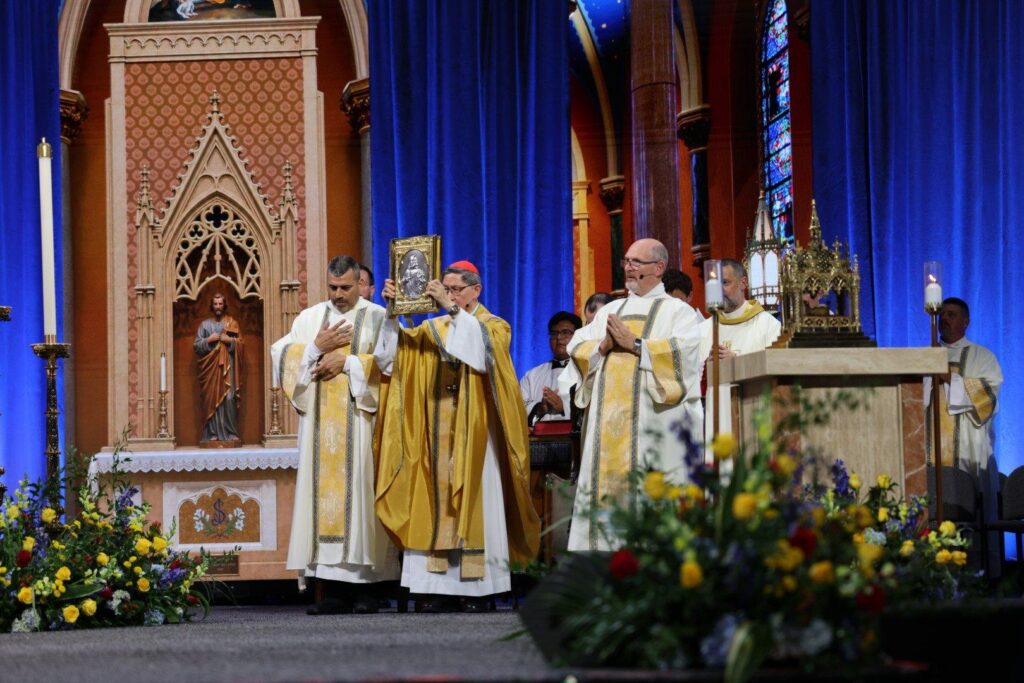
For Archbishop Sheen, caring for the poor was not ideological propaganda, but an imperative for the following of Christ, of the joining of the Church and the missions, and of the conversion inspired by the Holy Spirit.
Let me close with a story narrated by Archbishop Shin himself in his conference titled “30th Parallel” recorded in 1967. He recounted his visit to a place in Buluba in Uganda. That place housed 500 people afflicted with leprosy. He brought silver crosses as a gift to each one.
The first person who approached him had already lost his lower arm and hand to leprosy. But on the stump of his upper arm hung a rosary. The man extended his other hand to receive the gift, the cross.
When Bishop Sheen saw the corrupted flesh of the hand, he shivered in fear. And he dropped the cross on what is left of the hand of the man. But immediately the bishop realized how inconsistent his action was with the gift that he was giving. The cross spoke of Jesus who became vulnerable to give new life to sinners, to the sick and to the dead.
Jesus touched people afflicted with leprosy during his ministry. Why can’t he, Archbishop Fulton Sheen, do the same?
Embracing the vulnerability of Jesus, Fulton Sheen touched and held the damaged flesh of the vulnerable people with leprosy, counting himself as one of them, “the 501st person with leprosy,” he said.
Blessed is the earthen vessel that draws power from Jesus. Blessed is the evangelizer converted by beholding and touching the wounds of the risen Christ in wounded brothers and sisters. Blessed is the missionary who digs deep into the heart of the poor to meet Jesus there.
Blessed Fulton J. Sheen.
