


PALM BEACH GARDENS, Fla. (OSV News) — Pope Benedict XVI understood it. He knew that sexual abuse in the Catholic Church is not just an individual act of sin. It is a threat to faith itself.
It was from that serious foundation that Bishop Manuel de Jesús Rodríguez of Palm Beach spoke July 24 in the Family Life Center of the Cathedral of St. Ignatius Loyola at an event titled, “Let’s Talk About Listening to Victims.”
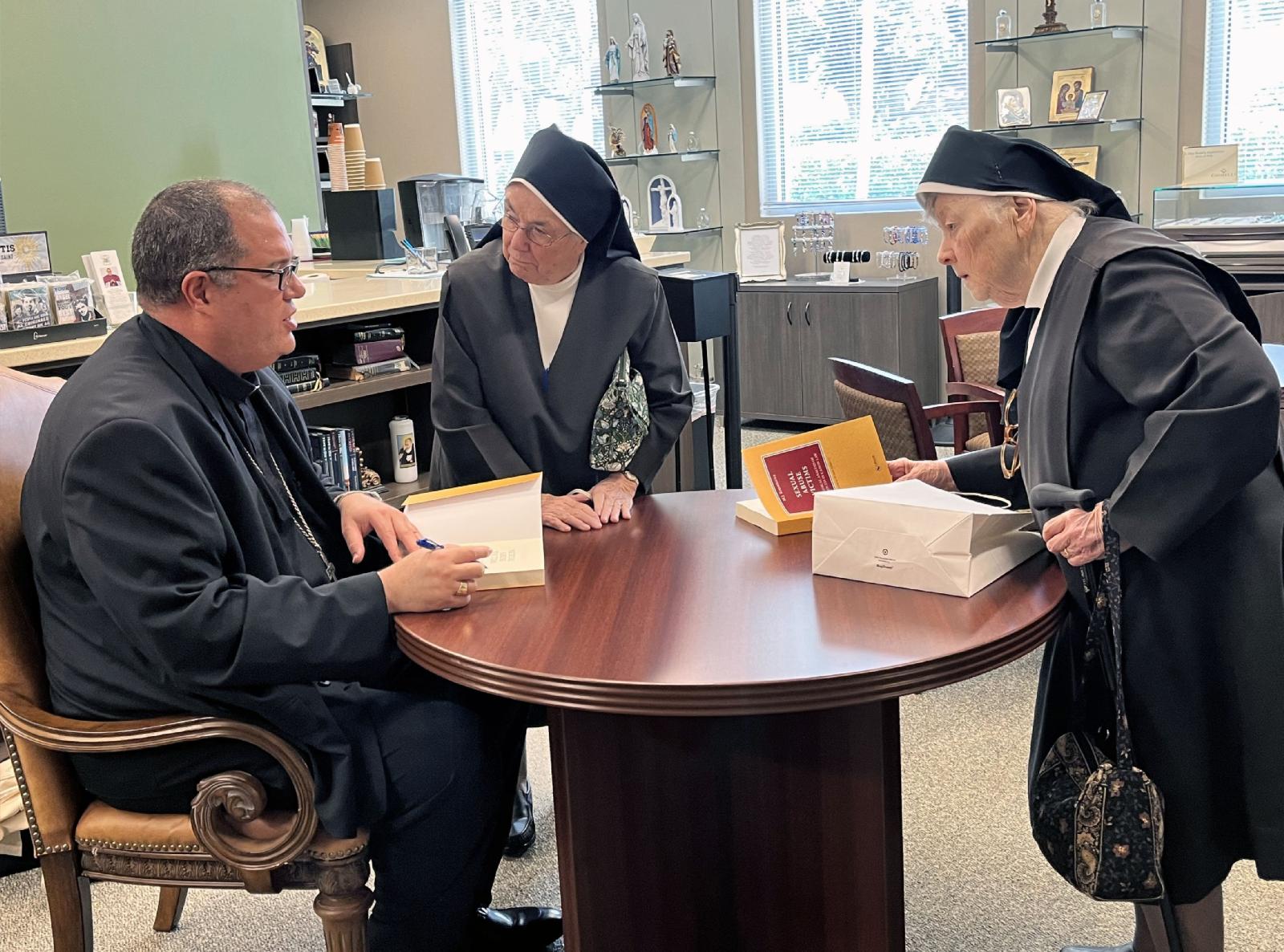
Copies of the bishop’s newly released book, “Sexual Abuse Victims: A Juridical Analysis of Due Process in Canon Law,” were available for purchase, with proceeds going toward diocesan safe environment programs.
Other speakers included Father Kevin McQuone, associate dean for propaedeutic and discipleship formation at St. Vincent de Paul Regional Seminary in Boynton Beach; Elizabeth Harris, retired New York Police Department detective in the Manhattan special victims squad and current victim assistance coordinator for the Diocese of Brooklyn; and Gina-Marie Loree, chief safeguarding officer for the Diocese of Palm Beach’s Office for the Protection and Safeguarding of the People of God.
‘Sacramentorum Sanctitatis Tutela’
Recalling the work of then-Cardinal Joseph Ratzinger, whom Bishop Rodríguez credited with helping promulgate “in 2001, what is known as the first-ever canonical law addressing the sexual abuse of minors,” “Sacramentorum Sanctitatis Tutela,” the bishop said Pope Benedict prophetically saw the seriousness of sexual abuse in the Church.
“The problem that we are handling here, my dear sisters, my dear brothers, is not only the problem of some individuals that have been victimized by priests, deacons or Church representatives,” Bishop Rodríguez said.
“What we are dealing really about here is with the future of our faith and the future of our Church,” he said. “Because tell me, who is going to believe in a God who is preached by someone who, after Mass, is going to abuse kids? Who is going to believe in that God?”
Sexual abuse “is a threat to the very existence of faith itself,” the bishop said.
‘Legal protection of the value of faith’
“Therefore,” he continued, “we must protect faith by ensuring the appropriate legal protection of the value of faith, to the good which is faith itself, and that’s why we’re here because we believe that our Church and our faith must be protected, and we need to convey to everybody, to the entire world, that the Catholic Church does not condone sexual abuse, and that the Catholic Church is not ever on the side of those who abuse people, namely kids, children, adults, vulnerable adults, anybody.”
The reason for the day’s presentation and writing his book, he said, was to safeguard people but also to protect the Church. “If we don’t do that, faith will disappear. People will no longer believe. Why should they? Why should they? If those who are in charge of faith are just doing criminal stuff against the most vulnerable,” he said.
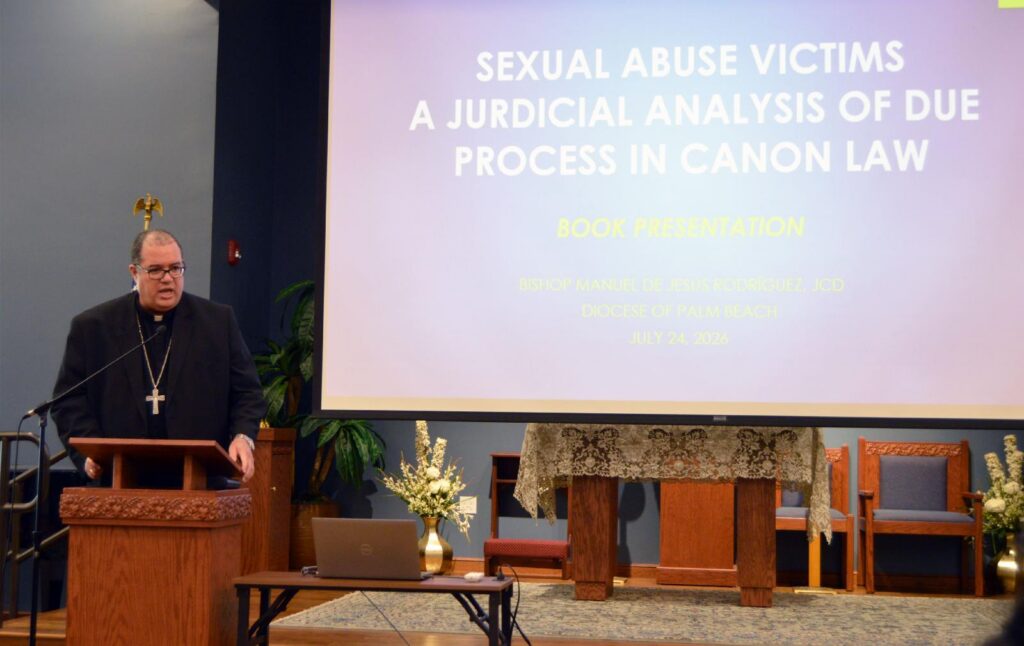
Writing his book, which was originally his doctoral dissertation, Bishop Rodríguez, who is a canon lawyer, collaborated with experts in canon law and the issue of sexual abuse in the Church. He analyzed the application of civil laws on sex abuse cases in the United States, Chile, France and Nigeria. One concept that underpinned his book and ministry is that victims are to be believed.
It’s a misconception among some that those who claim to be victims, he said, “are doing so only for the money associated with it, or with an agenda of being recognized publicly, or having a secret agenda as the true motivation of them coming forward.”
Church’s legal system, credibility of abuse cases
While acknowledging that some may falsely claim to be victims, his work is based on “true victims, people that have been harmed, that have been credibly targeted for sexual pleasure, for sexual reasons, as victims of different types of misconduct, criminal behaviors that happen on some occasions within an ecclesial context, perpetrated by representatives of the Church,” Bishop Rodríguez said, adding that the Church’s legal system is there to determine the credibility of a victim’s case.
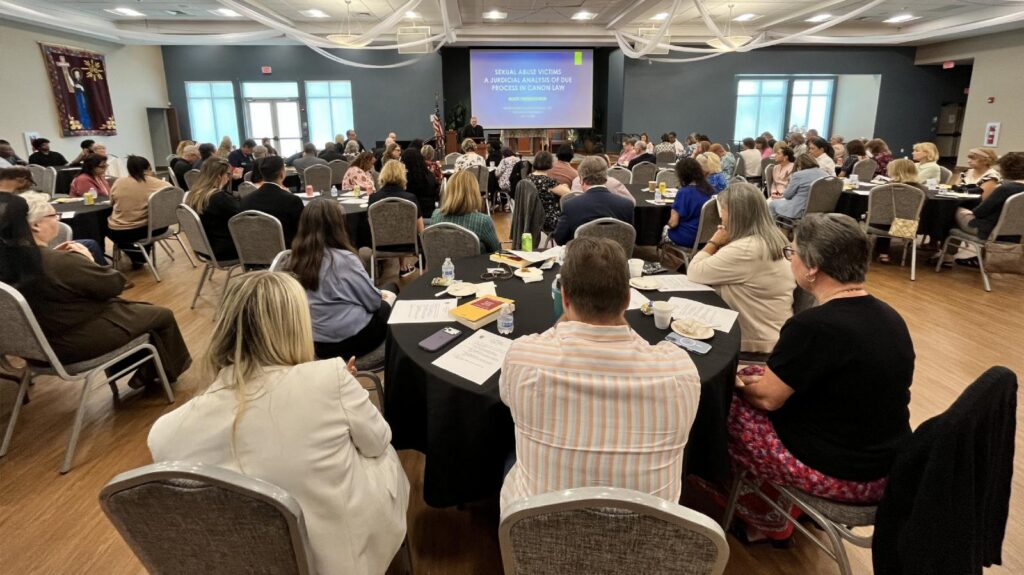
Harris, speaking in New York via Zoom, picked up the bishop’s focus on victims by reminding the more than 100 gathered in the cathedral hall, “There’s no timeline for a victim. There’s no timeline for when they disclose.”
After nearly 22 years on the NYPD, first on patrol, then in the sex offender monitoring unit and later on the special victims squad and dealing with child abuse victims, she learned about “trauma-informed care,” understanding the vulnerabilities, effects and experiences of trauma survivors, and integrating that knowledge into policies and practices.
Not coming forward ‘doesn’t mean’ abuse ‘didn’t happen’
“There are victims that don’t come forward for five months, five years, 45 years,” she said. “Sometimes it takes that long for someone to say their story, to be able to actually open up to someone, and that’s OK. We have to remember with trauma-informed care that, because someone didn’t come forward and speak about it, doesn’t mean that it didn’t happen. Doesn’t mean that it’s not true.”
Harris said in her role as victim assistance coordinator for the Diocese of Brooklyn, she has learned that childhood victims who come forward after many decades actually did earlier report the abuse.
“They did speak up, they told their parents, and they were told immediately to be quiet about it because it brought shame to the family, it brought shame to that parent,” she said. “Priests were so revered. So, it was ‘How could you say that about our priests? How dare you? You must be wrong. You must have brought it upon yourself.'”
Her hope is that Catholics have learned that it’s OK for victims to tell their story. Victims will be supported and believed by investigators and the Church.
In his talk, Father McQuone began with two quotes, first from Scripture, then from Christian psychologist and author Diane Langberg: “Carry one another’s burdens” (Galatians 6:2), and “Trauma is the mission field of the 21st century.”
Stats show just how pervasive abuse is
He said Langberg, showing how pervasive an issue that sexual abuse is, has reported that more than 45% of women and 16% of men in the United States have experienced some contact with sexual violence in their lifetimes.
“Upwards of 460,000 recorded incidents of rape or assault annually in recent years means that, on average, approximately every two minutes another person in the country is sexually assaulted,” Father McQuone said.
“This is something that, as a staff member, as a pastoral minister of the Church, you need to be expecting to encounter this in your ministry,” he said. “This is not just a one-off or something on the sidelines. This is front and center and often hidden in plain sight.”
Father McQuone added, “We recognize we can no longer be blind, if we ever were, to all of the systems and all of the laws, all of these things systemically that need to change to make sure that we can safeguard the most vulnerable.”
‘We must be people of accompaniment’
For pastoral ministers, diocesan and parish and other Catholic institution employees, Father McQuone said, “this means that we must be people of accompaniment and advocacy, of compassion and action, to help carry another’s burdens by building them up when they have been broken down, not only by abuse itself but by the lack of a trauma-informed response.”
The final speaker of the day, Gina-Marie Loree, recently named chief safeguarding officer for the diocese, detailed her department’s new name — from Office of Safe Environments to the Office for the Protection and Safeguarding of the People of God — and its updated direction.
Loree, who is a former parish youth minister and director of religious education, said educating adults about ways to spot and prevent abuse is a big part of the office’s work. And twice-a-year training for children gives them a voice and teaches them how to advocate for themselves. High schoolers are taught about boundaries and healthy relationships.
“Those are life-long lessons,” she said.
Compliance administrators throughout diocese
The main components of the diocese’s efforts to recognize and stop abuse are the compliance administrators in Church entities throughout the diocese.
Those people are the eyes and ears of the Protection and Safeguarding Office, keeping records current in regard to screening and training, and compliance with the diocesan code of conduct for employees and volunteers.
Among other updates, the office is revising its diocesan review board and adding an adult allegation board. Both boards decide the credibility of abuse allegations. The review board will handle cases involving minors and vulnerable adults, and the new adult board will handle cases involving adults.
William Cone is on the Florida Catholic staff. This story was originally published by the Florida Catholic and distributed through a partnership with OSV News.
