


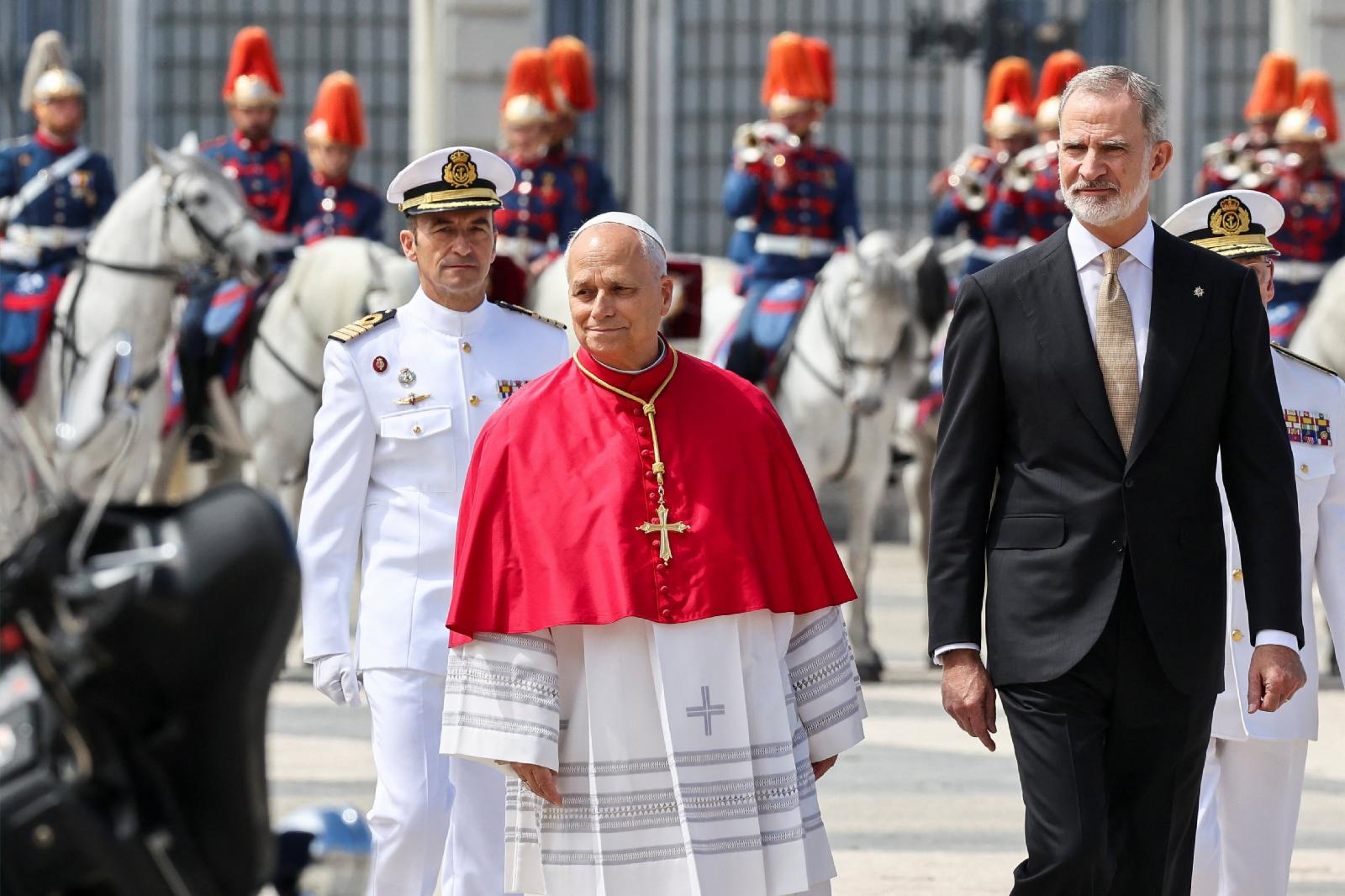
MADRID (OSV News) — Pope Leo XIV arrived in Spain June 6, invoking Saints Teresa of Ávila, John of the Cross and Ignatius of Loyola as spiritual guides for the polarized country as it navigates profound social tensions.
“I come among you to affirm, encourage and instill a renewed fidelity to the Gospel among believers, as well as a deeper reconciliation and collaboration among the various elements of this nation,” the pope said in his first speech in the Royal Palace of Madrid.
Madrid is the first stop of the pope’s seven-day apostolic visit to Spain which will also bring him to Barcelona and the Canary Islands.
A royal welcome for Pope Leo
The papal plane, a chartered ITA Airways flight, touched down at Madrid’s airport at about 10:10 a.m. local time, after a two-and-a-half-hour flight from Rome.
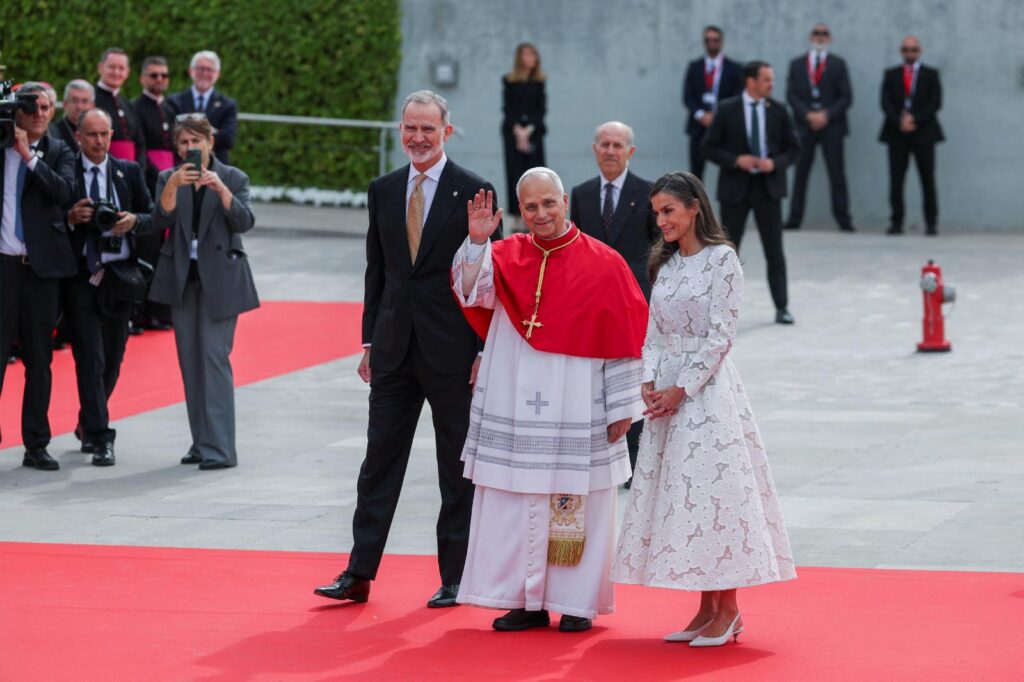
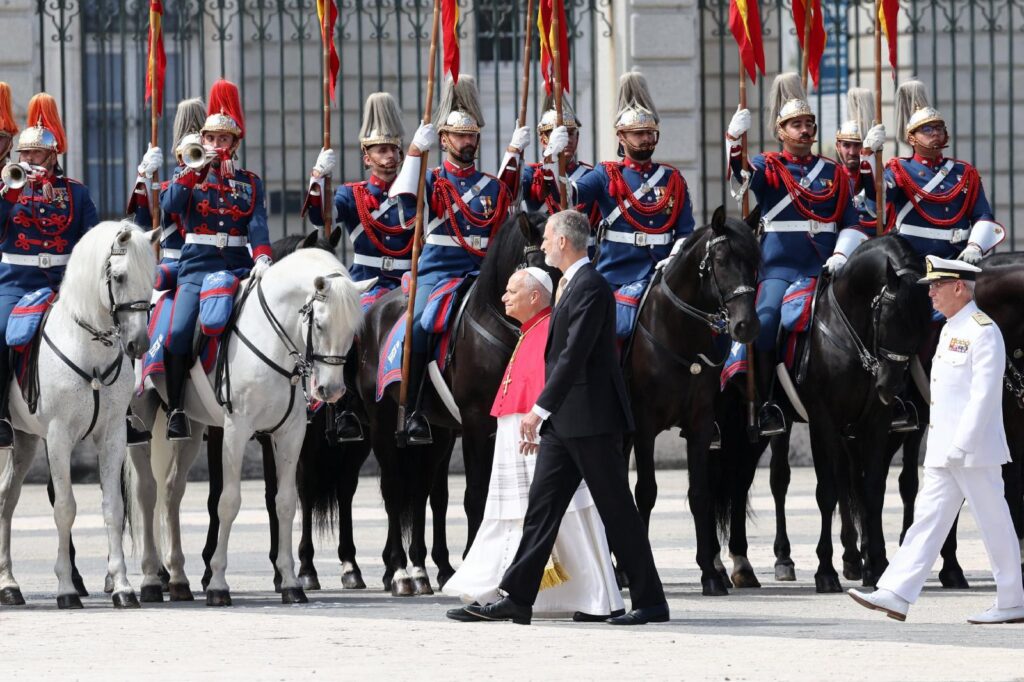
King Felipe VI and Queen Letizia personally welcomed the pope at the foot of the aircraft stairs for the first papal visit to Spain since Pope Benedict XVI traveled there in 2011, and the first during King Felipe’s reign, which began in June 2014.
Visiting a country he knows by heart
Pope Leo said, greeting reporters in the plane, that while he’s been in Spain “many times,”– as an Augustinian, and a missionary — “but this is my first visit on this mission — an apostolic visit to meet with the faithful, celebrate our faith, and reach out to all of society, because the Church has a message for everyone, as you may have seen in the encyclical,” he said, mentioning his recently released first encyclical, “Magnifica Humanitas.”
During the flight to Madrid, Pope Leo also said he is “very pleased” by the reports he is receiving about the rise in numbers of conversions among young people.
Today roughly half of Spaniards still call themselves Catholic, but fewer than 1 in 5 practice their faith regularly. The Church has shrunk in numbers and social weight, yet in recent years there are signs of a quiet return, especially among young people who discover new communities, music and forms of prayer.
“Young people that are looking for something more … they realize there’s an emptiness, and a lack of a sense of meaning,” the pope told reporters, hoping his visit would help “awaken” something “they are not even sure how they might define.”
“By sharing the joy of the faith, we can send a very positive message,” the pope told reporters.
“Each city has its own particular message, but the common thread is living the faith, proclaiming love, charity, and respect for every human being,” the pope said before landing in the Spanish capital, where an euphoric welcome awaited him.
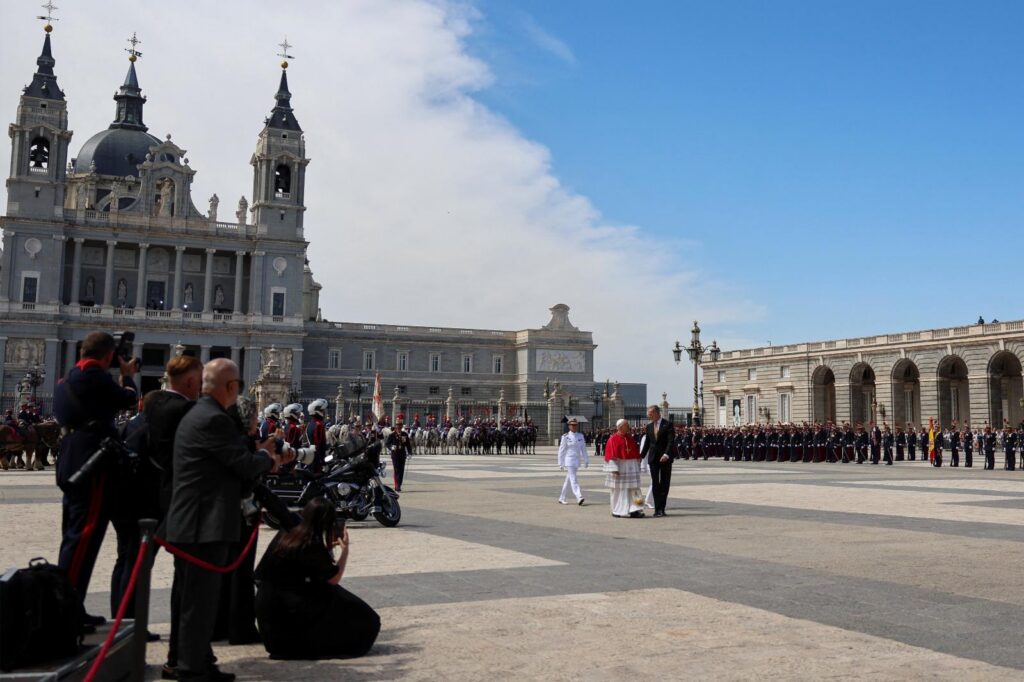
Young people passionately cheered as the pope’s car passed by Madrid’s Our Lady of Almudena Cathedral flanked by royal guards on horseback as a 21-gun salute welcomed him to the Royal Palace of Madrid. Pope Leo walked side by side with King Felipe VI through the palace courtyard before entering for a private meeting with Spain’s royal family and a speech to the nation’s leaders.
In times of polarization, ‘we need transcendence’
Speaking to assembled civil authorities and diplomatic corps in an adorned hall inside the royal palace, the pope urged the deeply polarized nation to set aside “divisive and polarizing narratives.”
“Today, the temptation to gain popularity by fanning the flames of polarization seems to have grown rather than diminished, and human dignity continues to be violated,” he said. “This is why we need culture, interiority, and free quality education; we need transcendence.”
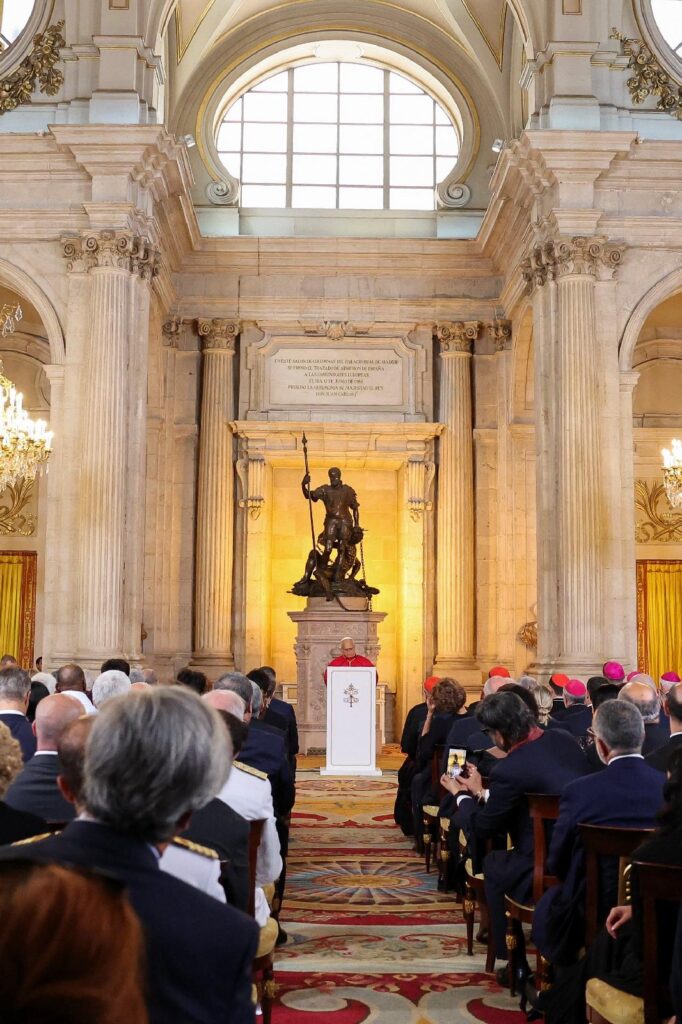
“Today the Church is ready to place herself at the service of the future of a people in search of reconciliation and peace,” Pope Leo added.
Spain has ranked among the world’s most polarized nations in recent surveys. A 2026 Edelman Trust Barometer study found that 75% of respondents in Spain exhibited an “insular trust mindset,” a marker of deep societal division.
Spanish mystics as a source of wisdom
Drawing on the mystics of Spain’s Golden Age, Pope Leo reflected on the writings of St. John of the Cross, whose Jubilee Year is being celebrated locally this year, as a spiritual resource for the challenges confronting modern Spain.
“Even in public life, we need men and women who can perceive light in the darkness: a new beginning, like the dawn of a truth that as yet blinds us, but which — if we trust and find peace — will gently lead us toward itself,” the pope said, before quoting the saint’s “The Dark Night of the Soul.”
Pope Leo turned next to St. Teresa’s image of the interior castle, “As one moves from room to room toward the innermost chamber — that is, toward one’s own heart, the sanctuary of truth — the space enlarges, the mind opens, challenges are overcome, tensions dissipate, others find their place, and the universe becomes a home.”
“This is not an escape into the self, but a radical openness,” he said, adding that such interior freedom is precisely why “religious freedom and freedom of conscience must be protected.”
Looking to Spain’s Middle Ages
The pope also highlighted Spain’s history of “convivencia,” the centuries-long coexistence of Christians, Muslims, and Jews on the Iberian Peninsula before the 16th century. He pointed to the School of Translators under the 13th-century king of Castille, Alfonso X the Wise, where scholars of all three faiths collaborated on translating the works of philosophers such as Averroes and Maimonides, arguing that the cities of Córdoba and Toledo stand as enduring models of dialogue.
“Security, which we all too often expect to find in weapons and walls, is in fact best achieved by learning to move forward alongside one another,” Pope Leo said.
From a Corpus Christi procession in Madrid to the Sagrada Familia
The pope’s visit to Spain June 6–12, will take the pope to Madrid, Barcelona, and the Canary Islands. Highlights include a Corpus Christi procession through central Madrid on June 7 — where as many as 1.5 million faithful are expected to gather around the Palacio de Cibeles — an address to the Spanish Parliament on June 8 (the first time a pope has ever addressed that body), the inauguration of the tower of Jesus Christ at Barcelona’s Sagrada Família — Basilica of the Holy Family, and visits to migrant reception centers in the Canary Islands.
The motto for the papal visit, “Alzad la mirada” (“Raise your eyes,” Jn 4:35), captures what Vatican officials describe as an invitation to look beyond daily anxieties toward the presence of God and openness to others.
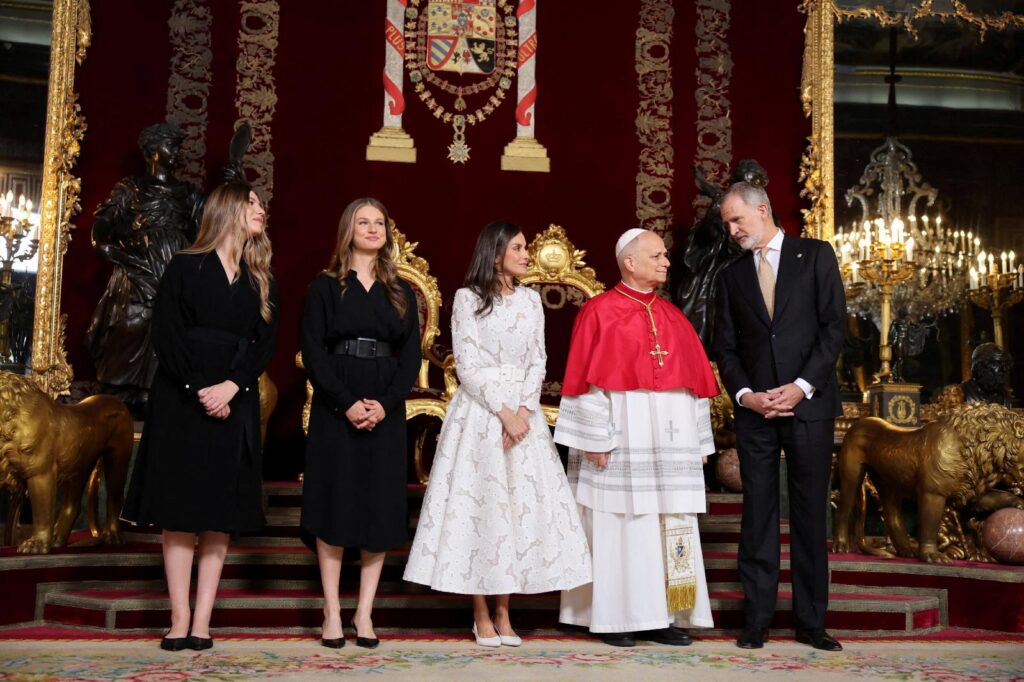
Pope Leo is no stranger to Spain, having visited the country nearly 50 times prior to this apostolic journey. Cardinals and bishops expressed high hopes that he can help bring unity and a measure of moral clarity to a nation still haunted by the legacy of the Spanish Civil War.
“There was a hunger for a visit of this kind at a special moment in our political, social and economic life,” Cardinal José Cobo of Madrid said. “I believe the pope can be a reference point to give light and direction to many who are searching.”
Pope Leo to meet abuse victims in Spain
The Vatican confirmed on the eve of the trip that Pope Leo will meet privately with victims of clerical abuse while in Spain.
King Felipe VI underlined the importance of this meeting in his speech in the palace welcoming the pope to Spain, saying that Pope Leo’s presence is “essential to the process of healing and making amends for the harm inflicted: they are essential for the victims, for the faithful, for the Church, and for society as a whole.”
Following the pope’s speech at the Royal Palace of Madrid, Pope Leo is scheduled to visit a Caritas emergency homeless shelter before meeting with young people at the Plaza de Lima, the same site where St. John Paul II celebrated Mass during his historic 1982 visit to Spain.
“The ancient bond between the Christian faith and this land has profoundly shaped your culture and represents a source of hope and direction amid the challenges we must face together as a human family today,” Pope Leo said.
– – –
Courtney Mares is Vatican editor for OSV News. Follow her on X @catholicourtney.
