


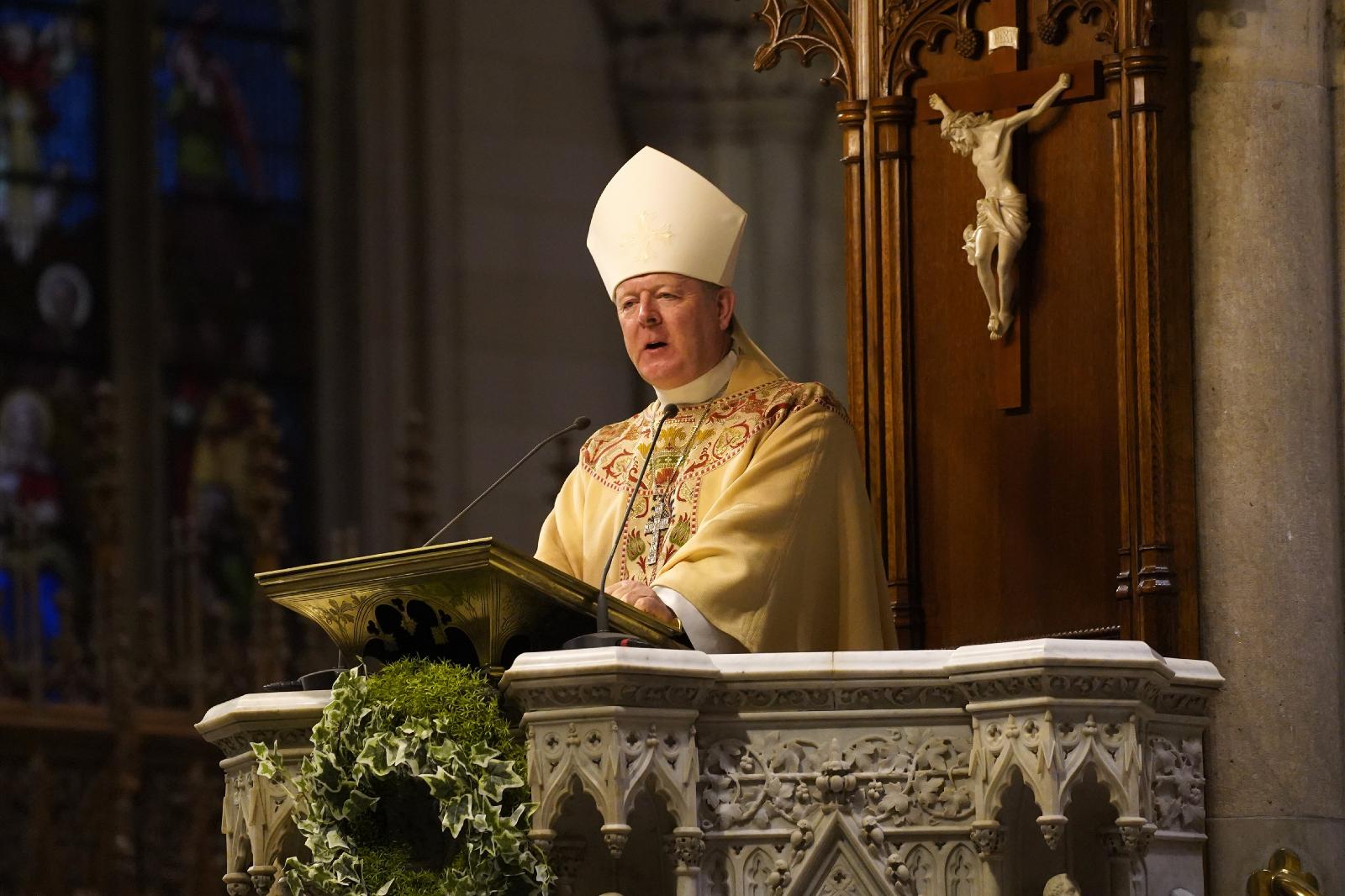
(OSV News) — Advancements in artificial intelligence can provide surface-level solutions, but in the age of manipulated images and manufactured creativity, it can never replace human beings created in the image and likeness of God, said Irish Archbishop Eamon Martin of Armagh.
The Vatican announced May 18 that Pope Leo XIV’s first encyclical, “Magnifica Humanitas,” will be published May 25, addressing artificial intelligence and the protection of human dignity.
In a pastoral reflection published May 15, Archbishop Martin said that Pope Leo’s message for World Communications Day, observed May 17, was a reminder that while AI can imitate certain human traits, people must ask themselves “whether our communication is truly recognizing, protecting and serving the human person.”
Pope Leo’s message “asks us to return to a simple but demanding truth: every human being has a face and a voice. Before a person is a profile, a statistic, a screen-name, a consumer, a complainant, or a ‘case,’ they are someone created in the image and likeness of God. Their face and voice matter,” he said.
The Vatican published the pope’s message, titled “Preserving Human Voices and Faces,” Jan. 24, ahead of World Communications Day, which is commemorated each spring. The pope recalled the world day during his Sunday Regina Caeli address.
“In this era of artificial intelligence, I encourage everyone to commit themselves to promoting forms of communication that always respect the truth of the human person, on which every technological innovation should be focused,” the pope told pilgrims gathered in St. Peter’s Square May 17.
Questions for the faithful to ask
In his reflection, Archbishop Martin said the pope’s call to preserve human voices and faces comes at a time when technology can produce and imitate human characteristics and behaviors that should prompt the faithful to think about “what is a person” and what it means to truly communicate.
“A person is not just an isolated individual. A person is someone who stands before us, someone to be recognized, someone whose dignity must be honored. That is deeply Christian because in Jesus Christ, God has shown us his face: the Word became flesh. God did not communicate with us from a distance but came among us with a human voice, a human face and a human heart,” he wrote.
While the use of technology is a prominent fixture in daily life, the Irish prelate said that one’s questions should not solely focus on efficient communication but most importantly on “recognizing the person before us.”
“Are we listening to real voices? Are we protecting real faces? Are we speaking truthfully? Are we allowing technology to serve communion, or are we letting it replace encounter?” he asked.
‘Christian communication should never be cold’
Returning to the heart of Pope Leo’s message, Archbishop Martin said the pontiff is reminding the faithful that Christian communication “recognizes the person before us,” and does not view the other as content, data, an image to be manipulated or a voice meant to be silenced or copied.
“A human person is a child of God, with a face to be honored and a voice to be heard,” he wrote. “Christian communication should never be cold, manipulative, faceless or mere strategy. It must seek to carry something of the way Jesus communicated: truthfully, personally, mercifully, courageously.”
The pope, he continued, recognizes the usefulness of artificial intelligence and digital technologies as an assistance in facilitating communication and learning. However, “from a faith perspective, the question goes much deeper.”
“The Church must always seek to preserve the faces of those who are easily hidden, edited out, mocked, exploited or forgotten: The face of the poor. The face of the refugee. The face of the abused. The face of the lonely young person. The face of the elderly person in a room with no visitors. The face of Christ in the suffering human person,” he wrote.
Archbishop Martin noted that while AI, algorithms and social media can provide answers or hold one’s attention, “none of these can replace conscience, wisdom and the slow work of truth.”
“A Christian cannot simply ask, ‘What is everyone saying?’ ‘What is trending?’ ‘What does the machine tell me?'” he said. “A Christian must ask: ‘Is it true?’ ‘Is it just?’ ‘Is it loving?’ ‘Does it honor the person made in God’s image?’ ‘Does it lead me towards Christ or away from him?'”
“I’m reminded of how St. Carlo Acutis saw technology as a path to encounter. Technology becomes dangerous when it becomes a substitute for real presence, real friendship and real communion. Technology is at its best when it helps us see Christ more clearly and love one another more deeply,” the Irish archbishop said.
Junno Arocho Esteves is an international correspondent for OSV News. Follow him on X @jae_journalist.
