


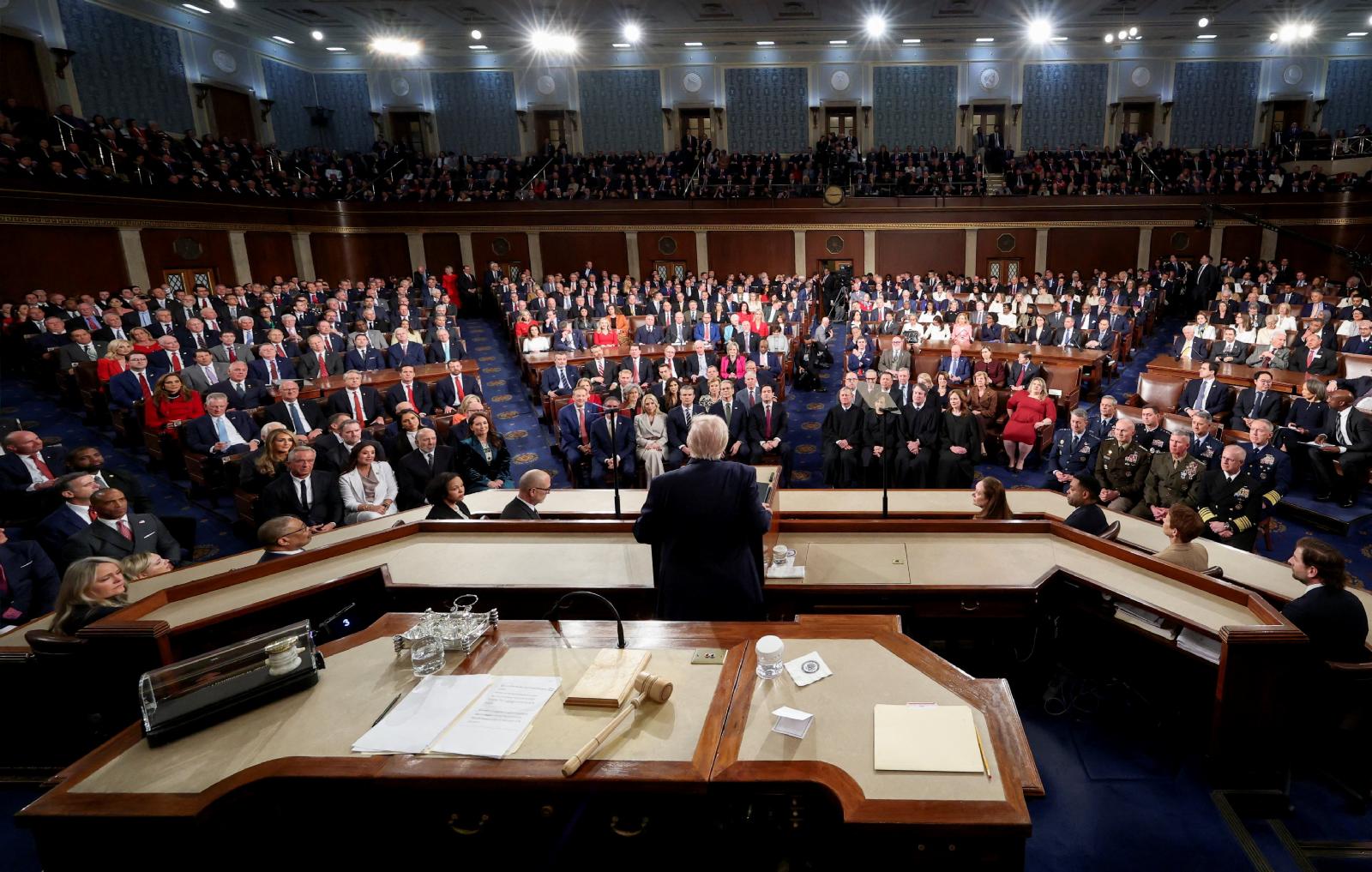
WASHINGTON (OSV News) — In the first State of the Union address of his second term — he previously delivered an address to a joint session of Congress in March 2025 — Trump touted his immigration policy in a pitch to midterm voters for his fellow Republicans. But the speech comes as more U.S. adults grow skeptical of aspects of his immigration policy. Trump’s comments largely centered around border security, rather than deportation.
A trio of national polls released in February found majorities of Americans said enforcement actions by U.S. Immigration and Customs Enforcement, or ICE, have gone too far, or found that minority shares said they approve of Trump’s handling of immigration.
In his speech, Trump touted what he called “the strongest and most secure border in American history,” but said “we will always allow people to come in legally, people that will love our country and will work hard to maintain our country.”
Immigration and tariffs
But Trump did not depart from a hardline tone, arguing, “The only thing standing between Americans and a wide-open border right now is President Donald J. Trump and our great Republican patriots in Congress.”
Trump told members in the chamber to stand for the phrase “the first duty of the American government is to protect American citizens, not illegal aliens,” and said members who did not “should be ashamed.”
In a statement issued hours before the speech, a group of U.S. bishops urged several reforms to immigration enforcement, including ensuring families of mixed immigration status are not separated, citing the unnecessary harm done to their children, and that sensitive locations such as houses of worship, schools and hospitals are protected from enforcement actions.
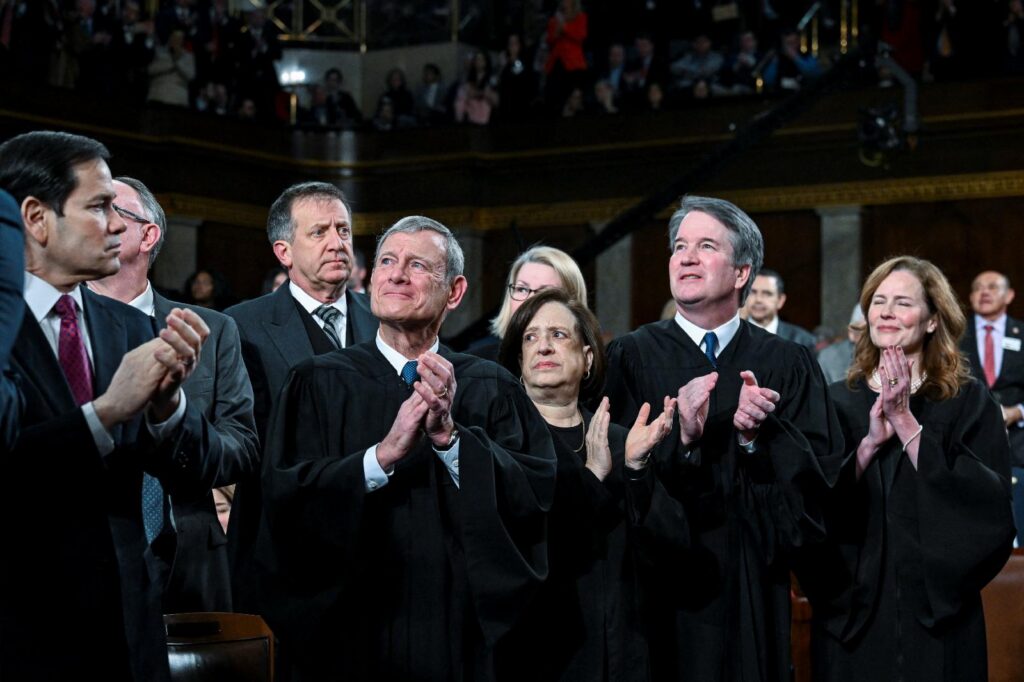
With four of nine Supreme Court justices in attendance, Trump called the court’s recent decision striking down his sweeping tariff policy a “very unfortunate ruling.” The ruling found Trump exceeded his authority in issuing the tariffs, marking a major setback for his economic agenda.
In effect, a tariff is a tax imposed by a government on imported goods. Trump has argued his tariffs would protect U.S. manufacturing, but some economists have cautioned they will raise consumer prices on many goods and could lead to a recession. Catholic economists, pointing out the Church’s preferential option for the poor in its social teaching, have also pointed out the burden of those tariffs disproportionately falls on Americans with the lowest incomes.
Trump also endorsed a ban on members of Congress trading stocks, as bipartisan legislation to restrict members from trading has stalled in the House.
Moral concerns
Elsewhere in the speech, Trump called for a ban on medical or surgical gender reassignment procedures for minors who identify as transgender. The U.S. bishops in November approved an updated version of “Ethical and Religious Directives for Catholic Health Care Services,” their guiding document on Catholic health care, with substantial revisions that include explicit prohibitions against such surgeries.
Trump also spoke about his efforts to increase access to in vitro fertilization, mentioning Catherine Rayner, a military spouse and the first user of TrumpRx, who was in the audience, and how she used the site to access more affordable drugs for the treatment. IVF is a form of fertility treatment opposed by the Catholic Church on the grounds that it often involves the destruction of human embryos, among other concerns.
“We are all praying for you, and you’re going to be a great mom,” he told her.
Rebuttal and reactions to Trump
Delivering a Democratic rebuttal to Trump’s speech from Colonial Williamsburg’s historic area in Virginia, Gov. Abigail Spanberger, D-Va., argued that “we did not hear the truth from our president” about his record from his first year in office, pointing to the economy.
“Let’s speak plainly and honestly, and let me ask you, the American people watching at home, three questions: Is the president working to make life more affordable for you and your family? Is the president working to keep Americans safe, both at home and abroad? Is the president working for you?” she asked.
Some Democratic members of Congress boycotted the event in protest of Trump, instead attending an event on the National Mall dubbed the “People’s State of the Union.”
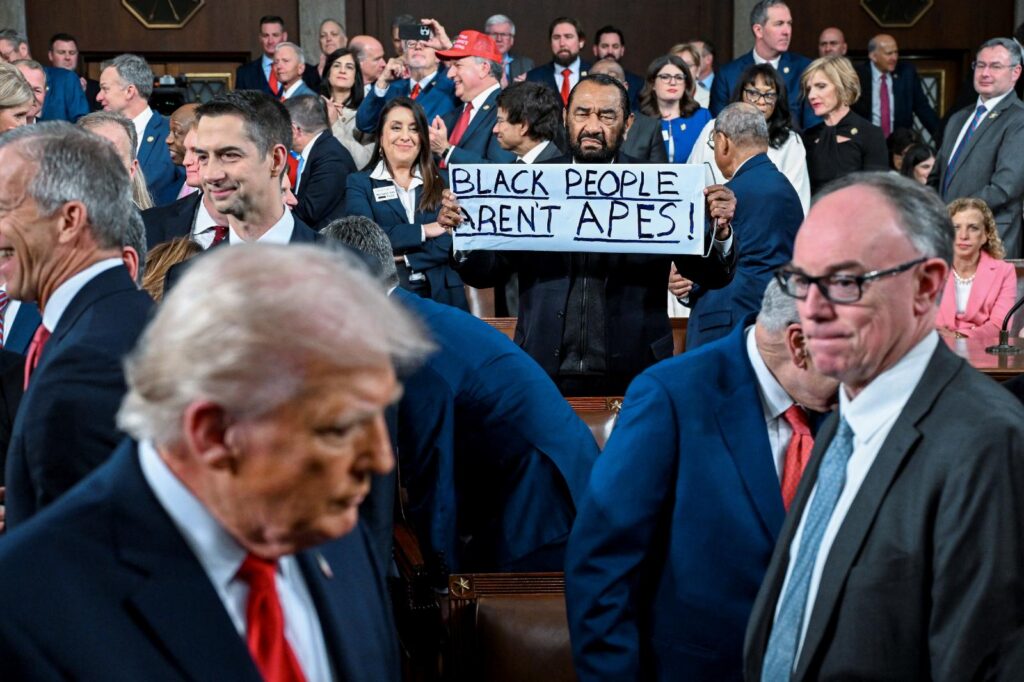
Rep. Al Green, D-Texas, was escorted from the chamber while carrying a sign that said “Black people aren’t apes,” an apparent reference to a video posted on Trump’s Truth Social account that depicted former first couple President Barack and Michelle Obama as apes that was deleted after widespread outrage denounced the content as racist. While not explicitly prohibited, House decorum rules are generally understood to limit signs and props on the floor.
But in one moment of bipartisanship, Trump awarded E. Royce Williams, a 100-year-old retired Navy captain, the Congressional Medal of Honor for his actions in a mission during the Korean War, to widespread applause in the chamber.
Guests in the chamber
Notable guests included Claire Lai, an attorney and the daughter of Jimmy Lai, Hong Kong’s prominent Catholic media tycoon and pro-democracy campaigner, who was recently sentenced to 20 years in prison after being convicted of offenses under the city’s controversial national security law in a trial U.S. officials called a farce.
Lai was a guest of Rep. Chris Smith, R-N.J., and was jointly hosted by House Speaker Mike Johnson.
“My wife, Marie, gave Claire her ticket to the State of the Union, because we are so deeply inspired by her courageous and tenacious campaign to obtain the release of her father — the Hong Kong free speech and religious liberty hero — Jimmy Lai,” Smith said in a Feb. 23 statement, adding, “Earlier this month, a CCP-controlled Hong Kong court unconscionably sentenced Jimmy Lai, a 78-year-old, to serve 20 years in a maximum-security prison; functionally, a life sentence. The only ‘crime’ that Jimmy committed was telling the truth, which is why we must remain resolute in our efforts to raise awareness of this grave injustice and to call for his immediate release.”
Johnson’s other guests included Reid Wiseman, Victor Glover, Christina Koch and Jeremy Hansen, the crew of NASA’s upcoming Artemis II lunar spaceflight mission.
Several House Democrats, including Rep. Ro Khanna, D-Calif., invited survivors of sex-trafficking by Jeffrey Epstein, a multimillionaire who was found dead in prison of an apparent hanging in 2019. Khanna spearheaded the Epstein Files Transparency Act, bipartisan legislation alongside Rep. Thomas Massie, R-Ky.., requiring the government to release all unclassified records in the case.
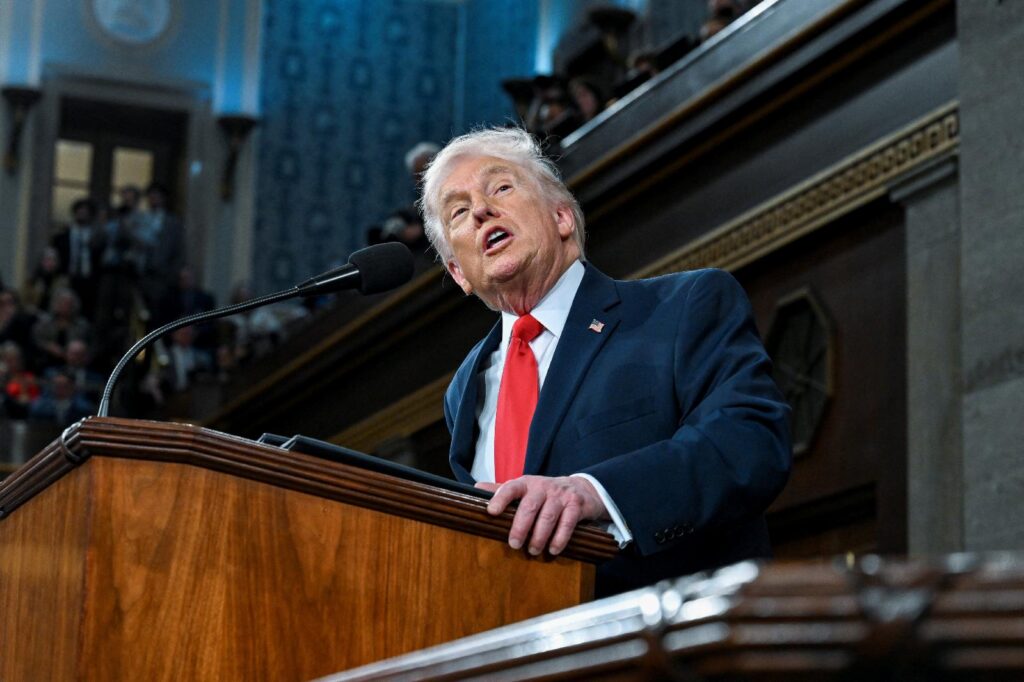
Trump honors late Charlie Kirk
Trump’s guests included Erika Kirk, the widow of slain conservative activist Charlie Kirk, now the CEO of his organization, Turning Point USA, and some members of the U.S. men’s Olympic hockey team.
Acknowledging Kirk in the chamber, Trump said, “In Charlie’s memory, we must all come together to reaffirm that America is one nation under God, and we must totally reject political violence of any kind.”
The U.S. Constitution requires the president to “from time to time give to the Congress Information of the State of the Union, and recommend to their Consideration such measures as he shall judge necessary and expedient.”
First known as the “Annual Message,” the practice has taken various forms throughout U.S. history, according to the House Historian’s office, at times taking the form of a written message to Congress, while at others delivered in person by the president, and broadcast on radio or television.
Kate Scanlon is a national reporter for OSV News covering Washington. Follow her on X @kgscanlon.
