


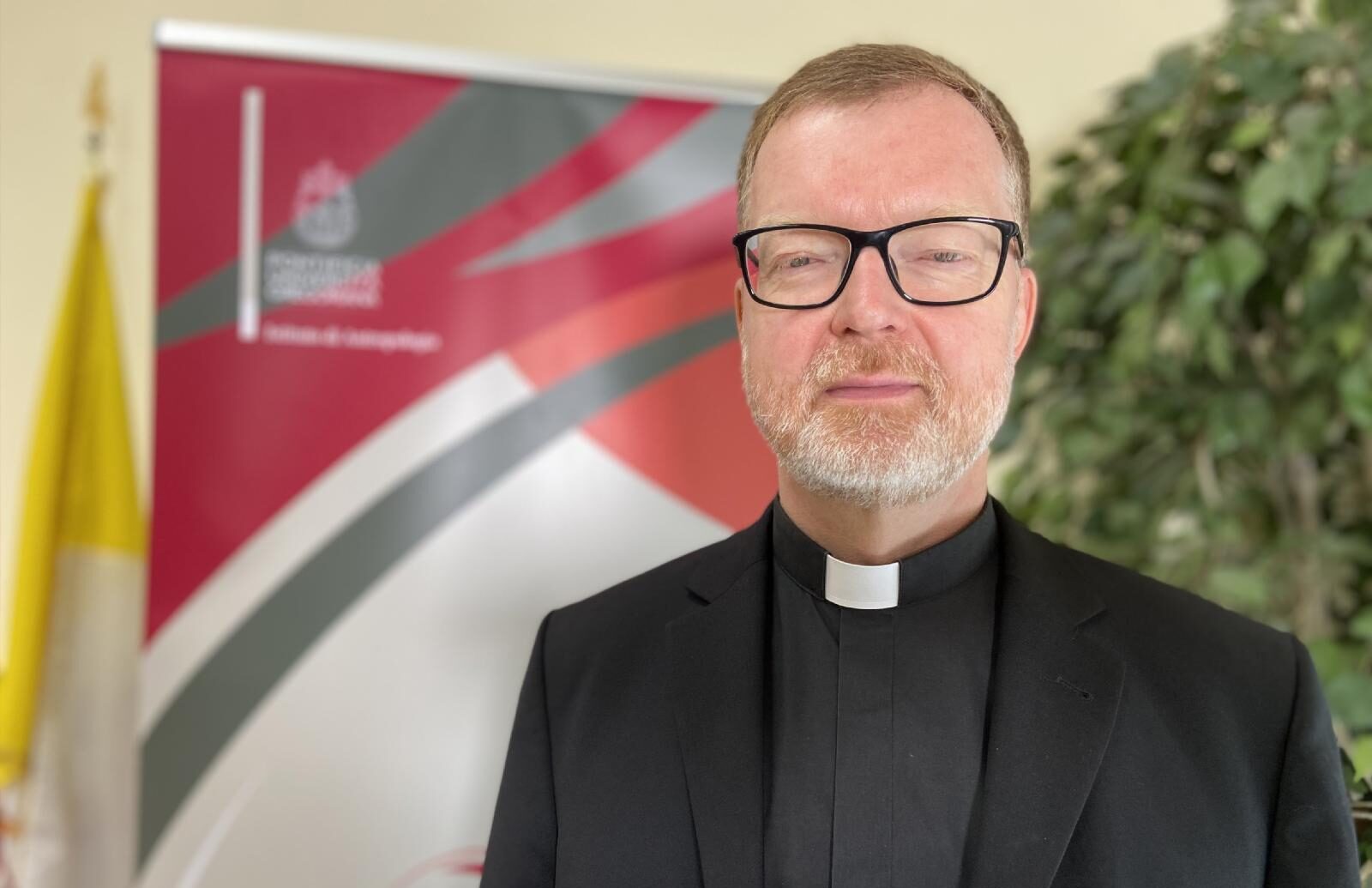
(OSV News) — Jesuit Father Hans Zollner is urging Catholics to make prayer for abuse victims a central focus this Lent, saying the Church’s spiritual response to sexual abuse remains underdeveloped. The director of the Institute of Anthropology at Rome’s Pontifical Gregorian University said that while safeguarding policies and research have grown, prayer for victims and secondary victims is often overlooked.
Recent global headlines surrounding abuse cases in Europe
Father Zollner spoke to OSV News as cases of abuse made global news with abuse survivor Gisèle Pelicot meeting Queen Camilla Feb. 23, and with two high profile figures — Andrew Mountbatten Windsor and Peter Mandelson, former British ambassador to the U.S. — arrested due to their connections with Jeffrey Epstein.
Pelicot was drugged by her now-former husband and raped in their French home by strangers while she lay unconscious. Her book, “Hymn to Life: Shame Has to Change Sides,” was launched in London, where actress Kate Winslet, among other stars, read passages from the memoir that left Queen Camilla, as she said in her own words, “speechless.”
Mountbatten Windsor, a former British Prince, allegedly abused Virginia Giuffre, who described her abuse at the hands of associates of Jeffrey Epstein — in what the BBC called “appalling detail” — in a book published posthumously after she took her own life in 2025.
Ongoing cases connected to Catholic priests
Many cases connected to Catholic priests, including high profile ones, such as Father Marko Rupnik, are also ongoing.
Asked for a Catholic response to such harrowing cases, Father Zollner, one of the world’s top experts in sexual abuse and safeguarding, with research spanning more than two decades, told OSV News that while “canonical, psychological, or sociological analysis” in the Church is much needed and developed, one aspect is still lacking in broader Catholic response to abuse in general: prayer. — and Lent is the best time to remind about it.
Father Zollner said “a spiritual reckoning and a spiritual way of understanding” abuse is something everyone in the Church should be paying attention to.
“We pray for the poor, we pray for the homeless, we pray for the sick — but when do we pray for victims?” he asked in a phone conversation with OSV News.
“Our discovery over the last months has been that more and more people are aware that the spirituality of safeguarding, and the theology of safeguarding in the face of abuse, is very much underdeveloped,” Father Zollner said.
“Very often, I ask at conferences — and have asked over the years — participants: ‘When did you pray for victims of abuse last time?’ Most of the time, there is a dead silence after that question, and many people say that they didn’t think about it.”
Prayers for survivors once a year are not enough
He said days of prayers once a year are not enough.
“When do we pray for victims? For secondary victims? When do we pray for perpetrators? When do we pray for Church leaders who have to deal with these situations?” he asked.
It’s not only a question of “credibility,” but a “question of how we understand redemption, how we understand ecclesial life, leadership in the Church, power, and authority from a theological and spiritual point of view.”
“I have been working on these issues for almost 20 years now, and I have asked these questions many times. Many people are startled because they had never thought about them.
For me, one of the really astonishing things is that there is very little faith response to this.”
“What does God want us to do when this is brought before us over and over again over the last 40 years? Where is the response from a strictly faith perspective?” Father Zollner asked.
Lenten reflection series released, focused on safeguarding
The Institute of Anthropology in Rome has announced it will offer a series of Lenten reflections focused on safeguarding, underscoring its longstanding commitment to integrating safeguarding awareness into the Church’s spiritual and liturgical life.
“Our Institute has always emphasized the importance of fostering reflection on safeguarding, including within our liturgical life,” the IADC website states.
The reflections highlight the need for parishes and faith communities to keep the suffering of vulnerable people at the forefront of prayer and pastoral concern.
“In every parish and every community of the faithful, the suffering of vulnerable persons should also become a focus of our prayer. At the same time, we seek to strengthen our sensitivity, to be ready to receive God’s grace and joy, and to encourage those working in safeguarding.”
The Institute is inviting the faithful to take part during the Lenten season, framing the initiative as both a spiritual and practical call to action.
Presenting the Church as an authority in this area must be done cautiously: “We are not through this process ourselves”
While Father Zollner said “we must be cautious about presenting the Church as an authority in this area, because we are not through this process ourselves,” he admitted that when he read about the stories of abuse on Epstein Island “it was very harrowing.”
“These were girls who were trafficked, who suffered the most despicable horrors at the hands of people who had promised them luxury, influence and wealth,” Father Zollner said. “They were probably also longing for real love and understanding — and what they found was hell.”
What was also striking was that “this was happening in front of many people’s eyes.”
“Why do we have millions of pages of documentation, photos, and other material? Because people wrote about it. This did not happen anonymously or in the dark of night — it happened in plain daylight,” he said. “Yet for years, nobody spoke up. Even today, victims have to fight, and some no longer have the the energy and commit suicide, as we have seen.”
For Father Zollner, “This confirms one of the main discoveries of recent years: sexual violence and sexual exploitation have been with humankind from the beginning. And they will not simply end.”
“Even if we do everything we can for safeguarding, even if we tighten laws, human nature requires that we reckon with this reality,” he said.
The Church needs to step up its efforts in education, awareness and support
“As religions, as churches, as societies, we need to step up our efforts to make abuse more difficult,” Father Zollner said “That means education, raising awareness, and engagement at all levels of society and in all sectors. This is not confined to the Catholic Church or to religion — it is everywhere. Nor is it confined to the poorest levels of society; as we see, it exists among the richest as well.”
Asked why both in the Church and in broader society people tend to put the reputation of a powerful person over the dignity of the victim, Father Zollner replied that main two elements are involved — one connected to emotions, the other to the issue of power.
“One is that human beings find it difficult to stand up for the dignity of others if they do not feel close to them or have an emotional connection to them. If someone is outside my family or circle of friends, I may feel sorry for them, but truly engaging in restoring their dignity becomes more difficult. If it is someone close to me, I will be committed and angry. But if the person is distant — an abstract number of victims — it becomes less convincing and less impactful.”
Global impact of sexual abuse today
Father Zollner highlighted that for many years, the World Health Organization has said that 20% of girls in any society are sexually abused before the age of 18.
“That is an abstract number,” he said. But translated to absolute figures it means that, in France alone, between 2.5 to 3.5 million women have been victims of abuse. “The same would be true in Germany, in Poland, and in the United States,” Father Zollner said.
Those numbers will remain abstract unless one listens “to one particular victim.”When you sit down with someone and hear their story, it becomes entirely different,” he said.
“The second element is the question of power, influence and perceived position,” Father Zollner said. “I say perceived because sometimes the power is not even real, but connected to an image — nobility, royalty, hierarchy. There is an elevation and protection around such people that goes beyond the normal citizen. Psychological processes of fear, submissiveness or lack of courage in confronting wrongdoing come into play.”
“There is often a layer of awe, respect and submissiveness attached to certain individuals, which combines with a sense of entitlement — the belief that one is beyond reproach and can do whatever one wishes. Fortunately, in some cases, this spell has begun to break.”
For Father Zollner, confronted with such reflection on the state of human nature, the time of Lent offers a unique opportunity for Catholics to contemplate Christ’s suffering “in which the Son of Man, the Son of God, saves us … identifying with the most vulnerable, marginalized and wounded.”
“This is part of the central message of the Gospel and of Jesus’ life: it is not about my well-being, but about the lives of others. Love of self must always be in relation to love of others,” Rome’s Anthropology Institute’s director said.
Paulina Guzik is international editor for OSV News. Follow her on X @Guzik_Paulina
