


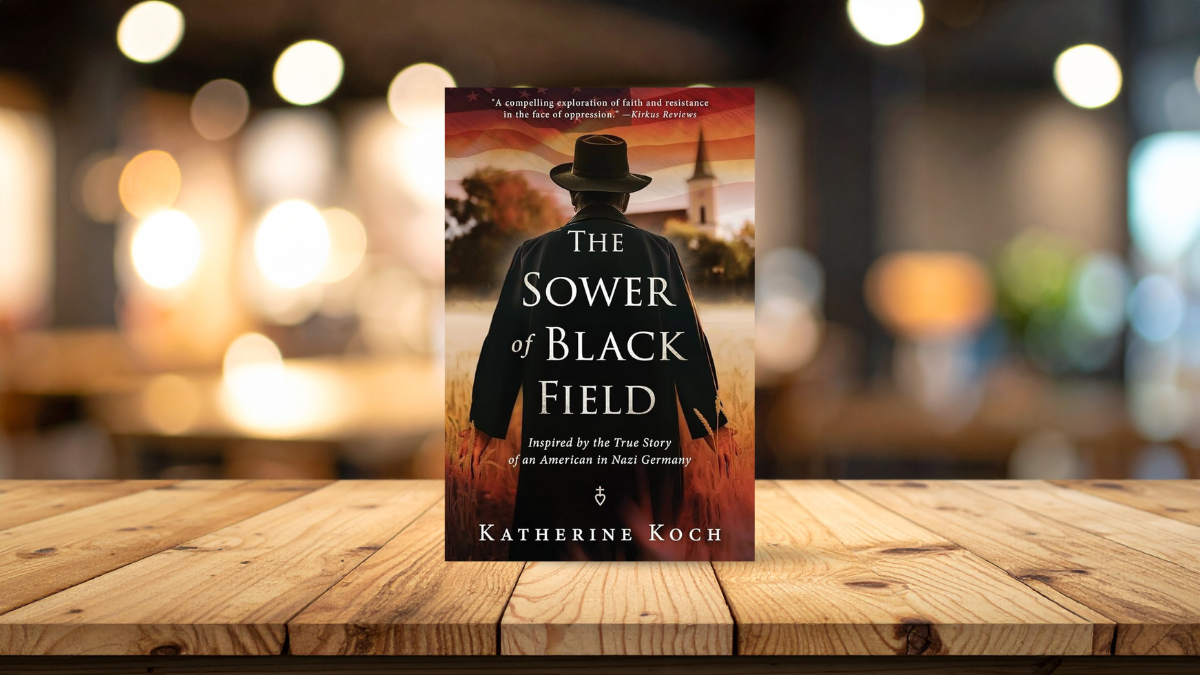
“The Sower of Black Field”
Katherine Koch, Time’s Arrow Press (2025)
360 pages, $19.99.
“What is Hitler doing to the people of Germany? He’s taking their pain, and twisting it for his own ends. In the history of humanity, we’ve proven that we’re capable of the greatest evils when hate turns us blind to the pain of our fellows. … Germany needs Passionists, my friend.”
In 1945, as Allied troops streamed into Germany on the heels of the retreating German army, they encountered a horrific atrocity: Jewish victims of the Holocaust murdered en masse and left unburied on the roadsides by their Nazi jailers, who had forced the prisoners on “death marches” in a futile effort to leave less evidence of the camps for the Allies to find. Allied troops compelled German civilians of nearby towns to bury the dead, as a means of forcing the German people to confront the evils their nation had done.
In the town of Schwarzenfeld, however, the Allies laid an additional ultimatum on the civilians: The burial of over a hundred victims would be completed in 24 hours — or the town’s entire adult male population would be shot in retribution.
But Schwarzenfeld had an unlikely advocate in the form of Father Victor Koch, a Passionist and American priest. Father Koch knew that, unlike many in Germany, the people of Schwarzenfeld were not complicit in Nazi atrocities, and had in fact, in innumerable small ways, resisted the seductions of fascism over their souls and their community.
New historical fiction based on true story of WWII priest
Katherine Koch’s novel, “The Sower of Black Field,” the Catholic Media Association’s 2025 first place winner for Catholic novel, presents a semi-fictionalized account of that day, and of Father Koch and his parishioners’ harrowing experiences under Nazi rule.
The novel relies heavily on Passionist theology. The Congregation of the Passion of Jesus Christ is a religious order devoted to the memory of Christ’s passion; for Father Koch, this meant seeing the sacred face of the suffering Christ in all human beings, a suffering which binds the whole human race together.
Naturally, this theology stands in stark opposition to National Socialism, which posits that the German race alone is bound together by Aryan identity. The latter position is held in the novel by a Nazi charity worker, Amtsleiter Wilhelm Seiz, whose soul becomes increasingly conflicted as his inborn sympathetic nature runs headlong into the gruesome realities of his Nazi loyalties. Through verbal sparring, land disputes and even unexpected favors, Seiz and Father Koch circle each other throughout the book, drawing out the nuances of their competing ideologies.
Seeing, serving Christ in those suffering
The presence of the crucified Christ within the suffering of humanity provides the backbone, too, of the novel’s engagement with the problem of evil. As Seiz descends deeper into the moral mire of being both a Nazi and a charity worker, believing that only National Socialism can alleviate the sufferings of his people, Father Koch preaches another doctrine: When human beings, reacting out of pain or selfishness, refuse to cooperate with “the Framework” — God’s loving plan for the human race — then evil and suffering develop.
Yet, even amid that evil and suffering, people who cooperate with the Framework by uniting their sufferings to those of the crucified Christ can be used by God to bring about love and goodness in a broken world. This preaching of how the suffering Christ unifies all human beings helps Father Koch’s parishioners see through the lies of Nazi ideology and, ultimately, to resist fascist hatred through heroic acts of compassion for their fellow man.
“The Sower of Black Field” is not only an excellent novel of historical semi-fiction, painstakingly researched and beautifully written, but an example to Catholics everywhere of how even ordinary people can resist the lure of hateful ideologies and confound authoritarianism and cruelty through Christlike compassion. It is an absolute must-read for anyone who has ever wondered how to reconcile the reality of a loving God with human suffering, whether in light of the atrocities of history, or those of our own age.
Madelyn Reichert is publications administrative coordinator at The Catholic Spirit, the official publication of the Archdiocese of St. Paul and Minneapolis.
