


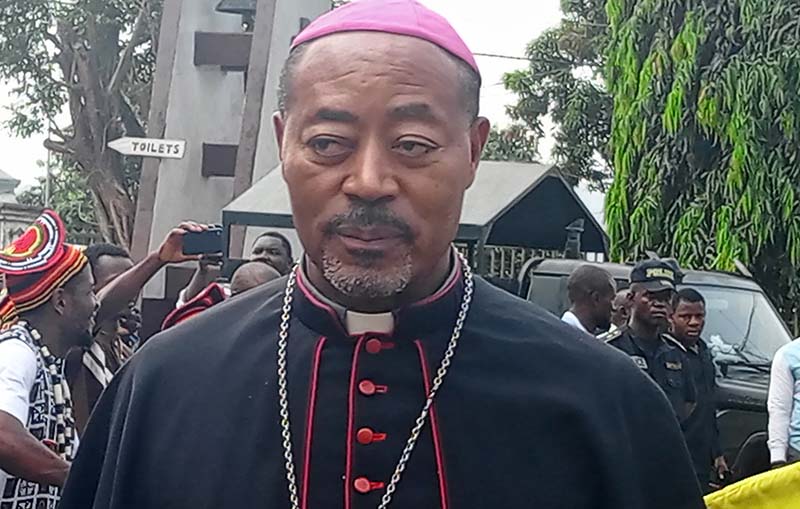
(OSV News) — Cameroonian Bishop Sosthène Bayemi of Obala is facing accusations of alleged sexual misconduct following the circulation of a video on social media.
While the diocese said “verification is underway with the relevant authorities,” local church leaders rejected the authenticity of the video, claiming it is AI-generated.
The unverified footage allegedly depicts Bishop Bayemi making sexually inappropriate suggestions to a woman. In the video, he allegedly is proposing that she film herself engaging in sexual acts with another individual and then share the recordings with him.
The video was shared on social media by prominent local YouTube influencer N’Zui Manto.
Diocese urges Christians to remain calm
The diocese responded by urging Christians to remain calm and avoid speculation.
“The diocesan communications department is aware of the recent circulation of videos concerning our bishop. Verification is underway with the relevant authorities and an official statement will be released soon,” said the diocesan communications team in a statement.
“Stay calm, don’t give in to rumors, keep following the pastoral activities of our diocese, and let’s be united in prayer,” it added.
Bishop Bayemi declined comment when contacted by OSV News. However, Father Humphrey Tatah Mbuy — a prominent intellectual and former communications director for the bishops’ conference — rejected the video’s authenticity, asserting it was an AI-fabrication intended to tarnish the bishop’s image.
‘AI can do and undo’
“These days, AI can do and undo,” Father Mbuy told OSV News. He justified his argument by pointing out that the video shows the priest first in cassock and then it jumps into showing him in a casual shirt.
“So, it is not possible that it could have been him who did that because he could not have sat down with the cassock and then been wearing a shirt.”
The priest assumed the video was generated as “deepfake” — a video that has been altered by artificial intelligence or other editing software, typically to harm or spread false information.
“The least and very simple video maker can make you do what you have not done,” Father Mbuy said, adding that “this is part of what we call the wrong use of social media” and that the right of the public to the truth in the age of “fake news” is part of his recent academic research.
Social media manipulation
He said it wasn’t the first time social media manipulation has been used to target church figures, including Pope Leo XIV.
“Some months ago, there was a story of Pope Leo having spoken with … Ibrahim Traoré of Burkina Faso,” he said.
Father Mbuy was referring to a 36-minute video uploaded on YouTube in May, showing Pope Leo allegedly praising Burkina Faso’s military leader. Vatican News headlined the story at the time: “Fake message to President of Burkina Faso attributed to Pope,” and said the speech in English, “created with artificial intelligence, has been uploaded to YouTube, falsely attributing to Pope Leo XIV words for Ibrahim Traoré, President of Burkina Faso.”
“So I’m just asking people to be careful about what comes on social media. Not everything on social media is to be accepted as authentic. You need to understand how it works and the morality of the people who are doing it,” Father Mbuy told OSV News.
Bishop advised not to address issue
He added church leaders have advised Bishop Bayemi to keep calm, and not address the issue.
Local media Cameroon Online said the allegations “come only weeks after the bishop made headlines for publicly expressing support for President Paul Biya,” adding that the “nature of the exchanges,” in allegedly abusive videos “described as explicit and shocking,” has triggered “widespread debate across Cameroon.”
Cameroonian faithful who went on social media to comment on the diocesan statement regarding Bishop Bayemi are sharing mixed reactions, with some dismissing the authenticity of the video and assuring of prayers for the bishops and some treating the video as authentic.
“The church should take this seriously,” one online comment said.
“The case unfolds in a sensitive context,” Cameroon Online commented.
“The Catholic Church in Cameroon has been navigating internal divisions, particularly regarding its political positioning,” the media stated. “The fact that these allegations emerged shortly after the bishop’s support for President Biya has fueled speculation about political motivations behind the scandal.”
Ngala Killian Chimtom writes for OSV News from Yaounde, Cameroon.
